Pearl Gemstone Information
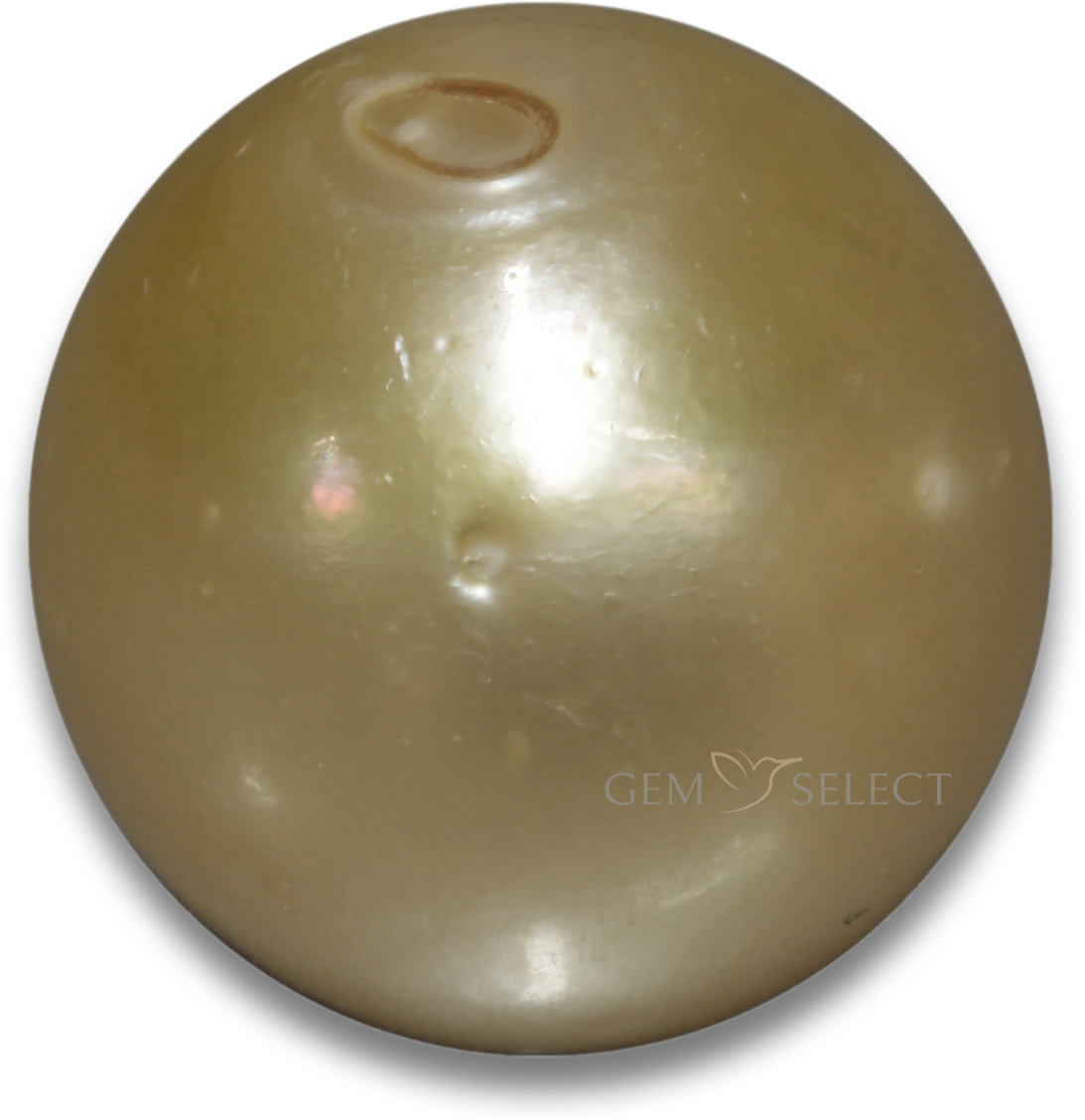 Buy Pearl Gemstones from GemSelect
About Pearls - History and Introduction
Pearls are organic gemstones that are formed by shelled molluscs; mainly bivalved oysters and mussels. These lustrous gems, formed within the depths of the ocean by living mollusks, hold a special place in the world of gemstones. In this article, we will delve into the origins, types, and unique characteristics of pearl gemstones, exploring why they continue to captivate jewelry lovers and collectors worldwide. Feel free to browse through our extensive inventory of pearl gemstones for sale.
Pearl gemstones are made up of nacre (mother-of-pearl) which is mostly aragonite (calcium carbonate) and conchiolin (complex proteins that form mollusc shells). The aragonite microcrystals build up around an irritant. The name "pearl" is said to have originated from the Middle English word "perle", which in turn came from the Latin word "perna", meaning "leg", thought to be due to the ham-leg shape of the bivalve mollusc.
Natural pearls are extremely rare, incredibly expensive and typically small. Therefore people have developed ways to culture pearls, so that these beautiful gemstones can be enjoyed by many. In cultured pearls, some tissue or a mother-of-pearl bead is introduced into the mollusc shell. If successful, this process induces the animal to form a "pearl sac" whose cells secrete a layer of brownish protein called conchiolin over the irritant. This is followed by the secretion of numerous mineral layers of nacre composed of calcium carbonate in thin overlapping plates. Pearls can come from fresh or seawater molluscs. The beauty of pearls is that they can be plucked from the shell naturally beautiful, fully-formed and displaying perfect luster with no need to be cut or polished. Discover our collection of loose mother of pearl for sale.
The oldest recorded reference to pearls in history is the 7,500 year-old "Umm Al Quwain Pearl", which was found in a grave in a place that is now known as the UAE. Before pearls were cultured by man, they were harvested from the Persian Gulf, Sri Lankan waters, fresh water sources in China and the rivers of Europe. Later, Christopher Columbus discovered pearls in South America. When these natural pearls were almost depleted in the early twentieth century, the Chinese and Japanese began to culture pearls and the rest is history. Nowadays, pearls remain a treasured adornment and are cultured all around the world.
|
|
|
Pearls can be identified by their pearly luster and when rubbed gently against the teeth, a slightly rough surface texture can be detected, whereas imitation pearls feel smooth. The surface appearance of natural and cultured pearls is the same, but the density of cultured pearls is usually higher, at approximately 2.73 for most. The only definite way of distinguishing between natural and cultured pearls is to examine their internal structure. Experts use endoscopes to do this through the drill holes of pearls. Natural pearls have concentric internal layers.
Pearls are found and cultured in waters all over the world. Natural sea pearls are found in Australia, Japan, Central America, the Persian Gulf, the Gulf of Manaar (between India and Sri Lanka), the coast of Madagascar, Burma (Myanmar), the Philippines, the South Pacific Islands (including Tahiti and Fiji) and South America.
Natural river pearls are found in Asia, Europe and North America.
Cultured seawater pearl sources include Southeast Asia (such as Indonesia and the Philippines), Australia, China, French Polynesia, Japan, South Pacific Islands (including Tahiti and Fiji) and the Philippines.
Cultured freshwater pearl sources include China and Japan.
Buying Pearl and Determining Pearl Gemstone Value
Back to Top
Pearl Color
Pearls are available in a variety of colors. Colors of pearls include the following: White, pink, silver, cream, golden, green, blue and black. Some pearls exhibit iridescence, which is known as orient.
Pearl Clarity and Luster
The luster of pearls depends on the quality of the nacre. Pearls should have the characteristic shiny pearly luster and their surface should show sharp and bright reflections. The surfaces of good quality pearls are smooth and blemish-free with a suitable layer of nacre to increase durability.
Pearl Cut and Shape
Pearls can be round, oval, pear-shaped or misshapen (baroque pearls). However, the best materials are regularly shaped. The most valuable shapes are symmetrical spheres or symmetrical drops. Pearl sizes depend on the type of mollusc that they form in and they typically range from 2 mm to 16 mm in diameter.
Pearl Treatment
Pearls are often bleached to lighten and enhance their color. In this way, a uniform color can be achieved for beaded necklaces.
| Chemical Composition: |
Calcium carbonate + organic substances + water |
| Crystal Structure: |
Orthorhombic, microcrystalline |
| Color: |
White, pink, yellow, silver, cream, golden, green, lavender, blue, black |
| Hardness: |
2.5 to 4.5 on the Mohs scale |
| Refractive Index: |
1.52 - 1.66 Black: 1.53 - 1.69 |
| Density: |
2.60 - 2.85 |
| Cleavage: |
None |
| Transparency: |
Translucent to opaque |
| Double Refraction or Birefringence: |
-0.156 |
| Luster: |
Pearly |
| Fluorescence: |
Weak, black pearl: red to reddish; river pearl: strong: pale-green |
Please refer to our Gemstone Glossary for details of gemology-related terms.
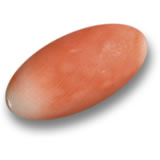 |
| Coral Gemstone |
As organic gemstones, pearls belong to the same group as ammolite, coral, ivory, jet and amber. These are all formed as a result of biological processes.
Pearls are similar in composition to mother-of-pearl (which comes from mollusc and abalone) and operculum, which is the lid of a sea snail.
Pearl Gemstone Mythology, Metaphysical and Healing Powers Back to Top
Numerous superstitions surround pearls, with some believing they symbolize tears and should not be gifted, used in engagement rings, or worn by brides to avoid bringing sorrow. Conversely, others view pearls as ideal for brides, representing purity, integrity, and loyalty. In ancient China, pearls were believed to offer protection against fire and dragons. Additionally, pearls are associated with love potions and believed to enhance fertility when placed under a pillow. While pearl superstitions vary, they are generally believed to promote good health and prosperity. Physically, pearls are thought to aid in hormone balance and alleviate digestive issues and allergies. June birthstones and symbols of the third and thirtieth anniversaries, pearls hold a rich history of folklore and significance.
|
Disclaimer: Metaphysical and Alternative Crystal Healing Powers and Properties are not to be taken as confirmed advice. Traditional, Ceremonial and Mythological Gemstone Lore is collected from various resources and does not represent the sole opinion of SETT Co., Ltd. This information is not to replace the advice of your doctor. Should you have any medical conditions, please see a licensed medical practitioner. GemSelect does not guarantee any claims or statements of healing or astrological birthstone powers and cannot be held liable under any circumstances. |
Pearls are popular as beaded necklaces, which come in a variety of lengths, from short collars and chokers to long opera and matinee strings. Pearl beaded necklaces can also be uniform, which means that the pearls are all the same size, or graduated, which means that the pearls taper gradually in size, with the largest at the middle of the necklace. For jewelry that uses several pearl gemstones, it is important that the pearls match in shape and color or that different colored pearls are well coordinated. Sizes should also be well calibrated for classic pearl necklaces. However, modern pearl cluster necklaces often mix sizes. Misshapen baroque pearls are used to make interesting modern pearl jewelry. Pearl pairs make beautiful earrings, and single pearls are perfect for pendants. Pearls also make attractive hair decorations and can be used to embellish wedding dresses. Both silver and gold settings compliment the luster of pearls. Pearls are popular for bridal jewellery and can be mixed with diamonds, for stunning rings, earrings or necklaces. Pearls can be simple or dramatic, vintage or modern, according to the preferred style. The wide variety of pearl colors means that there is a pearl to suit each and every skin tone.
Note: Buy colored gemstones by size and not by carat weight. Colored stones vary in size-to-weight ratio. Some stones are larger and others are smaller than diamonds by weight in comparison.
"The Hope Pearl" is one of the largest fine pearls ever found. It weighs 450 carats and is currently on loan to the British Museum of Natural History, London. It is a natural seawater drop-shaped blister pearl. It is named after its former owner; Henry Philip Hope, who also owned the Hope Diamond. In 2005, the Hope Pearl was reunited with the Hope Diamond at an exhibition at the Smithsonian National Museum of Natural History, Washington D.C.
The largest recorded pearl was found in 1934 near an island of the Philippines. It is known as the "Pearl of Lao Tzu". It is a non-nacreous pearl (lacking a surface layer of calcium carbonate) from a giant clam and weighs 6.4 kilograms.
A remarkably large natural pearl of 50.56 carats, known as "La Peregrina" sold for $11.8 million in 2011. It has been worn by both royalty and actress, Elizabeth Taylor.
"The Baroda Pearls", which were part of the Maharajah of Baroda's necklace, are a double strand of 68 natural pearls that sold for $7 million in 2007.
 Although pearls are relatively soft, with a Mohs hardness of 2.5 to 4.5, they are extremely compact, which makes them durable and resistant to being crushed. Do not expose pearls to harsh chemicals such as household cleaning fluid or acid. It is a good idea to take off pearl jewelry first and put them on last when dressing, so that these precious gems are not sprayed with perfume or hairspray. If pearls are worn as bracelets or rings, they should be limited to occasional wear, to minimize scratches. Gently wipe them with a soft cloth after they are removed. This will preserve the luster of your pearls, which can be dulled by perspiration. To clean your pearls, use a mild soap and mineral water or distilled water. Tap water often contains chemicals such as chlorine, which can damage pearls. Do not use brushes, ultrasonic cleaners or steamers, which can cause damage. If pearls are stored in a safety deposit box, a glass of water should be placed with them to prevent them from drying out and developing surface fractures. Store pearls separately from other gemstones to prevent scratches, and do not store pearls in direct sunlight, which can cause yellowing. Pearls should be kept away from heat, which can cause surface fractures. If pearls are on a beaded necklace, they should be restrung every year or two to prevent fraying and consequent loss. Although pearls are relatively soft, with a Mohs hardness of 2.5 to 4.5, they are extremely compact, which makes them durable and resistant to being crushed. Do not expose pearls to harsh chemicals such as household cleaning fluid or acid. It is a good idea to take off pearl jewelry first and put them on last when dressing, so that these precious gems are not sprayed with perfume or hairspray. If pearls are worn as bracelets or rings, they should be limited to occasional wear, to minimize scratches. Gently wipe them with a soft cloth after they are removed. This will preserve the luster of your pearls, which can be dulled by perspiration. To clean your pearls, use a mild soap and mineral water or distilled water. Tap water often contains chemicals such as chlorine, which can damage pearls. Do not use brushes, ultrasonic cleaners or steamers, which can cause damage. If pearls are stored in a safety deposit box, a glass of water should be placed with them to prevent them from drying out and developing surface fractures. Store pearls separately from other gemstones to prevent scratches, and do not store pearls in direct sunlight, which can cause yellowing. Pearls should be kept away from heat, which can cause surface fractures. If pearls are on a beaded necklace, they should be restrung every year or two to prevent fraying and consequent loss.
|


