GemSelect Newsletter - July 2008In our newsletter this month:
The Price of Gold Back to Top
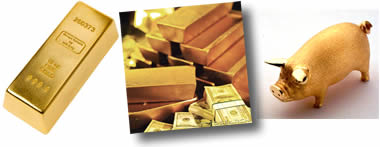
On March 13th, 2008, the price of gold reached a record US $1,000 per troy ounce for the first time. Though the price has fallen slightly since then, gold is still trading at over $910 per ounce in late June. For everyone involved in the gem and jewelry business, whether buyers or sellers, the high price of gold is a major worry. What's going on in the gold market? Is gold becoming like oil, where the price just continues to go up and up? Is world demand for gold pushing up the price to record levels? If so, who's buying all the gold? 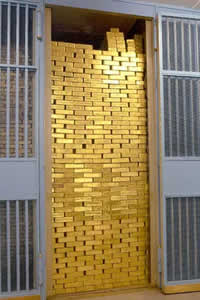
Federal Reserve Bank of New York
Though both gold and oil prices have been rising rapidly along with many other commodities, the demand for gold does not appear to be based on consumer market demand. Gold has some uses in the electronics industry, but for the most part gold is not an industrial metal, unlike copper or platinum. About 70 percent of gold consumption is for jewelry. But when gold prices are very high, gold jewelry sales fall. Since production of gold is steady, that should lead to falling prices, shouldn't it? It seems as though it should. But gold attracts speculators as well as jewelry buyers. When the financial markets - traders, mutual funds, hedge funds and so on - decide to buy gold, they buy it in vast quantities. They don't even need to buy actual gold to affect the gold price; speculators trade in futures and options as well. Why is so much cash moving into gold? Experts point to the credit crunch set off by out-of-control mortgage lending in the USA and the falling US dollar. Low interest rates, a slowing economy and worries about international oil supplies have apparently led financial institutions to move a lot of cash into the safety of gold. So is the high gold price just a temporary bubble? There's reason to think that it is, though no one knows how long the bubble will last. The gold price has been high before. In fact the recent $1,000 record is not a record at all. In January 1980, gold reached a price of $850. Adjusted for inflation, that's $2,200 in 2008 dollars! By 1999 the price of gold had fallen all the way back to $250. Developing countries, especially China, are increasing their consumption of the world's oil reserves. But the demand for gold is reasonably steady. When the financial markets move cash out of gold and into stocks, bonds or real estate, the price of gold will fall, probably as quickly as it increased. All of us in the gem and jewelry business are looking forward to this. New Content at GemSelect Back to Top
We add hundreds of new gems to our inventory every day. We also add new content to our site each week as well, in the form of articles and reference material. Recently we've added new articles on topics ranging from padparadscha sapphire to feldspar gems and zoisite. If you're interested in learning more about the history of the gemstone business, we are also adding short biographies of some of the most interesting figures. See our new pieces on Jean-Baptiste Tavernier, Friedrich Mohs and William Earl Hidden. Click the link to see all our gemstone articles. Rare and Unusual Gems Back to Top
Each month we feature a rare and unusual gem from our recent acquisitions. This month's featured gem is a very large flawless sapphire from Sri Lanka: 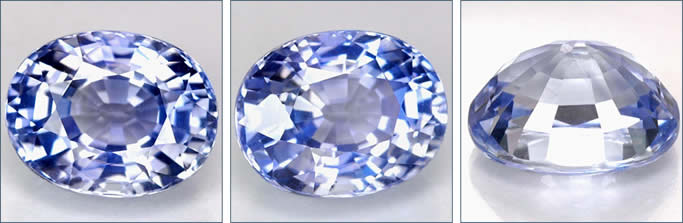
Natural Blue Sapphire
Sapphires tend to be cleaner than rubies, but large flawless sapphires weighing over 3 carats are quite rare. This outstanding violet-blue sapphire from Sri Lanka, at 4.76 carats, is a good example of the excellent large sapphires that can still be found at affordable prices. But we see very few of them. The color of this sapphire is reminiscient of fine tanzanite, but with all the virtues of sapphire (superb hardness and no cleavage). Though the lighter shades of blue sapphire have not been as highly valued as the darker tones, the lighter colors actually exhibit great fire and brilliance. Customer Questions Back to Top
Every month we answer questions of general interest from our customers. Please feel free to send your questions or suggestions to our support team at help@gemselect.com! Question
I noticed you've been adding some new kinds of gems, like bloodstone and scapolite. I was wondering, how many different kinds of gems are there in the world? TW, USA.
Answer
It's not an easy question to answer in a definitive way, but the latest edition of Walter Schumann's Gemstones of the World lists about 135 different varieties of natural gemstones. We currently stock about 80 varieties, but our eventual goal is to stock every known kind of gemstone, as soon as we can find them.
Question
I'm not a gemstone expert and I'm not familiar with all the different varieties of gems. But I'm looking for some particular colors (blue-green and soft pink). Do you have a way to search your stock by color instead of gem names? Thanks for any advice. JM, Australia.
Answer
A good place to start is with our gems by color page. This will show you all the different gem types that can be found in the basic colors (red, pink, blue, green, etc.). You can also type a color name, such as "blue-green" in the search box that you'll find on every page, and that will take you to a page with all of our blue-green gems, sorted by variety.
Keep up with our new arrivals before they hit the newsletter by joining our thousands of fans and followers on our social networking pages. We love interacting with our customers - you can visit us on LinkedIn, Twitter, Facebook or Pinterest! To ensure you can receive our emails, please be sure to add help@gemselect.com to your list of safe contacts, or you add us into your email address book! Please feel free to contact us with any questions, comments and queries! We respond to each and every email we receive. Happy Gem Hunting! This Page in Other Languages
About Us
Overall Rating -> 10 I particularly like information about product provided with purchase. Posted By Dick in May, 2023 Source: Bizrate Overall Rating -> 10 I bought a small ring green so I may practice my jewelry making. Posted By HairyOtter in July, 2023 Source: Bizrate Overall Rating -> 10 Purchasing from Gem Select was a pleasant and easy experience. The photos of the stones I was interested in were an accurate depiction of the stones I received. Ordering was easy and the items arrived within a week. Over all it was a very positive experience. Posted By Dee in September, 2023 Source: Bizrate Overall Rating -> 10 was just windowshopping and spotted a couple "Very Uncommons", a tsavorite & a demantoid garnet that were both in a size I was looking for, & that I could very easily pay for -- so figured I would grab the tsavo ASAP and got the demantoid to accompany so they wouldn't be lonely. Posted By Kittypie070 in April, 2024 Source: Bizrate Overall Rating -> 10 Had a problem ordering first time. Someone from Gem Select reached out to me and cleared problem and I made purchase. Posted By Myrtle in February, 2024 Source: Bizrate Overall Rating -> 10 first time here sooooooooooo we will seeeee!!!!! so far so good!!!!!! Posted By Seastone 56 in October, 2023 Source: Bizrate Related Articles Sapphire Info Sapphire Gemstone: What is Sapphire? Sapphire Color and more Tourmaline Gem Info Tourmaline Information - The most colorful gem on Earth Aquamarine Info Aquamarine Information - Get the facts, figures and stories behind... Emerald Info Emerald Information - Vivid green gemstones of unequaled quality Fire Opal Info Fire Opal Gemstone - A Mexican sunset captured in a gem Iolite Info Iolite Gemstone Information - Facts & Benefits Jade Info Jade Gemstone Information - GemSelect Kunzite Info Kunzite Gemstones - The must-have pink gem for evenings Orthoclase Info Orthoclase Gemstone Information: Unveil Its Natural Beauty Peridot Info Peridot: Properties & Value, Peridot Meaning & Healing Rhodolite Garnet Info Rhodolite Garnet Information - An elegant rose among thorns Ruby Info Ruby Information - The gemstone of passion and seduction Ruby-Zoisite Info Ruby-Zoisite Information - A unique gemstone mixture Spessartite Garnet Info Spessartite Garnet: The Best Orange Garnet, A Detailed Guide Sphene Info Sphene Gemstone Information - GemSelect Spinel Info Spinel Gemstone Information - An often overlooked Beauty Tanzanite Info Tanzanite Information - Africa's wonder risen from the ashes Topaz Info Topaz Gemstone Information – Take a look beyond the blue Zircon Info Zircon Information - A gemstone as old as the earth itself Lapis Lazuli Info Lapis Lazuli Information - The timeless deep blue gemstone Moss Opal Info Moss Opal Gemstones - Intriguing branch-like inclusions Mystic Topaz Info Mystic Topaz Information - A kaleidoscope of colors Star Ruby Info Star Ruby Gemstone Information - GemSelect Birthstones by Month Birthstones by Month, Every Birthstone, Zodiac & Anniversary Caring for Gemstones Gemstone Care - Gemstone Information - GemSelect Color Basics Gemstone Color - A Quick Guide to Colors Diffusion Treatment Diffusion Treatment for Gemstones - GemSelect Irradiation Treatment Irradiation Treatment - Gemstone Information - GemSelect Gemstone Hardness Explained Gemstone Hardness | Mohs Scale with Images and Charts Precious and Semi-Precious Gemstone Glossary Gemstone & Mineral Glossary - Gemstone Information - GemSelect Medicinal Gemstones Medicinal Gemstone Information - GemSelect Gemstone Treatments All About Gemstone Treatments - Information - GemSelect Fracture Filled Fracture Filled Treatment - Gemstone Information - GemSelect Gem Market Chanthaburi International Gemstone Market in Chanthaburi, Thailand: Shopping f... Gemstone Prices Gemstone Prices - A review of what influences the amount you pay Loose Gemstones from Mine to Market Loose Gemstones From Mine to Market - Gems and Jewelry Information... Precious Stones Precious & Semi-Precious Gemstone History, Legends & Myths Rare Tourmaline Rare Tourmaline Gemstones - Unique and distinctive varieties The Secret of Spinel The Secret of Spinel Gemstones Allure of Yellow Sapphire Yellow Sapphire: Meaning, Properties, Details and More Kunz and Tourmaline Kunz and Tourmaline - Creating the colored gemstone market Sources for Fine Ruby Gems Sources for Fine Ruby Gems Gem Mining in Madagascar Sapphire and Ruby Gemstone Mining in Madagascar Healing Gemstones Healing Gemstones: Could Gems Have Special Powers? Rare Garnets Rare Garnets: Tsavorite, Spessartite and Rhodolite Colored Gemstone Business Understanding the Colored Gemstone Business Tanzanite Prices Tanzanite Prices - Limited supplies of this stunning stone Star Gemstones Star Gemstones Gemstone Names Gemstone Names | Gem Name Origins, History, Lists and More Fine Green Sapphire Fine Green Sapphire - A fancy gemstone colored from mint to forest Rare Fire Agate Rare Fire Agate - An iridescent play of color in this rare gem February Birthstones Info February Birthstone: More than just a purple stone Pukhraj Yellow Sapphire Pukhraj Yellow Sapphire Citrine Properties Citrine Properties - The golden gem that radiates positive energy |
| STAY IN TOUCH | NEWSLETTER |
| *You're signing up to receive GemSelect promotional email. |


Copyright © 2005-2024 GemSelect.com all rights reserved.
Reproduction (text or graphics) without the express written consent of GemSelect.com (SETT Company Ltd.) is strictly prohibited.
549