FREE SHIPPING
|
GemSelect Newsletter - February 2008In our newsletter this month:
Buy It While You Can Back to Top
The colored gemstone business is quite different from the diamond business. Diamonds are promoted as rare and precious, but in fact they are widely available in standardized cuts and shapes. The fact that diamonds are expensive has more to do with De Beers' control of the supply chain than rarity. About 60 million carats of gem quality diamonds are mined each year. Unless you're looking for something very exceptional, you can always find diamonds in every shape, size and quality. The situation with colored gems could not be more different. Colored stones, unlike diamonds, are mostly mined by independent, small-scale miners, working in remote locations in far away places such as Sri Lanka, Madagascar, Tanzania, Burma, Afghanistan, Colombia and Bolivia. Mining is carried out with pick and shovel, and only rarely with heavy equipment. Colored gems reach the market in a variety of ways, many of them involving relatively small deals between independent businessmen. The reality of the colored gemstone business is very apparent when you go out in search of a specific gem. If you look for a sapphire in a specific color, size, shape and clarity, you have to be lucky to find exactly the stone you're looking for. The supply of material is so variable that not every kind of stone will be available in every color and size at any given time. It's one of the frustrations of the colored gemstone trade. At the same time, there is a lot of excitement when interesting stones appear on the market. From our years in the gem business, we've learned that you have to buy it while you can. When good stones come on the market - and especially good stones at good prices - you have to seize the opportunity. A few months could mean that something is no longer available to buy. We've learned the lesson the hard way. 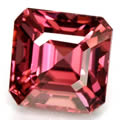
Zircon from GemSelect
Here are a few cases in point. Recently we were able to buy some unusual rose zircon from Tanzania. This was completely untreated material, very clean, and some of it in exceptional sizes - up to 5 or 6 carats. We bought as much as we could and we hope we'll be able to buy it again. But we won't be surprised if next month the supply has dried up. This happened with chrome tourmaline last year. We found a nice parcel of this rare tourmaline colored by chromium. Not surprisingly, we sold it very quickly. We tried to buy more but it was no longer available. Then we didn't see it again for many months. Last week we got lucky again and found a small amount at a very good price. We wish we could have bought more.
Some gems, such as the quartz family (amethyst, citrine, etc) are always in good supply. But some others, while usually available, are not always available in the sizes or quality that we want to buy. For example, we've had many requests for peridot in large sizes. Everything we had found in the market for months was under 2 carats. Then last month we found some Burmese peridot in sizes weighing up to 11 carats, with outstanding color saturation. It is quite rare to find peridot that large and we'll be surprised (but delighted) if we see it again any time soon. Like most gemstone buyers, we have a shopping list when we go into the market to buy gems. But if we only bought what was on our list, some months we'd buy hardly anything at all. In the colored gemstone market you have to be an opportunist. New Content at GemSelect Back to Top
We add hundreds of new gems to our inventory every day. Also, if you've looked at our sitemap recently, you may have noticed that we've been adding a lot of new website content. Some of the new content is reference material that we hope you'll find useful. New pages include a refractive index chart for all the different gemstones, and another chart listing gems by specific gravity (density). In our other gem selections you'll find a number of new pages that let you view gems by color or shape. So if you want an easy way to see all our red gemstones or all our trillion-cut gems you'll find convenient links to these and many more. Finally, in our gemstone articles section you'll find a number of interesting new articles on gemstones written by the GemSelect staff, on topics as diverse as the history of birthstones and the mystery of andesine-labradorite. Gemstones Worth Knowing Back to Top
Each month we focus on one of the lesser known gemstones. This month's featured stone is sphene. 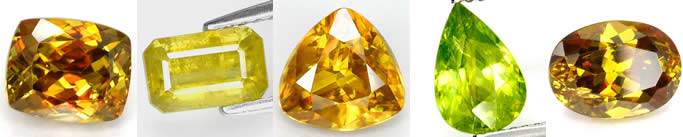
Natural Sphene from GemSelect
Sphene is composed of calcium titanium silicate and is also known by its mineralogical name, titanite. The name sphene comes from the fact that its crystals are typically sphenoid (from the Greek sphenos meaning wedge). The name titanite comes, not surprisingly, from its titanium content. Sphene occurs as translucent to transparent, reddish brown, gray, yellow, green, or red monoclinic crystals. Sphene has an unusually high refractive index (1.843 to 2.110), even higher than that of zircon, ruby and sapphire (but lower than diamond which has a refractive index of 2.417 to 2.419). Sphene's dispersion (fire) is truly exceptional, exceeding even that of diamond. For more information see our sphene information page and our recent article on sphene. Customer Questions Back to Top
Every month we answer questions of general interest from our customers. Please feel free to send your questions or suggestions to our support team at help@gemselect.com! Question
I need a 7 x 5 mm gem for a standard setting. How much can a gem vary from 7 x 5 mm and still fit? Thanks very much for your answer. JN, New Zealand.
Answer
The general rule for calibrated gemstones is a .1 mm variance for gems under 1 carat, and a .2 mm variance for gems over 1 carat. The exception is round stones, which have a larger variance since it is easier to adjust a setting for a round stone. When you search for gems using our calibrated size chart we'll automatically show you all the gems that qualify, including the permitted variance.
Question
When I put some items in my shopping cart they are always there when I come back the next day. But today when I came back the two gems I'd saved were gone. What happened? DS, USA.
Answer
Items will be saved in your cart for 3 days. There are 2 reasons why items might disappear before the 3 days are up: (1) Another customer buys the item; or (2) You clear your browser cache and delete cookies from your system. We use browser cookies to recognize you when you return to our site. However, if you create an account with us and login before you put items in your cart, you don't need to worry about browser cookies, since the items are tied to your account ID rather than the session ID stored in your browser cookies.
Keep up with our new arrivals before they hit the newsletter by joining our thousands of fans and followers on our social networking pages. We love interacting with our customers - you can visit us on Tumblr, LinkedIn, Twitter, Facebook or Pinterest! To ensure you can receive our emails, please be sure to add help@gemselect.com to your list of safe contacts, or you add us into your email address book! Please feel free to contact us with any questions, comments and queries! We respond to each and every email we receive. Happy Gem Hunting! This Page in Other Languages
About Us
Overall Rating -> 10 Super easy to do business for great products. Posted By BoBBy in January, 2024 Source: Bizrate Overall Rating -> 10 Purchasing from Gem Select was a pleasant and easy experience. The photos of the stones I was interested in were an accurate depiction of the stones I received. Ordering was easy and the items arrived within a week. Over all it was a very positive experience. Posted By Dee in September, 2023 Source: Bizrate Overall Rating -> 10 Very good, very fast, everything as described. Posted By B in October, 2023 Source: Bizrate Overall Rating -> 10 I found it to be easy to browse and easy to use Posted By Kyle in December, 2023 Source: Bizrate Overall Rating -> 9 GemSelect has a fantastic assortment of Semi-precious stones. I have not found any other web site with the variety you have. Posted By RobDill in August, 2023 Source: Bizrate Related Articles Sapphire Info Sapphire Gemstone: What is Sapphire? Sapphire Color and more Tourmaline Gem Info Tourmaline Information - The most colorful gem on Earth Aquamarine Info Aquamarine Information - Get the facts, figures and stories behind... Emerald Info Emerald Information - Vivid green gemstones of unequaled quality Fire Opal Info Fire Opal Gemstone - A Mexican sunset captured in a gem Iolite Info Iolite Gemstone Information - Facts & Benefits Jade Info Jade Gemstone Information - GemSelect Kunzite Info Kunzite Gemstones - The must-have pink gem for evenings Orthoclase Info Orthoclase Gemstone Information: Unveil Its Natural Beauty Peridot Info Peridot: Properties & Value, Peridot Meaning & Healing Rhodolite Garnet Info Rhodolite Garnet Information - An elegant rose among thorns Ruby Info Ruby Information - The gemstone of passion and seduction Ruby-Zoisite Info Ruby-Zoisite Information - A unique gemstone mixture Spessartite Garnet Info Spessartite Garnet: The Best Orange Garnet, A Detailed Guide Sphene Info Sphene Gemstone Information - GemSelect Spinel Info Spinel Gemstone Information - An often overlooked Beauty Tanzanite Info Tanzanite Information - Africa's wonder risen from the ashes Topaz Info Topaz Gemstone Information – Take a look beyond the blue Zircon Info Zircon Information - A gemstone as old as the earth itself Lapis Lazuli Info Lapis Lazuli Information - The timeless deep blue gemstone Moss Opal Info Moss Opal Gemstones - Intriguing branch-like inclusions Mystic Topaz Info Mystic Topaz Information - A kaleidoscope of colors Star Ruby Info Star Ruby Gemstone Information - GemSelect Birthstones by Month Birthstones by Month, Every Birthstone, Zodiac & Anniversary Caring for Gemstones Gemstone Care - Gemstone Information - GemSelect Color Basics Gemstone Color - A Quick Guide to Colors Diffusion Treatment Diffusion Treatment for Gemstones - GemSelect Irradiation Treatment Irradiation Treatment - Gemstone Information - GemSelect Gemstone Hardness Explained Gemstone Hardness | Mohs Scale with Images and Charts Gemstone Clarity and Cut Clarity and Cut - Gemstone Information - GemSelect Precious and Semi-Precious Gemstone Glossary Gemstone & Mineral Glossary - Gemstone Information - GemSelect Medicinal Gemstones Medicinal Gemstone Information - GemSelect Gemstone Treatments All About Gemstone Treatments - Information - GemSelect Fracture Filled Fracture Filled Treatment - Gemstone Information - GemSelect Gem Market Chanthaburi International Gemstone Market in Chanthaburi, Thailand: Shopping f... Gemstone Prices Gemstone Prices - A review of what influences the amount you pay Loose Gemstones from Mine to Market Loose Gemstones From Mine to Market - Gems and Jewelry Information... Precious Stones Precious & Semi-Precious Gemstone History, Legends & Myths Rare Tourmaline Rare Tourmaline Gemstones - Unique and distinctive varieties The Secret of Spinel The Secret of Spinel Gemstones Allure of Yellow Sapphire Yellow Sapphire: Meaning, Properties, Details and More Kunz and Tourmaline Kunz and Tourmaline - Creating the colored gemstone market Sources for Fine Ruby Gems Sources for Fine Ruby Gems Gem Mining in Madagascar Sapphire and Ruby Gemstone Mining in Madagascar Healing Gemstones Healing Gemstones: Could Gems Have Special Powers? Rare Garnets Rare Garnets: Tsavorite, Spessartite and Rhodolite Colored Gemstone Business Understanding the Colored Gemstone Business Tanzanite Prices Tanzanite Prices - Limited supplies of this stunning stone Star Gemstones Star Gemstones Apatite Gemstones Apatite Gemstones - They are a lot more common than you think Moonstone Lore & Legend Moonstone Lore and Legend - Myths surround this glowing gemstone Pink Sapphire Pink Sapphire: A Complete Guide for Rare Pink Sapphires |
| STAY IN TOUCH | NEWSLETTER |
| *You're signing up to receive GemSelect promotional email. |


Copyright © 2005-2024 GemSelect.com all rights reserved.
Reproduction (text or graphics) without the express written consent of GemSelect.com (SETT Company Ltd.) is strictly prohibited.
440