
FREE SHIPPING
|
GemSelect Newsletter - November 2007In our newsletter this month:
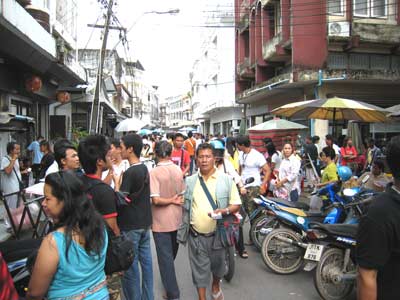
Gem Dealers at Chathaburi's Gem Market
Many people who visit Thailand shop for gemstones in Bangkok. But very few people have the chance to see where many of the Thai gem dealers buy their gemstones. For that you need to travel 250 kilometers south east of Bangkok to our home of Chanthaburi. This small city of about 50,000 people is the major processing and trading center for colored gemstones in Southeast Asia. It is estimated that 80% of the world's supply of ruby and sapphire passes through Chanthaburi. Chanthaburi was once famous for its ruby and sapphire mines. The mining business reached its peak in the 1960s and 70s when political events in Burma reduced the supply of Burmese ruby to a trickle. The demand for Thai gemstones was so great that by the 1980s the local mines were worked out. The gem business in Chanthaburi might have died along with mining, but the gem factories here had developed new techniques for heating gemstones to improve their color and clarity. When the local supply of ruby and sapphire started to disappear, traders began to bring colored gemstone from all over the world to be processed in Chanthaburi. Gemstone processing in Chanthaburi is largely a cottage industry. Though there are a few large companies, most of the work is done by smaller family-owned businesses. Their expertise is in grading, cutting and polishing gemstones, not in marketing their product to the world. So a local market has developed to help the Chanthaburi factories get their gemstones into distribution. For those in the know, this market has some of the best deals in colored gemstones in the world. The Chanthaburi gemstone market, known in Thai as the talad ploy, is open every Friday, Saturday and Sunday, from about 11 in the morning to about 6 in the evening. The main part of the market is in a narrow set of lanes at the intersection of Si Chan Road ("Gems Street") and Tessaban Road. This neighbourhood is full of retail shops for gemstones and gemstone equipment (scales, loupes and the like). During weekdays, this area seems fairly quiet, but the weekend gems market is a whole new world of activity. The talad ploy is a public market where anyone can come to buy and sell. If you visited the market for the first time, you probably wouldn't know where to begin. This is not a market where dealers display their wares and buyers browse through the goods. The commercial model here is entirely different from the local produce market a few blocks away. At the talad ploy, the buyers occupy the trading desks and the sellers circulate through the market looking for buyers. 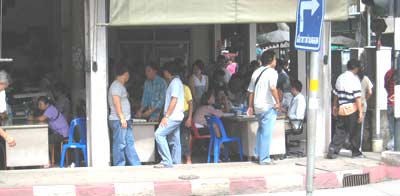
Open Gem Sales Office in the Center of the Market
So let's say you wanted to buy some sapphire at the market. The first thing you need to do is find a place a sit. You'll see a number of storefronts, many of them open to the street, with desks and chairs. These are trading offices and they'll be happy to provide you with space for your trading. The trading offices make their living by earning commissions on every sale. You won't know exactly what the commission is, since it's paid by the seller. In the most popular spots, it could be as high as 15%. Just remember that the commission will be included in the price you will pay for any gems you buy. The next thing you need to do is let the market know what you want to buy. This is done by posting a sign (in Thai of course) on the window of the trading office or to the front of your trading desk. Sometimes the signs are fairly general, such as "tourmaline and spinel". But very often you will see buyers looking for sapphire in a specific color and size or weight. 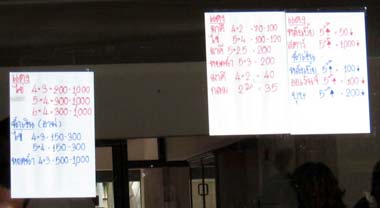
Gem Wish List Outside the Offices
Sellers who have gemstones that meet your requirements will stop by and show their goods. The sellers are fairly easy to spot in the market - they are the people with shoulder bags worn securely across their chests. Inside those bags are gemstones that may be worth several hundred thousand dollars. You might be surprised at the unassuming appearance of these sellers, dressed in T-shirts, jeans and sandals. Are these really the wealthy gem dealers of Chanthaburi? In fact they are only brokers, acting as the legal representatives of the gem owners, who rarely make an appearance in the market. The brokers will show you what they have to offer and can answer questions about the goods, assuming you can speak enough Thai to ask. They will state an asking price, but the final price may well be only 40% of the initial price, so you'll need very good negotiating skills to strike a bargain. If you make an offer on some gemstones that the broker thinks might be acceptable to the owner, the gemstones will be wrapped up and taped securely with your name and price, and the broker will disappear to consult with the owner by phone. You'll usually get your answer within the hour. If you've offered a low price for the gemstones, you may get lucky if the owner has done well on other gemstones from the same lot or needs to raise some cash quickly. 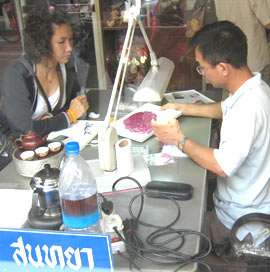
Gem Buyers and Brokers in a Typical Office
Eventually you'll get hungry, and this being Thailand, there are many food sellers right in the market. You'll see many of the same street stalls you see all over Thailand - noodle soup, chicken or pork over rice, fresh local fruit and interesting sweets. You definitely won't go hungry. The final stop on our tour is a new gem trade center a few blocks away. This modern air-conditioned building has an open trading floor and a number of private rooms. It even has a gemological lab on site where you can get identification reports within an hour or two. This clean and inviting environment looks to be the future of the gems market in Chanthaburi. But where are the buyers and sellers? The half empty trading floor stands out in stark contrast to the crowded streets of the old market. Traditions die very slowly in Asia, and despite the heat, dust and crowds, the gem traders prefer the atmosphere of the old quarter. We are always looking for ways to make it easier for our customers to find what they're looking for on our website. Since we've recently added a large number of interesting gemstone pairs and lots, we made some changes so you can find them more easily: 1. On our home page, you'll see 2 buttons labelled "pairs" and "lots." Clicking on these buttons will show you all of our pairs (or lots) listed by gem type. 2. When you're browsing a gem page such as sapphire or tourmaline, you can use the tick boxes to view just the pairs or lots for that gem type. 3. On any page, you can use the search box and look for "spinel pairs" or "tourmaline lots", for example. Gemstones Worth Knowing Back to Top
Each month we focus on one of the lesser-known gemstones. This month's featured stone is peridot. 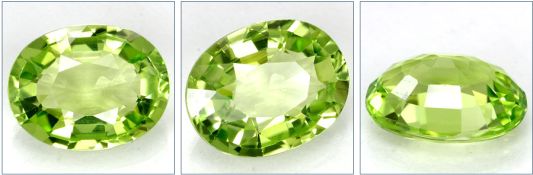
Peridot from Burma
Peridot is one of very few gemstones found only in one color. That's because the green of peridot comes from the basic chemical composition of the material itself (magnesium iron silicate) rather than from minor impurities. The bright yellow-green of peridot is quite unique in the gemstone world. Peridot is a historically important gem. It is mentioned in the Bible and legend has it that peridot was the favorite gemstone of Cleopatra. Fine peridot is sourced from a number of locations, including Pakistan, the USA, Burma, China and Vietnam. To see our selecion of peridot gems click here. Customer Questions Back to Top
Every month we answer questions of general interest from our customers. Please feel free to send your questions or suggestions to our support team at help@gemselect.com! Question
When gem people talk about "luster" what do are they referring to? Is it just how shiny a gemstone is? Hope this isn't a silly question! JK, Canada.
Answer
It's not a silly question at all. "Luster" is actually a technical term used to refer to the light reflected from the surface of a gemstone. Luster is the result of both the surface and the refractive index (RI) of the material. Though it's a technical term, it is qualitative rather than quantitative.
Terms used to describe luster include metallic, adamantine (diamond-like), pearly, silky, vitreous (glass-like), resinous and waxy. The most common luster of gemstones is vitreous, but some interesting gems have a non-vitreous luster, such as turquoise (waxy), amber (resinous), cat's eye (silky), and jadeite (greasy). One of the few gems with an adamantine luster (apart from diamond) is sphene. Question
Could you explain specific gravity? I know it has to do with the density of a gemstone, but what does it mean exactly and how do I measure it? Thanks, DTO, USA.
Answer
You're correct - specific gravity is a way to express the relative density of a gemstone. It is measured as the ratio of the density of the gemstone to the density of water. It is expressed as a number that indicates how much heavier the gemstone is compared to an equal volume of water.
Scientifically, specific gravity is defined as a ratio of the mass of a given material to the mass of an equal volume of water at 4 degrees centigrade. Most gemstone substances are two to four times denser than an equal volume of water. Specific gravities are expressed in decimal numbers, for example, 4.00 for corundum, 3.52 for diamond and 2.72 for quartz. Zircon, the densest of all gemstones, may have a specific gravity as high as 4.73! For exact values, various measuring devices are used. Rough approximations of the specific gravity of lighter stones can be made by using a series of liquids with known specific gravity values. For example, if a stone floats in a liquid with a specific gravity of 4 and sinks in a liquid with a specific gravity of 3, the specific gravity of the stone must lie between these values. Keep up with our new arrivals before they hit the newsletter by joining our thousands of fans and followers on our social networking pages. We love interacting with our customers - you can visit us on Tumblr, LinkedIn, Twitter, Facebook or Pinterest! To ensure you can receive our emails, please be sure to add help@gemselect.com to your list of safe contacts, or you add us into your email address book! Please feel free to contact us with any questions, comments and queries! We respond to each and every email we receive. Happy Gem Hunting! This Page in Other Languages
About Us
Overall Rating -> 10 Very easy. I have purchased a few times before and was satisfied each time. Thank you. Posted By Ray in December, 2023 Source: Bizrate Overall Rating -> 8 Very easy to find the specific stone I was looking for. I am pleased by both the selection and the price of the stones that are available. The only "bad" thing that I have to say is that the interface of the site is outdated. Posted By Nick in March, 2024 Source: Bizrate Overall Rating -> 10 After having looked at other purchasing sites, this is my first choice. Posted By MJC in January, 2024 Source: Bizrate Overall Rating -> 10 Always have good experience Posted By Ginnie in September, 2023 Source: Bizrate Overall Rating -> 10 Great selection, I love your site! Great product visibility, information, etc. Posted By John in February, 2024 Source: Bizrate Overall Rating -> 10 Gem Select has gems at afffordable prices. Posted By George in March, 2024 Source: Bizrate Related Articles Sapphire Info Sapphire Gemstone: What is Sapphire? Sapphire Color and more Tourmaline Gem Info Tourmaline Information - The most colorful gem on Earth Apatite Info Apatite Gemstone Information - An obscure gem in striking colors Aquamarine Info Aquamarine Information - Get the facts, figures and stories behind... Emerald Info Emerald Information - Vivid green gemstones of unequaled quality Fire Opal Info Fire Opal Gemstone - A Mexican sunset captured in a gem Iolite Info Iolite Gemstone Information - Facts & Benefits Jade Info Jade Gemstone Information - GemSelect Kunzite Info Kunzite Gemstones - The must-have pink gem for evenings Orthoclase Info Orthoclase Gemstone Information: Unveil Its Natural Beauty Peridot Info Peridot: Properties & Value, Peridot Meaning & Healing Rhodolite Garnet Info Rhodolite Garnet Information - An elegant rose among thorns Ruby Info Ruby Information - The gemstone of passion and seduction Ruby-Zoisite Info Ruby-Zoisite Information - A unique gemstone mixture Spessartite Garnet Info Spessartite Garnet: The Best Orange Garnet, A Detailed Guide Sphene Info Sphene Gemstone Information - GemSelect Spinel Info Spinel Gemstone Information - An often overlooked Beauty Tanzanite Info Tanzanite Information - Africa's wonder risen from the ashes Topaz Info Topaz Gemstone Information – Take a look beyond the blue Zircon Info Zircon Information - A gemstone as old as the earth itself Lapis Lazuli Info Lapis Lazuli Information - The timeless deep blue gemstone Moss Opal Info Moss Opal Gemstones - Intriguing branch-like inclusions Mystic Topaz Info Mystic Topaz Information - A kaleidoscope of colors Star Ruby Info Star Ruby Gemstone Information - GemSelect Birthstones by Month Birthstones by Month, Every Birthstone, Zodiac & Anniversary Caring for Gemstones Gemstone Care - Gemstone Information - GemSelect Color Basics Gemstone Color - A Quick Guide to Colors Diffusion Treatment Diffusion Treatment for Gemstones - GemSelect Irradiation Treatment Irradiation Treatment - Gemstone Information - GemSelect Gemstone Hardness Explained Gemstone Hardness | Mohs Scale with Images and Charts Precious and Semi-Precious Gemstone Glossary Gemstone & Mineral Glossary - Gemstone Information - GemSelect Medicinal Gemstones Medicinal Gemstone Information - GemSelect Gemstone Treatments All About Gemstone Treatments - Information - GemSelect Fracture Filled Fracture Filled Treatment - Gemstone Information - GemSelect Gem Market Chanthaburi International Gemstone Market in Chanthaburi, Thailand: Shopping f... Gemstone Prices Gemstone Prices - A review of what influences the amount you pay Loose Gemstones from Mine to Market Loose Gemstones From Mine to Market - Gems and Jewelry Information... Precious Stones Precious & Semi-Precious Gemstone History, Legends & Myths Rare Tourmaline Rare Tourmaline Gemstones - Unique and distinctive varieties The Secret of Spinel The Secret of Spinel Gemstones Kunz and Tourmaline Kunz and Tourmaline - Creating the colored gemstone market Sources for Fine Ruby Gems Sources for Fine Ruby Gems Gem Mining in Madagascar Sapphire and Ruby Gemstone Mining in Madagascar Healing Gemstones Healing Gemstones: Could Gems Have Special Powers? Gemstone Names Gemstone Names | Gem Name Origins, History, Lists and More Chrome Diopside Information - Facts, History and More Chrome Diopside Apatite Gemstones Apatite Gemstones - They are a lot more common than you think Fine Green Sapphire Fine Green Sapphire - A fancy gemstone colored from mint to forest Labradorite Iridescence Labradorite Iridescence: Discover the Mystic Glow Rutile in Gems Rutile in Gems |
| STAY IN TOUCH | NEWSLETTER |
| *You're signing up to receive GemSelect promotional email. |


Copyright © 2005-2024 GemSelect.com all rights reserved.
Reproduction (text or graphics) without the express written consent of GemSelect.com (SETT Company Ltd.) is strictly prohibited.
330


