FREE SHIPPING
|
GemSelect Newsletter - July 2009In our newsletter this month:
Finding Matching Gems Back to Top
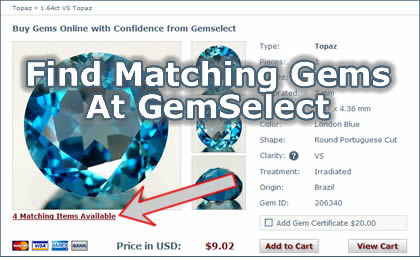
We've been increasing our inventory this year, as we find more opportunities to buy new and interesting gems. We now have about 12,000 items in stock. But as we grow our stock, it can take more work to sort through our gems to find the ones you need. Browsing through all our 1,300 sapphires, for example, can take quite a while. We've begun some improvements to simplify navigation of our website. For example, you'll notice a new menu bar across the top of each page that provides direct links to popular pages such as our new arrivals or calibrated gems. Therefore, no matter where you are on gemselect.com, you can go directly to many pages without returning to the home page. Recently we've added a new function, which we think is both powerful and extremely easy to use. With a single click it enables you to find all the matching or very similar pieces for a particular gem. It can save a lot of time when you want to buy several similar pieces or just compare similar items. Here's how it works. When you go to the detail page for a particular gem, you'll see a link right below the gem details that will tell you if matching items are available, and how many matching items were found. Clicking on the link will bring up a page that will show you all the matching items side by side, including the original item you were looking at. You'll find that approximately 70% of our gems have at least 1 matching item. Occasionally you'll see large numbers of matching items in the cases where we buy large lots of calibrated sizes, as we did recently with pyrope garnet, citrine and ametrine. We display matching items based on gem type, color, shape and size, with a maximum size variance of 4%. We'll even show you matching items for previously sold pieces. So if you purchased a gem from us in the past and want to find a similar piece, just enter the gem ID for your item in the search box on our home page. Then view the detail page for the item and we'll include a link if any matching items are available. Our matching items link will really save you time when you are ready to select a stone and want to make sure you've reviewed all the similar items in our inventory. Our matching items list is constantly updated as new items are added and others are sold, so you can be sure you are seeing all the similar items we have in stock. Rare and Unusual Gems Back to Top
Each month we feature a rare and unusual gem from our inventory. This month we would like to show you a stunning large aquamarine gem from Madagascar: 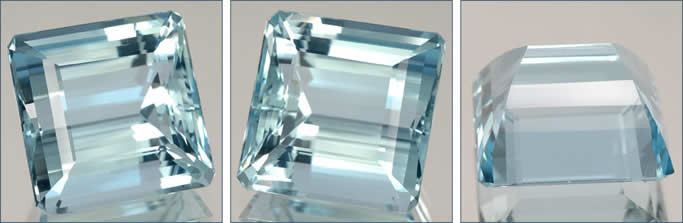
Top Grade Aquamarine
Aquamarine belongs to the beryl family, along with emerald and morganite. But where emeralds are typically heavily included and are routinely treated with oil to fill fissures, high quality aquamarine can have wonderful clarity. Recently we acquired two large aquamarines from Madagascar that combine excellent color saturation with top clarity. We have a 15.86 carat square octagon as well as a similar 10.58 carat stone. Customer Questions Back to Top
Every month we answer questions of general interest from our customers. Please feel free to send your questions or suggestions to our support team at help@gemselect.com! Question
In your June newsletter you wrote that prices for colored gemstones are stable even when we're in a recession. But I saw another article that said that diamond prices have fallen by more than a third. Is it true? WJ, USA.
Answer
Yes, it's true. If you've been shopping for diamonds in a retail shop, you would have no idea that diamond prices had taken such a nosedive, since the retail market does not adjust prices when commodity prices fall. The diamond market is still largely run by the De Beers cartel, and when prices are weak they respond by cutting production in the mines rather than lowering prices in the sales channel. It's really the worst of both world when this happens, because both the consumer and the miner suffer. But it's a reminder that diamonds are not rare. Over 1 million carats of gem-quality diamonds were produced in 2008.
Question
What is the rarest gemstone you sell? I'm just interested to know even if I can't afford it! Thanks, KM, New Zealand.
Answer
Many colored gemstones are rare, including alexandrite, tsavorite garnet, chrysoberyl cat's eye and sphalerite. But recently we acquired some specimens of clinohumite, a gem so rare that until recently, only a few thousand carats were known to exist in private collections. A recent find in Mahenge, Tanzania, is making clinohumite more widely available but it still counts as very rare. It is not particularly expensive, however, so it's a very attractive gem for collectors.
Keep up with our new arrivals before they hit the newsletter by joining our thousands of fans and followers on our social networking pages. We love interacting with our customers - you can visit us on Tumblr, LinkedIn, Twitter, Facebook or Pinterest! To ensure you can receive our emails, please be sure to add help@gemselect.com to your list of safe contacts, or you add us into your email address book! Please feel free to contact us with any questions, comments and queries! We respond to each and every email we receive. Happy Gem Hunting! This Page in Other Languages
About Us
Overall Rating -> 10 I’ve enjoyed purchasing stones from this site. It’s convenient and fairly priced. Posted By Chico in May, 2023 Source: Bizrate Overall Rating -> 10 Great selection, I love your site! Great product visibility, information, etc. Posted By John in February, 2024 Source: Bizrate Overall Rating -> 10 My last experience was good, in fact every experience I have had with them has met my expectations or surpassed them. These are really good people to work with. Posted By Spinach in May, 2023 Source: Bizrate Related Articles Sapphire Info Sapphire Gemstone: What is Sapphire? Sapphire Color and more Tourmaline Gem Info Tourmaline Information - The most colorful gem on Earth Aquamarine Info Aquamarine Information - Get the facts, figures and stories behind... Emerald Info Emerald Information - Vivid green gemstones of unequaled quality Fire Opal Info Fire Opal Gemstone - A Mexican sunset captured in a gem Iolite Info Iolite Gemstone Information - Facts & Benefits Jade Info Jade Gemstone Information - GemSelect Kunzite Info Kunzite Gemstones - The must-have pink gem for evenings Orthoclase Info Orthoclase Gemstone Information: Unveil Its Natural Beauty Peridot Info Peridot: Properties & Value, Peridot Meaning & Healing Rhodolite Garnet Info Rhodolite Garnet Information - An elegant rose among thorns Ruby Info Ruby Information - The gemstone of passion and seduction Ruby-Zoisite Info Ruby-Zoisite Information - A unique gemstone mixture Spessartite Garnet Info Spessartite Garnet: The Best Orange Garnet, A Detailed Guide Sphene Info Sphene Gemstone Information - GemSelect Spinel Info Spinel Gemstone Information - An often overlooked Beauty Tanzanite Info Tanzanite Information - Africa's wonder risen from the ashes Topaz Info Topaz Gemstone Information – Take a look beyond the blue Zircon Info Zircon Information - A gemstone as old as the earth itself Lapis Lazuli Info Lapis Lazuli Information - The timeless deep blue gemstone Moss Opal Info Moss Opal Gemstones - Intriguing branch-like inclusions Mystic Topaz Info Mystic Topaz Information - A kaleidoscope of colors Star Ruby Info Star Ruby Gemstone Information - GemSelect Birthstones by Month Birthstones by Month, Every Birthstone, Zodiac & Anniversary Caring for Gemstones Gemstone Care - Gemstone Information - GemSelect Color Basics Gemstone Color - A Quick Guide to Colors Diffusion Treatment Diffusion Treatment for Gemstones - GemSelect Irradiation Treatment Irradiation Treatment - Gemstone Information - GemSelect Gemstone Hardness Explained Gemstone Hardness | Mohs Scale with Images and Charts Precious and Semi-Precious Gemstone Glossary Gemstone & Mineral Glossary - Gemstone Information - GemSelect Medicinal Gemstones Medicinal Gemstone Information - GemSelect Gemstone Treatments All About Gemstone Treatments - Information - GemSelect Fracture Filled Fracture Filled Treatment - Gemstone Information - GemSelect Gem Market Chanthaburi International Gemstone Market in Chanthaburi, Thailand: Shopping f... Gemstone Prices Gemstone Prices - A review of what influences the amount you pay Loose Gemstones from Mine to Market Loose Gemstones From Mine to Market - Gems and Jewelry Information... Precious Stones Precious & Semi-Precious Gemstone History, Legends & Myths Rare Tourmaline Rare Tourmaline Gemstones - Unique and distinctive varieties The Secret of Spinel The Secret of Spinel Gemstones Allure of Yellow Sapphire Yellow Sapphire: Meaning, Properties, Details and More Kunz and Tourmaline Kunz and Tourmaline - Creating the colored gemstone market Sources for Fine Ruby Gems Sources for Fine Ruby Gems Gem Mining in Madagascar Sapphire and Ruby Gemstone Mining in Madagascar Healing Gemstones Healing Gemstones: Could Gems Have Special Powers? Rare Garnets Rare Garnets: Tsavorite, Spessartite and Rhodolite Colored Gemstone Business Understanding the Colored Gemstone Business Tanzanite Prices Tanzanite Prices - Limited supplies of this stunning stone Star Gemstones Star Gemstones Labradorite Iridescence Labradorite Iridescence: Discover the Mystic Glow Prong Vs. Bezel Settings Prong Vs. Bezel Settings Blue Sodalite Gems Blue Sodalite Gemstones - Royal Blue from the snowy north Discover the Beauty of Aventurine Gemstones Aventurine Gems Moldavite and Tektite Moldavite and Tektite Goshenite Gemstones Goshenite Gemstone | Learn all about this Elegant Gemstone Blue Indicolite Tourmaline Indicolite Tourmaline: A Comprehensive Guide to Its Unique Beauty ... |
| STAY IN TOUCH | NEWSLETTER |
| *You're signing up to receive GemSelect promotional email. |


Copyright © 2005-2024 GemSelect.com all rights reserved.
Reproduction (text or graphics) without the express written consent of GemSelect.com (SETT Company Ltd.) is strictly prohibited.
923