GemSelect Newsletter - August 2009In our newsletter this month:
The Green Garnets Back to Top
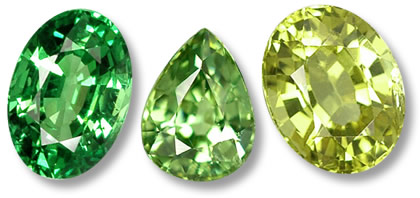
When most people think of garnet, they think of the common red garnets like almandine and pyrope. But the garnet family is actually remarkably diverse. Garnets can occur in nearly any color, including brown, yellow, orange, red and purple. The green garnets are among the rarest. Recently we've been lucky in finding some excellent specimens. The garnet group is conventionally divided into 6 species: Pyrope, almandite, spessartite, grossular, andradite and uvarovite. The different garnets share a similar crystal structure, but differ slightly in their chemical compositions. Green garnets are found in both the grossular and andradite types. Grossular garnets include two green garnets - the yellow-green grossularite and the chrome green tsavorite. The name "grossular" comes from the botanical name of the gooseberry, grossularia. The garnet known as grossularite is typically golden green, yellow-green or olive-green. The rarest grossular garnet is tsavorite, which is a rich green to emerald green garnet variety found only in Kenya and Tanzania. The outstanding green of tsavorite is thought to be due to trace amounts of chromium and/or vanadium. Tsavorite has become a popular alternative to emerald, though tsavorite is actually the rarer stone. The more common grossularite has its own attractions. Grossularite displays similar brilliance to tsavorite, due to a refractive index that lies midway between spinel and sapphire. The lighter colors of grossularite tend to have better dispersion (fire). The rarest of all garnets - and one of the rarest of all gemstones - is the green demantoid garnet. Particularly fine examples can command thousands of dollars per carat. Demantoid belongs to the andradite variety of garnet, which is calcium iron silicate with a refractive index of 1.88 to 1.94. The high refractive index makes demantoid the most brilliant of all the garnets; in fact it has a higher refractive index than sapphire and ruby. Demantoid also has remarkable dispersion (fire) that exceeds even that of diamond. Indeed, the very name demantoid means "diamond-like". Most of the green garnets, especially demantoid, are found only in small sizes. Specimens weighing over one carat are uncommon and stones over 2 carats count as very rare indeed. Rare and Unusual Gems Back to Top
Each month we feature a rare and unusual gem from our inventory. This month we feature an unusual black star sapphire from Thailand: 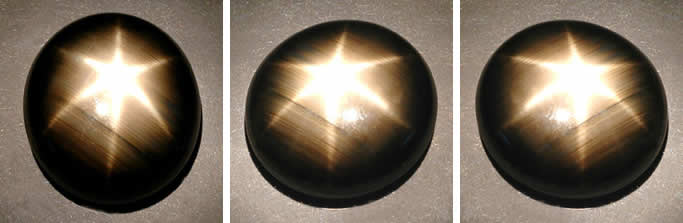
Black Star Sapphire from Thailand
Black star sapphires with gold stars are found in only one location; our home province of Chanthaburi in Thailand. They are also special because they are completely untreated. Most blue star sapphires have been diffusion-treated with rutile to improve the star, but these black star sapphires tend to have a distinct star without any treatment. The 55.93 ct stone shown above is especially rare because it displays a degree of perfection that is rarely seen. Due to its almost round dimensions (22.36 x 20.53 mm) and its well-centred and vivid 6-ray star, this is a true collector's item. Customer Questions Back to Top
Every month we answer questions of general interest from our customers. Please feel free to send your questions or suggestions to our support team at help@gemselect.com! Question
How important is it to get a certificate of authenticity when one purchases a gemstone? Thank you for your advice. HH, UK.
Answer
If you buy from a reputable dealer, your risk is very low. For example, we test samples of all the gems we buy, and any stone we're not sure of gets sent to a gemological lab to be checked. Some customers want the added assurance of a certificate when they purchase a gemstone, so we offer optional certification from independent gemological labs for many of our gems. Just check the "add gem certificate" box on the detail page when you add a gem to your shopping cart.
Question
What is a gemstone "culet"? I'm not even sure how to pronounce it! DB, Canada.
Answer
The culet is the tiny facet at the very bottom of many faceted gems. Not every faceted gem has a culet. In some gems the culet is closed, meaning that the the tip comes to a sharp point with no facet. Often the culet facet is very small and you need some level of magnification to detect it. Strictly speaking, gemologists say that a gemstone has a culet only in the case where a small facet is cut at the tip of the pavilion. A closed culet really means no culet at all. But many people in the trade still refer to the pointed tip as the culet. Also, by the way, the correct pronounciation is kyoo-lit (from Latin "culus" meaning bottom).
Keep up with our new arrivals before they hit the newsletter by joining our thousands of fans and followers on our social networking pages. We love interacting with our customers - you can visit us on Tumblr, LinkedIn, Twitter, Facebook or Pinterest! To ensure you can receive our emails, please be sure to add help@gemselect.com to your list of safe contacts, or you add us into your email address book! Please feel free to contact us with any questions, comments and queries! We respond to each and every email we receive. Happy Gem Hunting! This Page in Other Languages
About Us
Overall Rating -> 10 Always have good experience Posted By Ginnie in September, 2023 Source: Bizrate Overall Rating -> 9 Easy to use. Limited supply of higher quality gemstones. Posted By Newfguy in February, 2024 Source: Bizrate Overall Rating -> 10 I love GemSelect, photos and details are great. Posted By #1 in February, 2024 Source: Bizrate Overall Rating -> 10 I really enjoy browsing through GemSelect. The selection is always marvelous and I love how detailed everything is described. The only thing I noticed is that when browsing through my phone, the videos of the gems do not load. If there were more videos of the gems, that would be amazing, though I understand that is a lot of work on GemSelect's part! Checking out is also very fast and easy, and I love that the return policy is very good, though I hope I don't have to use it anytime soon. Posted By ChiChi in January, 2024 Source: Bizrate Overall Rating -> 10 I have used GemSelect for several years and plan to shop more in the further. This is a good source of information on gemstones. I love looking at and learning about them. Lot more than I ever knew existed. Posted By Bikerwalrus in October, 2023 Source: Bizrate Overall Rating -> 10 I really enjoy browsing through GemSelect. The selection is always marvelous and I love how detailed everything is described. The only thing I noticed is that when browsing through my phone, the videos of the gems do not load. If there were more videos of the gems, that would be amazing, though I understand that is a lot of work on GemSelect's part! Checking out is also very fast and easy, and I love that the return policy is very good, though I hope I don't have to use it anytime soon. Posted By ChiChi in January, 2024 Source: Bizrate Overall Rating -> 10 Easy to find products I want. I've ordered several times from gem select and never any problems. Will order again. Thank you. Posted By Ray in January, 2024 Source: Bizrate Related Articles Sapphire Info Sapphire Gemstone: What is Sapphire? Sapphire Color and more Tourmaline Gem Info Tourmaline Information - The most colorful gem on Earth Aquamarine Info Aquamarine Information - Get the facts, figures and stories behind... Fire Opal Info Fire Opal Gemstone - A Mexican sunset captured in a gem Iolite Info Iolite Gemstone Information - Facts & Benefits Jade Info Jade Gemstone Information - GemSelect Kunzite Info Kunzite Gemstones - The must-have pink gem for evenings Orthoclase Info Orthoclase Gemstone Information: Unveil Its Natural Beauty Peridot Info Peridot: Properties & Value, Peridot Meaning & Healing Rhodolite Garnet Info Rhodolite Garnet Information - An elegant rose among thorns Ruby Info Ruby Information - The gemstone of passion and seduction Ruby-Zoisite Info Ruby-Zoisite Information - A unique gemstone mixture Spessartite Garnet Info Spessartite Garnet: The Best Orange Garnet, A Detailed Guide Sphene Info Sphene Gemstone Information - GemSelect Spinel Info Spinel Gemstone Information - An often overlooked Beauty Tanzanite Info Tanzanite Information - Africa's wonder risen from the ashes Topaz Info Topaz Gemstone Information – Take a look beyond the blue Zircon Info Zircon Information - A gemstone as old as the earth itself Lapis Lazuli Info Lapis Lazuli Information - The timeless deep blue gemstone Moss Opal Info Moss Opal Gemstones - Intriguing branch-like inclusions Mystic Topaz Info Mystic Topaz Information - A kaleidoscope of colors Star Ruby Info Star Ruby Gemstone Information - GemSelect Birthstones by Month Birthstones by Month, Every Birthstone, Zodiac & Anniversary Caring for Gemstones Gemstone Care - Gemstone Information - GemSelect Color Basics Gemstone Color - A Quick Guide to Colors Diffusion Treatment Diffusion Treatment for Gemstones - GemSelect Irradiation Treatment Irradiation Treatment - Gemstone Information - GemSelect Gemstone Hardness Explained Gemstone Hardness | Mohs Scale with Images and Charts Precious and Semi-Precious Gemstone Glossary Gemstone & Mineral Glossary - Gemstone Information - GemSelect Medicinal Gemstones Medicinal Gemstone Information - GemSelect Gemstone Treatments All About Gemstone Treatments - Information - GemSelect Fracture Filled Fracture Filled Treatment - Gemstone Information - GemSelect Gem Market Chanthaburi International Gemstone Market in Chanthaburi, Thailand: Shopping f... Gemstone Prices Gemstone Prices - A review of what influences the amount you pay Loose Gemstones from Mine to Market Loose Gemstones From Mine to Market - Gems and Jewelry Information... Precious Stones Precious & Semi-Precious Gemstone History, Legends & Myths Rare Tourmaline Rare Tourmaline Gemstones - Unique and distinctive varieties The Secret of Spinel The Secret of Spinel Gemstones Allure of Yellow Sapphire Yellow Sapphire: Meaning, Properties, Details and More Kunz and Tourmaline Kunz and Tourmaline - Creating the colored gemstone market Sources for Fine Ruby Gems Sources for Fine Ruby Gems Gem Mining in Madagascar Sapphire and Ruby Gemstone Mining in Madagascar Healing Gemstones Healing Gemstones: Could Gems Have Special Powers? Rare Garnets Rare Garnets: Tsavorite, Spessartite and Rhodolite Colored Gemstone Business Understanding the Colored Gemstone Business Tanzanite Prices Tanzanite Prices - Limited supplies of this stunning stone Star Gemstones Star Gemstones Gemstone Names Gemstone Names | Gem Name Origins, History, Lists and More Labradorite Iridescence Labradorite Iridescence: Discover the Mystic Glow Amazonite Locations Amazonite Locations - Can it be found in the Amazon Jungle? Caring for Opals Caring for Opals - The what, why and where of opal care. Axinite Gems Discover Axinite Gemstones: Unique Earthy Elegance Moldavite and Tektite Moldavite and Tektite Pailin Blue Sapphire Pailin Blue Sapphire - Controversy rages around these gems |
| STAY IN TOUCH | NEWSLETTER |
| *You're signing up to receive GemSelect promotional email. |


Copyright © 2005-2024 GemSelect.com all rights reserved.
Reproduction (text or graphics) without the express written consent of GemSelect.com (SETT Company Ltd.) is strictly prohibited.
1001