Ametrine Gemstone Information
Buy Natural Ametrine from GemSelect
About Ametrine - History and Introduction
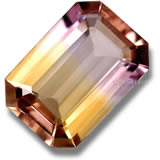
Ametrine is a color-zoned variety of macrocrystalline quartz. It is sometimes referred to as trystine and is a natural bicolor combination of amethyst and citrine. Color band combinations in ametrine can range from pale-violet to deep-purple and from pale-yellow to gold-brown. Ametrine's color split is rather abrupt and is not a smooth blend of colors. Both the violet and yellow colors found in ametrine are from traces of iron. The only difference between amethyst, citrine and ametrine is the level of oxidized iron impurities in the visible color-zone bands. All three gemstones obtain their color from iron and all three varieties have a silicon dioxide chemical composition.
There are very few naturally occurring yellow gemstones, including diamond, sapphire, tourmaline and chrysoberyl. However, most tend to occur with more greenish tones. Beryl and topaz are known to occur with golden color. Golden topaz is known as 'imperial topaz' and golden beryl is known as 'heliodor.' Although amethyst is very abundant, natural citrine is considerably rare and since citrine is rare, deposits of natural ametrine are very limited. The most desirable ametrine stones are those with an even 50/50 split of color.
Ametrine comes in bands of yellow and purple. It is easily identified by its unique bicoloring. Since it has a limited color range, it can easily be distinguished from other bicolored stones. Ametrine typically exhibits an abrupt color transition from purple to yellow, lacking any smooth color band transitions. Ametrine colors typically only reach a medium level of saturation of color, which means that most ametrine specimens are not very vivid or intense. Some synthetic or lab-grown ametrine can have extremely bright, vivid and intense colors and since this is not normal for ametrine, the authenticity of such stones should be questioned. In addition, ametrine is a variety of quartz, so it can be easily scratched by harder materials, such as sapphire and spinel. Simple scratch tests can distinguish ametrine quartz from other gemstone types.
The Anahi Mine, located in Bolivia is the world's largest source for precious ametrine. The mine became famous in the 17th century when a Spanish conquistador received an ametrine stone as a gift. He had received the gift when he married a princess from the Ayoreos tribe by the name of Anahi from Bolivia. Ametrine was introduced to the rest of Europe when the conquistador presented the stone to the Spanish queen. Currently, the mine is operated by Minerales y Metales del Oriente. Although this source has been known to Bolivian natives for hundred of years, it has only been worked at a commercial level since the 1980s. There are also other ametrine deposits in Brazil (Rio Grande de Sul).
Buying Ametrine and Determining its Gemstone Value Back to Top
Ametrine Color
Ametrine comes in bands of yellow and purple. Both colors will typically only reach a medium level of saturation, so ametrine is not usually very vivid or intense. Some synthetic ametrine stones may appear too vivid, bright and intense. Ametrine typically exhibits an abrupt color transition from purple to yellow. Stones with 50/50 color splits are considered the most desirable.
Ametrine Clarity and Luster
Ametrine stones, like most other clear quartz varieties, are typically eye-clean and transparent. When cut and polished, they have a vitreous luster. Since ametrine is usually found with good clarity, there is little reason to buy ametrine that is not eye-clean.
Ametrine Cut and Shape
Since there is not a great choice of ametrine colors, cutting-style and quality are the most important factors. Ametrine is most often faceted and is not often cut en cabochon. Ametrine is typically octagonal or rectangular cut with a 50/50 pairing of amethyst and citrine colors.
Step-cut styles are most common, followed by traditional oval and round-facet stones. Checkerboard facets may be added to the crown to increase light reflection. Portuguese cut and scissor cut ametrine is becoming very popular because the modified cutting-styles increase light reflection and brilliance. Skilled cutters may also attempt to blend the colors, resulting in a mixture of yellow, purple, and peach tones throughout the stone. Ametrine is a very popular stone for 'artistic' gem cutters because they can play with the colors and create patterns using skilled techniques, such concave-cut faceting. Ametrine carvings are also quite popular, including carved gemstone animals and other natural objects.
Ametrine Treatment
Ametrine is not typically treated or enhanced. Amethyst is sometimes lightly heated or irradiated, but these enhancement treatments are not routine. Synthetic ametrine does exist, but is not easily found because it is not in high demand. Despite ametrine being quite rare and sourced in only one locality, prices for ametrine remain very affordable.
| Chemical Formula: |
SiO2; Silicon dioxide |
| Crystal Structure: |
Trigonal, hexagonal prisms |
| Color: |
Bicolor, violet-purple, yellow-brown (white color of streak) |
| Hardness: |
7 on the Mohs scale |
| Refractive Index: |
1.54 - 1.553 |
| Density: |
2.65 |
| Cleavage: |
None |
| Transparency: |
Transparent |
| Double Refraction / Birefringence: |
0.009 |
| Luster: |
Vitreous |
| Fluorescence: |
None-Weak; bluish |
Ametrine Gemstone Varieties or other Similar Gemstones: Back to Top
As a member of the quartz group of gemstones, there are several varieties of related gemstones. The quartz group is one of the most abundant mineral groups on earth, second only to feldspar. There are many varieties and trade names, many of which are locality based. There are two main branches of quartz: Cryptocrystalline quartz and macrocrystalline quartz.
Ametrine is a macrocrystalline quartz, along with amethyst, citrine and more. There are many similar stones by way of composition, and even by color; such as bicolor tourmaline and bicolor sapphire, which can be mistaken for ametrine.
Most Popular Related Gemstones and Trade Names:
Amethyst, citrine, rose quartz, chalcedony, agate, rutile quartz, star quartz, cat's eye quartz, golden quartz, carnelian, colorless quartz and chrysoprase are the most popular related quartz varieties.
Lesser Known Related Gemstones and Trade Names:
Aventurine, rock crystal quartz, sardonyx, onyx, mystic quartz, strawberry quartz, blue quartz, hawk's eye, prasiolite, bloodstone and gem silica are lesser-known quartz varieties.
Ametrine Gemstone Mythology, Metaphysical and Alternative Crystal Healing Powers Back to Top
Since ametrine is the bicolor union of both amethyst and citrine, ametrine combines the powers of both. Therefore ametrine can be the birthstone for those born in February and November. Ametrine is a planetary stone for both Uranus and Neptune, and it can represent the astrological signs of both Pisces and Cancer.
Amethyst's name originates from ancient Greek mythology and the Greek word 'amethystos' means 'not drunken'. Amethyst was often worn to protect against intoxication and it acts as a symbol for sobriety. Citrine's name originates from France and was named after 'citron' which means 'lemon'. Today, citrine is known as the 'merchant's stone' and it is thought to bring success and prosperity for merchants. Citrine was also used as protection against poisonous snake venom and evil thoughts.
Throughout the Middle Ages and times of antiquity, people believed that the cosmos was reflected in gemstones. The esoteric movement revived these ancient beliefs and many gemstone and crystal collectors buy colored stones primarily for astrological healing powers. The healing powers of gemstones have been used for centuries by healers, shamans and medicine men all over the world. Whether it's based on fact or simply a result of the placebo effect, people believe that crystals work. To achieve the most benefit from your crystal, wear the stone in contact with the skin, especially the targeted area. Ametrine is said to be of help for headaches, pancreatic disorders, backache and alcoholism.
|
Disclaimer: Metaphysical and Alternative Crystal Healing Powers and Properties are not to be taken as confirmed advice. Should you have any medical conditions, please see a licensed practitioner. This information is not to replace the advice of your doctor. GemSelect does not guarantee any claims or statements made and cannot be held liable under any circumstances. |
Bicolor ametrine gemstones are ideal for any gemstone jewelry, including daily-wear ametrine rings -- why? Because they are both durable and hard. Ametrine gems are best used in open settings because they have excellent transparency. Closed settings will not allow light to properly pass through, making the stone appear dark. Ametrine makes beautiful pendants, necklaces, brooches and rings. Some ametrines are sought after for jewelry because they are uniquely bicolored. Ametrine is very popular due to a wide variety of sizes, shapes and cutting-styles available. Bicolor ametrine is the most popular two-toned gemstone on the market today, followed by bicolor tourmaline.
Note: Buy colored gemstones by size and not by carat weight. Colored stones vary in size-to-weight ratio. Some stones are larger and others are smaller than diamonds by weight in comparison.
Ametrine Gemstone and Jewelry Care and Cleaning Back to Top
 Ametrine is very durable. It can easily be cleaned with a mild soap and warm water. Wipe down ametrine using a soft cloth or toothbrush. Although ametrine is relatively hard and quite durable, there are other gem types capable of scratching ametrine. Take caution by not wearing or storing other gems near ametrine, especially when engaging in physical activities. As with almost all colored stones, harsh chemicals are not recommended. Avoid overexposure to extreme heat, because heat can cause permanent damage to ametrine color. Ametrine can be stored wrapped in a soft cloth or inside a fabric-lined box. Ametrine should be stored separately from other gems, regardless of whether they are harder or softer. Ametrine is very durable. It can easily be cleaned with a mild soap and warm water. Wipe down ametrine using a soft cloth or toothbrush. Although ametrine is relatively hard and quite durable, there are other gem types capable of scratching ametrine. Take caution by not wearing or storing other gems near ametrine, especially when engaging in physical activities. As with almost all colored stones, harsh chemicals are not recommended. Avoid overexposure to extreme heat, because heat can cause permanent damage to ametrine color. Ametrine can be stored wrapped in a soft cloth or inside a fabric-lined box. Ametrine should be stored separately from other gems, regardless of whether they are harder or softer.
|





 Free Report
Included
Free Report
Included
 Worldwide
Shipping
Worldwide
Shipping
 30 Day
Returns
30 Day
Returns