GemSelect Newsletter - February 2007In our newsletter this month:
The Future of Gemstones Back to Top
Gemstones, like oil, are not a renewable resource. At some time in the future, virtually all the world's accessible gem-quality material will have been mined, and gem dealers will be trading in second hand or synthetic gems. That's certainly not a happy thought. But how quickly are the world's gemstone resources being depleted? In the developed world where more sophisticated technology is available, gemstone production is definitely declining. In the USA, for example, the production of natural gemstones fell 25% from 2000 to 2004. To a large degree, this is the result of the high cost of mining the remaining material. This has happened in Australia as well, where many of the biggest sapphire mines have shut down because of the high cost of mining there. In the developing world, many famous mining regions have been almost entirely worked out. In our October 2006 newsletter, we told the story of ruby and sapphire mining in our home province of Chanthaburi, Thailand. These days there is only one small functioning mine left in the province, though many dealers here speculate that large sapphire deposits remain undiscovered in the military buffer zone along the border with Cambodia. Many of the world's colored gemstone mines are in troubled places - Burma, Pakistan, Kenya, Afghanistan, Columbia - and this affects the rate at which supplies are depleted. In addition, in the developing world most mining is still "artisanal". In Africa, the vast majority of colored gemstone mining is done by independent, small-scale miners, working in remote locations. Gem mining in Southeast Asia continues to use primitive methods which cannot be scaled up when demand increases. In any case, most deposits are too small to exploit economically with heavy equipment. In Sri Lanka, there are more than 5,000 registered colored gemstone mining locations on the island. The majority of these pits measure no more than three by three meters, and go down to a maximum depth of 25 meters. Colored gemstone mining is so labor intensive that over 500,000 people in Madagascar are estimated to be involved in the gemstone sector, despite the fact that Madagascar became an important gemstone source only in the 1990s. While most colored gemstone mining worldwide is highly distributed and small scale, a notable exception is in South America. Amethyst, citrine, and ametrine are produced at the Anah Mine, which is located in Eastern Bolivia in the province of Santa Cruz. This mine is known for the volume and uniform quality of its gemstones and is the only known deposit of ametrine. In 2005, the mine produced a total of 11 million cut stones in a variety of grades and sizes. This included six million carats of amethyst, three million carats of ametrine, and two million carats of citrine. But this is not sustainable. The output at the mine has decreased in the last year, and dealers are reporting a shortage of high quality amethyst rough, as well as ametrine. In our own business we see many signs of declining production - smaller gemstones, lower quality, more treated stones and higher prices. We have to work harder to find the gems we want at the prices we are willing to pay. One only has to look at the skyrocketing prices and dwindling supply of a gemstone like tanzanite to get a sense of how scarce many gemstones may become in the future. In 10 years, we may well look back at today and marvel at the abundance of fine material at affordable prices. New in Gems Back to Top
We have been busy rebuilding our stock after a very busy holiday season. Our buyers have been busy finding the best value gems for our customers, and we are adding new gems to our website every day. Here are the latest. Click on the gem names to view the latest samples. Watermelon tourmaline from Nigeria: Some very lovely pieces of this distinctive tourmaline in the 1.5 to 3.5 carat range. Excellent color and clarity at a very attractive price. Peridot from Burma: In the past we've had peridot from Pakistan, China and, most recently, Vietnam. But we think this Burmese peridot is as nice as any we've seen, with a bright apple green coloration and wonderful clarity. If you love peridot, these are some special pieces. However, the stock is very limited. London Blue Topaz from Brazil: We've just bought a new lot of blue topaz in the most coveted color, the deep blue known as London blue. Spessartite Garnet Cabochons from Namibia: Every once in a while we find something interesting that we've never stocked before. Here's an example; cabochon cut mandarin spessartite. These are lovely pieces, beautifully polished, in a range of sizes and shapes, with a few pieces weighing over 20 carats. Collectors take note! Lemon Quartz from Brazil: We've just acquired a range of sparkling lemon quartz gems, mainly in ovals and octagons. These are large pieces in the 20 to 30 carat range, with a few pieces weighing over 50 carats. Prehnite Cabochons from South Africa: Prehnite has been very popular recently with our customers and we think these new cabochons are the nicest prehnite we've bought in the last year. We think you'll agree. Rhodolite Garnet from Zimbabwe: We've just bought some lovely red Zimbabwean rhodolite, in round and octagon shapes, in the 1.5 to 2.5 carat range. Chrysoberyl from Pakistan: We have just purchased a small lot of very nice Pakistani chrysoberyl. If you're not familiar with this brilliant gemstone, it's worth checking out - chrysoberyl has a hardness of 8.5, almost as hard as ruby and sapphire. Smoky Quartz from Brazil: We've acquired some nice pieces of Brazilian smoky quartz, mainly in the 10 to 20 carat range. These are very clean pieces, in a lovely smoky brown, in a variety of shapes and cuts. These make wonderful pendants. Golden Diamond Lots from India: We've just added some lots of dazzling golden diamonds from India. We have several sizes, in lots of 8 or 15, with total carat weight of each lot in the .75 to 1.2 carat range. Blue Green Apatite from Madagascar: We've bought a number of pieces of apatite with the strong Paraiba-like blue green that has become so popular. These are good-sized ovals, mainly between 2.5 and 3.25 carats. They have some very slight inclusions but represent very good value at the price. Staff Selections Back to Top
Beginning this month, our staff will select some of their favorite gemstones from our inventory. Click on the photos to go to the product page for the item. 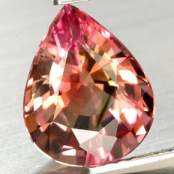
2.82ct VVS Watermelon Tourmaline
We were recently cutting some pink tourmaline rough and discovered this fascinating piece. It has a well-defined green ring in the center and an intense pink coloration at the tip. It's a good example of the special one-of-a-kind gems we discover when we buy large lots of rough stone. Usually gems of this caliber are only offered privately to collectors. 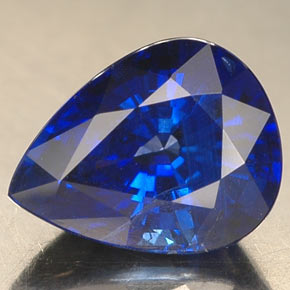
2.3ct VS Cornflower Blue Sapphire
We think this stone is a fine example of Sri Lankan cornflower blue sapphire at its best. The color is very pure and intense, neither too dark nor too light, and is very consistent throughout the stone. This piece was cut in Thailand and has a wonderful sparkle. Fine blue sapphires over 2 carats are becoming increasingly rare. 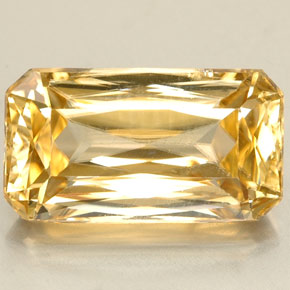
4.85ct VVS-VS Golden Zircon
This gem is an excellent example of top grade unheated zircon. Mined in Northern Cambodia near the Vietnamese border and cut in Thailand, this stone displays the brilliance and fire for which zircon is justly famed. Most natural zircon is brown, and the well-known blue zircon is produced by heat treatment. The yellow or golden zircon is fairly rare, and was once known by the name hyacinth. Gemstones Worth Knowing Back to Top
Each month we focus on one of the lesser known gemstones. This month's featured stone is prehnite. 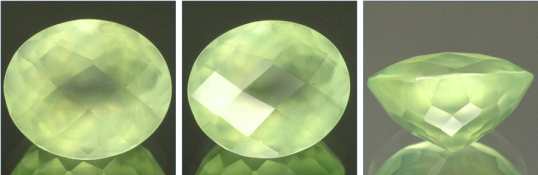
Prehnite Gemstone
Prehnite was once a very obscure and rare gemstone. But new deposits have made this very interesting mineral more widely available. Prehnite is a form of calcium aluminum silicate with a vitreous to pearly luster. It has a hardness rating of 6 to 6.5. It was first discovered in South Africa by Colonel Hendrik Von Prehn, an early Dutch governor of the Cape of Good Hope Colony. An interesting bit of gem trivia is that prehnite was actually the first mineral to be named after a person. Prehnite is typically found in yellow-green or brown-yellow, and though it is translucent, it is cut in many ways - faceted, en cabochon and carved. Click on the link to see more prehnite samples. Customer Questions Back to Top
Every month we answer questions of general interest from our customers. Please feel free to send your questions or suggestions to our support team at help@gemselect.com! Question
I notice you have a number of gemstones in concave cut. Could you explain what that is and how it is produced? Thanks so much! AL, Australia.
Answer
Traditional gem facets are flat or two-dimensional. Concave cutting creates facets that are curved or three-dimensional. These curved facets refract more of the ambient light and return it to the eye as brilliance. Concave cutting is a recent innovation that became known in the early 1990s. It requires considerable expertise and results in higher weight loss to the rough stone, since more material must be cut away to create the curved facets.
Question
What is "Portuguese cut"? I can't find a definition for it on the internet. MR, USA.
Answer
The Portuguese cut refers to a particular type of faceting where the gem is cut with two rows of rhomboidal and three rows of triangular facets above and below the girdle. (The girdle is the line that divides the top or crown of the stone from the bottom or pavilion). The Portuguese cut thus has an extra row of facets on the crown, and this style enhances the brilliance of the gem. The Portuguese cut is one of the most popular fancy cuts and you'll find many varieties of gems cut in this style. Please click the link to see some Portuguese cut gems. Notice how the Portuguese-cut stone has a smaller table due to the extra row of facets on the crown.
Keep up with our new arrivals before they hit the newsletter by joining our thousands of fans and followers on our social networking pages. We love interacting with our customers - you can visit us on Tumblr, LinkedIn, Twitter, Facebook or Pinterest! To ensure you can receive our emails, please be sure to add help@gemselect.com to your list of safe contacts, or you add us into your email address book! Please feel free to contact us with any questions, comments and queries! We respond to each and every email we receive. Happy Gem Hunting! This Page in Other Languages
About Us
Overall Rating -> 10 I have used gm select a while ago and was always pleased with the products Posted By Jaytee in November, 2023 Source: Bizrate Overall Rating -> 10 Hello: You do have good website. Vast majority of folks would buy the Gems for its spiritual, physical / energy level, emotional level positive aspects. You have only very brief mention of this aspect of each Gem ..may be you can add little bit more about ways to leverage the beneificial effect of each gems i.e. some practical tips.ThanksRupen Patel Posted By EarthDeep in February, 2024 Source: Bizrate Overall Rating -> 10 Great selection, I love your site! Great product visibility, information, etc. Posted By John in February, 2024 Source: Bizrate Overall Rating -> 10 The website is user friendly, has excellent selection. I've always found what I was looking for with Gem Select. When others don't have it they do. And most important, they have a way for you to pay without using PayPal. I cannot use PayPal they closed my account because of no cell phone. Posted By NJD in September, 2023 Source: Bizrate Overall Rating -> 10 I have started a small gem brokerage. I find stones to meet clients needs. Gemselect has helped me find what people what. Posted By Pirates Bounty in April, 2024 Source: Bizrate Overall Rating -> 10 Trustworthy site. I've had several good experiences with company. Products always have met my expectations. Thank you. Posted By Ray in February, 2024 Source: Bizrate Overall Rating -> 10 Love the variety of stones, sizes and the prices Posted By Dorita in March, 2024 Source: Bizrate Related Articles Sapphire Info Sapphire Gemstone: What is Sapphire? Sapphire Color and more Apatite Info Apatite Gemstone Information - An obscure gem in striking colors Aquamarine Info Aquamarine Information - Get the facts, figures and stories behind... Emerald Info Emerald Information - Vivid green gemstones of unequaled quality Fire Opal Info Fire Opal Gemstone - A Mexican sunset captured in a gem Iolite Info Iolite Gemstone Information - Facts & Benefits Orthoclase Info Orthoclase Gemstone Information: Unveil Its Natural Beauty Rhodolite Garnet Info Rhodolite Garnet Information - An elegant rose among thorns Ruby-Zoisite Info Ruby-Zoisite Information - A unique gemstone mixture Spessartite Garnet Info Spessartite Garnet: The Best Orange Garnet, A Detailed Guide Sphene Info Sphene Gemstone Information - GemSelect Spinel Info Spinel Gemstone Information - An often overlooked Beauty Tanzanite Info Tanzanite Information - Africa's wonder risen from the ashes Topaz Info Topaz Gemstone Information – Take a look beyond the blue Zircon Info Zircon Information - A gemstone as old as the earth itself Mystic Topaz Info Mystic Topaz Information - A kaleidoscope of colors Star Ruby Info Star Ruby Gemstone Information - GemSelect Birthstones by Month Birthstones by Month, Every Birthstone, Zodiac & Anniversary Caring for Gemstones Gemstone Care - Gemstone Information - GemSelect Gemstone Hardness Explained Gemstone Hardness | Mohs Scale with Images and Charts Precious and Semi-Precious Gemstone Glossary Gemstone & Mineral Glossary - Gemstone Information - GemSelect Medicinal Gemstones Medicinal Gemstone Information - GemSelect Gemstone Treatments All About Gemstone Treatments - Information - GemSelect Fracture Filled Fracture Filled Treatment - Gemstone Information - GemSelect Gem Market Chanthaburi International Gemstone Market in Chanthaburi, Thailand: Shopping f... Gemstone Prices Gemstone Prices - A review of what influences the amount you pay Loose Gemstones from Mine to Market Loose Gemstones From Mine to Market - Gems and Jewelry Information... Precious Stones Precious & Semi-Precious Gemstone History, Legends & Myths Rare Tourmaline Rare Tourmaline Gemstones - Unique and distinctive varieties The Secret of Spinel The Secret of Spinel Gemstones Moonstone Gems Moonstone Gemstones - So magical they seem to glow from within Sphene Brilliance Sphene Brilliance Buying Aquamarine Buying Aquamarine - What you should know before you buy |
| STAY IN TOUCH | NEWSLETTER |
| *You're signing up to receive GemSelect promotional email. |


Copyright © 2005-2024 GemSelect.com all rights reserved.
Reproduction (text or graphics) without the express written consent of GemSelect.com (SETT Company Ltd.) is strictly prohibited.
173


