Precious and Semi Precious Gemstones: Myth and Reality
The idea that some gemstones are precious and others are only semi-precious is familiar to every buyer of colored stones. Precious stones - diamond, ruby, sapphire and emerald - traditionally command high prices due to their extraordinary color or brilliance and extreme rarity.
While the precious stones are deservedly famous, the conventional distinction between precious and semi-precious gems is laden with myth and misconceptions. Let's try to sort out some of the myths from the reality.
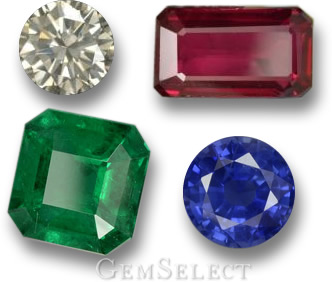
The Traditional Four Precious Gems - Diamond, Ruby, Emerald and Sapphire
A prevalent misunderstanding is that the categorization of gemstones into precious and semi-precious categories has deep historical roots spanning centuries. However, this classification is a relatively modern concept, originating in the nineteenth century. The term "semi-precious," denoting stones of lesser commercial value compared to precious gems, was first recorded in 1858.
Another misconception is that the list of four precious gems has a long history. In fact the traditional list of precious gemstones is rather longer and includes some surprising members. Pearl was considered to be precious; so was opal. One of the most traditional precious stones with a history going back to ancient Greece is amethyst. Amethyst was reclassified as semi-precious after large deposits were found in Brazil and Uruguay in the first half of the nineteenth century. The introduction of the term semi-precious into the English lexicon corresponds with the new amethyst discoveries.
Diamond, among all precious stones, holds a unique place in the realm of myths. Surprisingly, these myths are of modern origin rather than ancient lore. Historically, colored gemstones like ruby and sapphire were prized more highly than diamond, as diamond was not considered particularly rare. However, the landscape shifted significantly in the twentieth century. The discovery of vast diamond deposits in South Africa led to an even greater abundance of gem-quality diamonds. Simultaneously, the perceived value of diamonds soared, placing them at the forefront of the public's perception of precious stones. This raises the question: Shouldn't precious gems be valued primarily for their rarity?
 |
In the 19th century, the collective worldwide production of diamond only amounted to a few pounds per year. After the discovery of the huge South African diamond mines in 1870, diamonds were being dug out of the ground literally by the ton. There was such a glut of supply and so little demand that the British financiers of the South African mines were in danger of losing their investment. Their solution was to create the powerful De Beers cartel that to this day controls worldwide diamond production and supply. Quality diamonds are actually not scarce at all. But De Beers controls how much supply comes on the market and that keeps prices high.
The De Beers consortium also mounted a concerted advertising campaign that spanned decades, in order to create an association of diamonds with love, courtship and marriage, under the now familiar slogan "Diamonds are Forever". The diamond engagement ring, once unknown in most parts of the world (including Europe), is now considered an essential part of the ritual of marriage. It is hard to avoid the conclusion that diamond's special position as a precious stone is largely due to monopoly economics and social engineering.
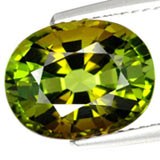 |
These days a number of rare semi-precious stones such as alexandrite, demantoid garnet, tsavorite garnet and tanzanite can be just as expensive as ruby and sapphire. Very fine tourmaline, spinel and large aquamarine gems also command very high prices. It is fair to say that we have now reached the point where the distinction between precious and semi-precious gemstones has become meaningless. The US Federal Trade Commission periodically considers banning the use of the terms altogether to reduce consumer confusion. Indeed, the American Gem Trade Association (AGTA) has already added the following text to their Code of Ethics; "Members should avoid the use of the term 'semi-precious' in describing gemstones". |





 Free Report
Included
Free Report
Included
 Worldwide
Shipping
Worldwide
Shipping
 30 Day
Returns
30 Day
Returns