Homepage
We Ship Worldwide!
Shopping Cart
Gemstone Articles » Hardness Durability
Gemstone Hardness and Durability

Nearly everyone buying gemstones knows that some gems are harder than others. Most buyers know that hardness is measured on something called the Mohs scale, which ranks gemstones on a scale of 1 to 10. But many people don't know what the Mohs scale really means. Even more people mistakenly believe that hardness is the key to gemstone durability. This article will try to clear up some confusions about gemstone hardness.

Friedrich MohsMohs' scale of mineral hardness was created by the German mineralogist Friedrich Mohs in 1822 to measure the relative hardness or scratch resistance of various minerals. He based it on ten readily available minerals. As it is an ordinal scale, you have to compare two minerals to decide which is harder.

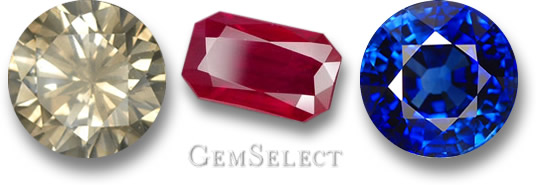
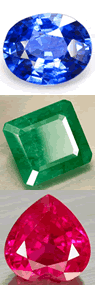
Loose Natural Gemstones from GemSelect Natural Burma Ruby at GemSelect Buy Emerald from GemSelect Natural Blue Sapphire from GemSelect On the Mohs scale, diamond is rated 10, meaning that it can scratch all the other gems on the list: corundum (ruby and sapphire) (9), topaz (8), quartz (7), orthcoclase (6), apatite (5), fluorite (4), calcite (3), gypsum (2) and talc (1). Topaz can scratch all the gems with a lower rating, but can be scratched by diamond and corundum.

But the Mohs scale is only relative. It doesn't tell us how much harder diamond is than corundum or topaz or quartz. In fact the scale is not linear at all. Diamond is about 4 times harder than corundum, but corundum is only 2 times harder than topaz. Topaz, in turn, is twice as hard as quartz, but quartz is only about 25% harder than apatite.

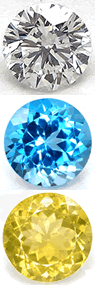
However, the durability of a gemstone should not be judged solely on the basis of hardness. There is more to durability than just hardness. For example, diamond has perfect cleavage, meaning it can be split with a single blow. The same is true for topaz, another very hard gem. Loose Natural Gemstones from GemSelect Quartz from GemSelect Natural Topaz at GemSelect Diamonds from GemSelect Corundum (ruby and sapphire), while not as hard as diamond, has no cleavage, a property it shares with spinel and quartz. Some other gems which are quite hard, such as emerald, typically have internal fractures which are filled by oiling, and thus require special care. Some gems which are not particularly hard, such as jade (6.5 to 7.0 on the Mohs scale) are extremely tough because of their particular crystal structure.

Another measure of durability is stability. Stability is the tendency of a material to be altered by exposure to light, heat or chemicals. Many gemstones, such as aquamarine and peridot, should not be exposed to acids. Some gems, such as kunzite, hiddenite and yellow-brown topaz, are sensitive to light and can fade if exposed to strong light for long periods. Gems that contain water, such as the opals, can become dehydrated and crack.

You can see the complete Mohs chart, including ratings for about 50 different gem varieties, on our Gem Hardness Information Page.

For more information on caring and cleaning different types of gems, see our Cleaning Gemstones Information Page.

First Published: January-21-2008

© 2003-2009 GemSelect.com all rights reserved.
Reproduction (text or graphics) without the express written consent of GemSelect.com (SETT Company Ltd.) is strictly prohibited.

 
Items: 0 | Total: $0.00
Pay Gemstones with Credit Card Pay Gems with PayPal Pay Gem Stones with Visa Delta Ship Gemstones with USPS Secure Payment
Ship Gemstones securely with FedEx
GO!
Agate  •  Agate Geode  •  Alexandrite  •  Almandine Garnet  •  Amazonite  •  Amber  •  Amethyst  •  Ametrine  •  Andalusite  •  Andesine Labradorite  •  Apatite  •  Aquamarine  •  Aventurine  •  Axinite  •  Azotic Topaz  •  Beryl  •  Bloodstone  •  Boulder Opal  •  Carnelian  •  Cat's Eye Apatite  •  Cat's Eye Diaspore  •  Cat's Eye Scapolite  •  Chalcedony  •  Charoite  •  Chrome Diopside  •  Chrome Tourmaline  •  Chrysoberyl  •  Chrysoberyl Cat's Eye  •  Chrysocolla  •  Chrysoprase  •  Citrine  •  Clinohumite  •  Color-Change Diaspore  •  Color-Change Garnet  •  Color-Change Sapphire  •  Coral  •  Demantoid Garnet  •  Dendritic Agate  •  Emerald  •  Fire Agate  •  Fire Opal  •  Fluorite  •  Fossil Coral  •  Gaspeite  •  Grossularite Garnet  •  Hematite  •  Hemimorphite  •  Hessonite Garnet  •  Idocrase  •  Iolite  •  Jadeite  •  Jasper  •  Kunzite  •  Kyanite  •  Labradorite  •  Lapis Lazuli  •  Larimar  •  Lepidolite  •  Malachite  •  Maw-Sit-Sit  •  Moonstone  •  Morganite  •  Mystic Quartz  •  Mystic Topaz  •  Nuumite  •  Obsidian  •  Onyx  •  Opal  •  Opal Doublet  •  Orthoclase  •  Paraiba Tourmaline  •  Peanut Wood  •  Pearl  •  Peridot  •  Prehnite  •  Pyrope Garnet  •  Quartz  •  Quartz Cat's Eye  •  Rainbow Moonstone  •  Rhodochrosite  •  Rhodolite Garnet  •  Rose Quartz  •  Rubellite Tourmaline  •  Ruby  •  Ruby-Zoisite  •  Rutile Quartz  •  Sapphire  •  Scapolite  •  Seraphinite  •  Sillimanite Cat's Eye  •  Smoky Quartz  •  Snowflake Obsidian  •  Sodalite  •  Spessartite Garnet  •  Sphalerite  •  Sphene  •  Spinel  •  Spodumene  •  Star Diopside  •  Star Garnet  •  Star Moonstone  •  Star Rose Quartz  •  Star Ruby  •  Star Sapphire  •  Star Sunstone  •  Strawberry Quartz  •  Sugilite  •  Sunstone  •  Tanzanite  •  Tashmarine Diopside  •  Tiger's Eye  •  Tiger's Eye Matrix  •  Topaz  •  Tourmaline  •  Tsavorite Garnet  •  Turquoise  •  Verdite  •  Zircon
©2005-2009 SETT Company Ltd. All Rights Reserved. Use of this site is subject to certain terms of use
which constitute a legal agreement between you and SETT Company Ltd.
FULL GEM LIST
441