GemSelect Newsletter - October 2006
Chanthaburi: Colored Gemstone Capital of the World Back to Top
It never ceases to amaze us that our home of Chanthaburi, a small and rather obscure town on the eastern seaboard of Thailand, became the colored gemstone capital of the world. Therefore, we think you'd be interested in the story of how that came to be. 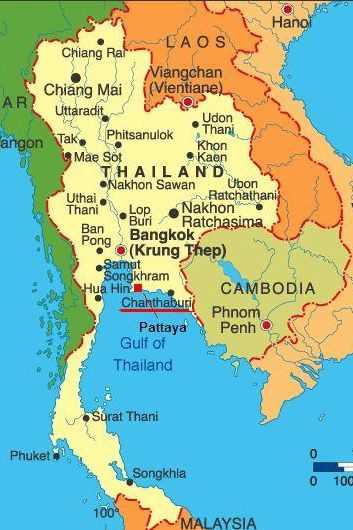
Map of Thailand
Ruby mining in the border region between Thailand and Cambodia goes back centuries, with historical references found as early as the 15th century. But the Thai and Cambodian rubies had long been overshadowed by the wondrous pigeon's blood rubies from the Mogok region of Burma. However, events in the 1960s changed the world market for rubies. When Ne Win's military government took power in Burma, he took control of the famed Mogok ruby mines, and the world ruby market was forced to look elsewhere. They looked to Thailand, because Thailand had the largest supply of facetable material. The Thai and Cambodian rubies had one shortcoming - an excess of iron that rendered them a dark garnet-like red. The clever gem cutters in Chanthaburi solved the problem by perfecting age-old techniques of heat treatment to improve the color of the local rubies, and the gem business in Chanthaburi province had its first big boom. As events turned out, this technical advance was to be the basis for Chanthaburi's long term success. Given the tremendous world demand for ruby, modern equipment was brought to the Chanthaburi mines, and by the 1980s the mines were mostly worked out. But a new era in the Chanthaburi gem business was already beginning, as it was discovered that the Chanthaburi gem labs could improve stones from foreign sources as well. The first to benefit were the dark inky Australian sapphires, which had never competed successfully in the world market. The Chanthaburi labs were able to use heat to reduce the excess silk (rutile) in these stones and thus improve the color, and the Australian sapphire went on to have major market success. The Chanthaburi gemstone industry now realized that the future was in foreign rather than local gems, and that Thai expertise in treating and cutting stones could make Chanthaburi a focal point for the international colored gem trade. The next major success for Chanthaburi came in the 1970s with the "geuda" sapphire from Sri Lanka. The geuda sapphire was pale and milky as a result of excess titanium. But the Chanthaburi burners were able to find the right heating techniques to turn these sapphires an outstanding cornflower blue. These sapphires are now highly regarded in the world market, and the bulk of the supply continues to be heated and cut in Chanthaburi. By the 1980s, Chanthaburi's position as the leading center for processing and trading colored stones was already secure. But events in the early 1990s made Chanthaburi the undisputed center for colored gems. In 1992, a major ruby deposit was discovered in the Mong Hsu area of Burma, about half way between Mogok and the the Thai town of Mae Sai. This find was hailed as the most significant discovery of Burmese ruby for thousands of years. But these Mong Hsu rubies were not the same quality as the famed Mogok rubies - they had a tendency to appear slightly bluish or purplish, which was not as attractive. After some months of experimentation, the Chanthaburi labs found a solution that unlocked the full potential of these new Burmese rubies and satisfied the world demand for rubies with the distinctive Burmese look. That treatment is now standard for Mong Hsu rubies and most of the world's supply passes through Chanthaburi. Today Chanthaburi continues to process and trade gemstones from new sources, especially Africa and Madagascar. Virtually every variety of colored gem can be found here, and rough stone is brought from every mining location in the world to be cut and traded in Chanthaburi. What once seemed like the end of the gem business in Eastern Thailand - the depletion of the local ruby mines - turned out to be a new and much greater opportunity. Ingenuity, hard work and experience, an international outlook and, no doubt, a bit of good luck, have made the small town in Eastern Thailand the capital of the colored gemstone world. New in Gems Back to Top
Our buyers are always busy seeking out the best value gemstones for our customers. Here are some of the excellent buys we've made in the last week. Click on the gem names to view the latest samples. Blue Zircon from Cambodia: Blue has long been the most coveted color of zircon but the supply is limited. We've just found some fine specimens, well cut, in round, oval and trillion shapes, and weights up to about 3 carats. We also have some very nice matching pairs for earrings. If you're in the market for zircon, we think you'll be very happy with the quality of these stones. Tourmaline from Nigeria: Tourmaline is our second most popular gem (second to sapphire), and it's easy to see why. No other gem comes in such a rainbow of colors, and tourmaline's excellent clarity and hardness make it an exceptionally good value gem. We've just made a good buy of some fine untreated Nigerian tourmaline in a range of attractive pastel shades, in rounds, ovals, pears and trillions, mainly in small sizes. Hiddenite from Afghanistan: Hiddenite is the green variety of spodumene. It's fairly rare, but popular with collectors. We just found some very fine hiddenite in the market and were able to buy a small number of pieces, in green and bluish-green, and several interesting cuts. These are clean, good sized pieces with excellent color, ranging up to 12 carats. Aquamarine from Mozambique: It is always difficult to find aquamarine in a good color, since so many of the nicest stones are rather pallid. We know many of our customers have been waiting, so here, finally, are some nice looking aquamarine gems. Enjoy. Spinel from Mogok, Burma: Burma is best known for ruby, but it is also the source of some of the finest spinel. We've just added a wonderful range of new colors to our inventory, in shades including pink, rose, purplish-pink, red, violet and silver bluish-gray. The shapes are mainly rounds and ovals. Due to its excellent hardness and high clarity, spinel has become a real customer favorite. It's also one of the few gemstones that is never treated. We now stock nearly 400 spinel gems, with weights up to 8 carats. We think it's one of the best value gemstones in the world today. Top Grade Gemstones Back to Top
Want to see the best of the best? Tired of sorting through our stock to find them? Now you can view our very best gems in one place by clicking the top grade gemstones link on our home page. Once you're on the top grade gems page you can use the drop-down menu to sort the top grade stones by color, shape, weight, size or price. This Month's Birthstone(s) Back to Top
Most months of the year are associated with a single birthstone. But a few months, like October, have more than one. The traditional birthstones for October are opal and tourmaline. If you're lucky enough to be born in October, you have the choice of two entirely different gems; indeed, two gems that are as different as two gems could be. Tourmaline is thought to inspire creativity and has been used extensively as a talisman by artists and writers. Opal has traditionally been regarded as a symbol of hope and love. If you're considering an opal for an October birthday and want something unique, have a look at our fire opal and moss opal as well. Gemstones Worth Knowing Back to Top
In a new feature this month, we focus on some of the lesser known gemstones. This month's featured stone is chrysoberyl. If you're looking for a brilliant and durable gem in the golden-yellow color range, consider chrysoberyl. It's an exceptionally hard stone at 8.5 on the Mohs scale, nearly as hard as sapphire and ruby, so it's suitable for any kind of jewelry. 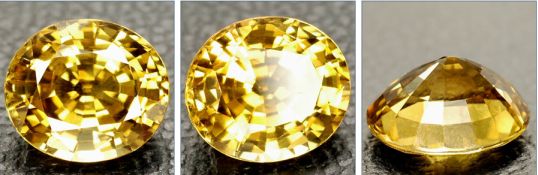
Chrysoberyl
Chrysoberyl belongs to the same family as the more expensive alexandrite. We have chrysoberyl from Pakistan, Sri Lanka and Russia, in colors including green, yellow, golden and brown, in weights up to 5 carats. These are mainly eye-clean (VS to VVS clarity) and have never been treated. For more information see our chrysoberyl information page. Finding Your Way Around Gemselect.com Back to Top
In another new feature this month, we focus on some of the tools we've developed to help you find the gems you're looking for on our website. This month we look at the search box. We have a large inventory on our website (over 1,000 sapphires alone!) and it can be a lot of work to browse through all the pages to find what you're looking for. We have a number of shortcuts that can save you some time. One easy shortcut is to use the search box that you'll see on the right side of every page: 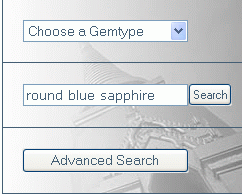
GemSelect Search Box
You can type in any combination of gem type, shape and color in the search box and we'll show you just the gems that match your search criteria. So if you wanted to find a round blue sapphire, just type "round blue sapphire" in the search box. If you want to find all the different kinds of gems available in pink, just type "pink" in the search box and we'll show you all the gems that we have in shades of pink. Or you can type "yellow octagon" to find all the octagonal yellow gems. You can also type in a country name if that's useful to your search - you can search for "Burma ruby", "Ceylon sapphire" or "India". It's easy and might help to save some time. Customer Questions Back to Top
Every month we answer questions of general interest from our customers. Please feel free to send your questions or suggestions to our support team at help@gemselect.com! Question
Do you carry gemstones that go under the name of rubellite and indicolite? I don't see them on your website. Thanks in advance, AH, USA.
Answer
These are names that are often used in the trade to refer to particular colors of tourmaline. "Rubellite" is used to refer to the deep red variety, while "indicolite" is blue tourmaline. These are really marketing terms rather than gemological terms, so we follow the standard gemology practice in referring to all the varieties as "tourmaline". And yes, we do stock those. Click here for red tourmaline, and here for blue tourmaline.
Question
We've read about the political troubles in Thailand, and we hope life returns to normal for you soon. Have these events affected your business at all? MG, Canada.
Answer
Thanks very much for your concern. We're glad to say that it's business as usual here in Chanthaburi - everyone is hard at work, the gem market is busy and we're all focused on the part of life we can control. The post and FedEx are functioning normally, and we have reliable Internet connections. We believe the spirit of democracy in Thailand is strong and that the Thai people will insist on a quick transition back to elected government.
Keep up with our new arrivals before they hit the newsletter by joining our thousands of fans and followers on our social networking pages. We love interacting with our customers - you can visit us on Tumblr, LinkedIn, Twitter, Facebook or Pinterest! To ensure you can receive our emails, please be sure to add help@gemselect.com to your list of safe contacts, or you add us into your email address book! Please feel free to contact us with any questions, comments and queries! We respond to each and every email we receive. Happy Gem Hunting! This Page in Other Languages
About Us
Overall Rating -> 10 I bought a small ring green so I may practice my jewelry making. Posted By HairyOtter in July, 2023 Source: Bizrate Overall Rating -> 10 The website is easy to navigate and has a great selection. I am an amateur silver smith casting jewelry with stones Posted By Jrplunk in April, 2024 Source: Bizrate Overall Rating -> 10 Extremely easy to use, and I am fully satisfied with the purchase process. Posted By Fl_Beachcomber in October, 2023 Source: Bizrate Overall Rating -> 10 The website is well organized and works fast forward and back. Plenty of filters. Each gem is described in detail and you receive the one pictured. Gem material info and sources available. I would like to see more specifics on sources besides country- at least region or state and in the US with Turquiose which mine. Thanks! Posted By Orchidisle in February, 2024 Source: Bizrate Overall Rating -> 10 Very pleased with shopping on this site. It's easy to navigate and information about gemstones is very good. Posted By Kate in December, 2023 Source: Bizrate Overall Rating -> 10 Convenient selection, arrival on time Posted By Alin in February, 2024 Source: Bizrate Related Articles Sapphire Info Sapphire Gemstone: What is Sapphire? Sapphire Color and more Apatite Info Apatite Gemstone Information - An obscure gem in striking colors Aquamarine Info Aquamarine Information - Get the facts, figures and stories behind... Emerald Info Emerald Information - Vivid green gemstones of unequaled quality Fire Opal Info Fire Opal Gemstone - A Mexican sunset captured in a gem Iolite Info Iolite Gemstone Information - Facts & Benefits Orthoclase Info Orthoclase Gemstone Information: Unveil Its Natural Beauty Rhodolite Garnet Info Rhodolite Garnet Information - An elegant rose among thorns Ruby-Zoisite Info Ruby-Zoisite Information - A unique gemstone mixture Spessartite Garnet Info Spessartite Garnet: The Best Orange Garnet, A Detailed Guide Sphene Info Sphene Gemstone Information - GemSelect Spinel Info Spinel Gemstone Information - An often overlooked Beauty Tanzanite Info Tanzanite Information - Africa's wonder risen from the ashes Topaz Info Topaz Gemstone Information – Take a look beyond the blue Zircon Info Zircon Information - A gemstone as old as the earth itself Mystic Topaz Info Mystic Topaz Information - A kaleidoscope of colors Star Ruby Info Star Ruby Gemstone Information - GemSelect Birthstones by Month Birthstones by Month, Every Birthstone, Zodiac & Anniversary Caring for Gemstones Gemstone Care - Gemstone Information - GemSelect Gemstone Hardness Explained Gemstone Hardness | Mohs Scale with Images and Charts Gemstone Clarity and Cut Clarity and Cut - Gemstone Information - GemSelect Precious and Semi-Precious Gemstone Glossary Gemstone & Mineral Glossary - Gemstone Information - GemSelect Medicinal Gemstones Medicinal Gemstone Information - GemSelect Gemstone Treatments All About Gemstone Treatments - Information - GemSelect Fracture Filled Fracture Filled Treatment - Gemstone Information - GemSelect Gem Market Chanthaburi International Gemstone Market in Chanthaburi, Thailand: Shopping f... Gemstone Prices Gemstone Prices - A review of what influences the amount you pay Loose Gemstones from Mine to Market Loose Gemstones From Mine to Market - Gems and Jewelry Information... Precious Stones Precious & Semi-Precious Gemstone History, Legends & Myths Rare Tourmaline Rare Tourmaline Gemstones - Unique and distinctive varieties The Secret of Spinel The Secret of Spinel Gemstones Gemstone Names Gemstone Names | Gem Name Origins, History, Lists and More Black Tourmaline Black Tourmaline - Stand out from the crowd Trilliant Cut Gems Trilliant Cut Gems |
| STAY IN TOUCH | NEWSLETTER |
| *You're signing up to receive GemSelect promotional email. |


Copyright © 2005-2024 GemSelect.com all rights reserved.
Reproduction (text or graphics) without the express written consent of GemSelect.com (SETT Company Ltd.) is strictly prohibited.
169


