|
Reviewed By Andreas Zabczyk
Story of the Timur Ruby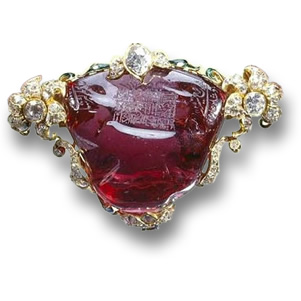
Timur Ruby
The famous Timur Ruby is in fact not a ruby; rather it is a spinel. It weighs over 352 carats and until 1851, was widely regarded as the largest known ruby in the world. It was presented to Queen Victoria by the East India Company in October 1851, and has remained amongst the collection of the British Royal Family ever since. The Timur Ruby has a long and colorful history. Timur was a Turko-Mongol ruler who was believed to have acquired the ruby when he sacked Delhi in 1398. He stayed in India for a little over a year, before returning to Samarkand with the ruby among his spoils of war. The ruby was inherited by his son, Mir Shah Rukh, and later his grandson, Mirza Ulugli Beg. During his reign, there were several wars with the Persians and after one of these, the ruby fell into the hands of Shah Abbas I of Persia, who in 1612 gave the ruby as a gift to his close friend, Jahangir, the Mughal Emperor of India. Jahangir had his name engraved on the ruby, as well as that of his father, Akbar. Legend has it that when his favorite wife rebuked him for defacing such a magnificent gem, he replied, "This jewel will more certainly hand down my name to posterity than any written history. The House of Timur may fall, but as long as there is a King, this jewel will be his". The next owner of the gemstone was Shah Jehan, who had his name inscribed on it and placed it in the Peacock Throne. Successive owners of the jewel continued to inscribe their names until Farukhsiyar, who was the last of the Delhi emperors to inscribe his name upon the gem. His successor was Nadir Shah of Iran, who attacked Delhi in 1739. He engraved the stone as follows: 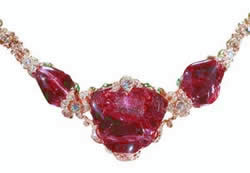
Timur Ruby Necklace
This (is) the ruby from among the 25,000 genuine jewels of the King of Kings, the Sultan Sahib Qiran [Timur], which in the year 1153 [1740 AD] from the (collection of) jewels of Hindustan reached this place [Isfahan]. The last inscription on the Timur Ruby was made by Ahmad Shah, who was the commander of Nadir Shah's army at the time of his assassination in 1747. He attempted to seize the throne, but managed only to grab a large amount of booty, which he took with him to help found the Kingdom of Afghanistan. However, the stone once again returned to India when the ruby eventually passed to his grandson Shah Suja. Expelled from his homeland, he took refuge in the Punjab, where Ranjit Singh, Lion of the Punjab, forced him to surrender the jewel along with the Koh-i-Noor Diamond. Like so many of the famous gems of the Orient, the Timur Ruby traveled to England amongst a collection of Indian jewelry taken from the Lahore Treasury in 1849 when Britain annexed the Punjab to its Empire. The jewels were displayed during the Great Exhibition at Crystal Palace in 1851, and then given to Queen Victoria. Queen Victoria was delighted by the gemstones - she particularly admired what she termed 'the wonderful rubies', and on 23 October 1851 wrote in her journal, "They are cabochons, uncut, unset, but pierced. The one is the largest in the world, therefore even more remarkable than the Koh-i-noor!" In April 1853, Garrards set four of these so-called 'rubies' in a new diamond-encrusted gold and enamel necklace 'of Oriental design', with four diamond pendants also from Lahore. At the center of the necklace came the huge rose-pink stone of 352 carats that Queen Victoria had remarked upon. Two months later, Garrards adjusted the necklace to allow this stone to be detached for use as a brooch and to alternate with the recently recut Koh-i-noor Diamond. Where is the Timur Ruby now?The Timur Ruby is believed to be housed in the collection of the British Crown Jewels. It is displayed in the Tower of London alongside other precious gemstones and royal artifacts. This Page in Other Languages
About Us
Overall Rating -> 10 Great Job today! No issues! Posted By Samlovesgems777 in August, 2023 Source: Bizrate Overall Rating -> 10 Always have good experience Posted By Ginnie in September, 2023 Source: Bizrate Overall Rating -> 10 Everthing about researching and ordering from Gemselect was easy and uncomplicated. In the past I had payment problems, but your customer rep, Thomas, helped me get everything right. I will continue using Gemselet in the future for these reasons. Posted By WildwillyfromArizona in August, 2023 Source: Bizrate Overall Rating -> 10 The website design is a bit finicky for mobile, but Im sure its most likely just a mobile issue. Amazing selection of products, great prices. Posted By Kuba in December, 2023 Source: Bizrate Overall Rating -> 8 purchased birthstones to be mounted into stud earrings as a gift for a friend's gift Posted By MI photo in May, 2023 Source: Bizrate Overall Rating -> 10 I have used this site for sseveral years now. All has been great. I started collection gems from GemSelect for years and wanted to collect at least one of most stones. I loved Safers because the mols is a 9 + and they come in every color. This is the best place to buy gems for the assortment and price. Great place to learn about gems too. Sometimes the shipping is a little on the long side. But I would give them a 9.9 out of 10 !! Posted By Steve in July, 2023 Source: Bizrate Overall Rating -> 10 Hello: You do have good website. Vast majority of folks would buy the Gems for its spiritual, physical / energy level, emotional level positive aspects. You have only very brief mention of this aspect of each Gem ..may be you can add little bit more about ways to leverage the beneificial effect of each gems i.e. some practical tips.ThanksRupen Patel Posted By EarthDeep in February, 2024 Source: Bizrate Related Articles Ruby Info Ruby Information - The gemstone of passion and seduction Tanzanite Info Tanzanite Information - Africa's wonder risen from the ashes Sources for Fine Ruby Gems Sources for Fine Ruby Gems Rubellite Rubric Rubellite Tourmaline: Vibrant Gems for Collectors Golden Triangle Sapphires Sapphires from the Golden Triangle |
| STAY IN TOUCH | NEWSLETTER |
| *You're signing up to receive GemSelect promotional email. |


Copyright © 2005-2024 GemSelect.com all rights reserved.
Reproduction (text or graphics) without the express written consent of GemSelect.com (SETT Company Ltd.) is strictly prohibited.
522


