
FREE SHIPPING
|
|
Reviewed By Andreas Zabczyk
Why are Some Gems Cut as Cabochons?A cabochon, derived from the French term "en cabochon," refers to a specific gemstone cut where the stone is shaped and polished into a smooth, typically convex form with a flat base. Cabochons, often referred to as "cabs," may be cut in any shape, though oval is by far the most common. Certain stones are almost always cut "en cabochon", including opal, turquoise, onyx, moonstone, and star sapphire. In the gemstone world you will often hear the term cabochon shortened to "cab". 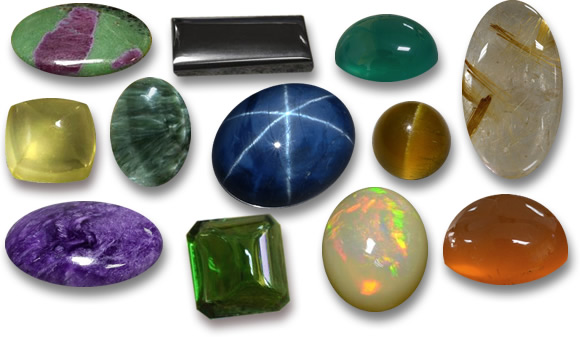 Technically, cabochons are not really "cut". Rather, they are shaped and then polished. It is thus a much simpler task to produce a cabochon than it is to cut a faceted gem with many faces. Before the art of faceting was developed, all gemstones were produced as cabochons, though some were intricately carved as well. Faceted gemstones first emerged in European jewelry towards the end of the 13th and beginning of the 14th centuries. The introduction of the horizontally turning cutting-wheel in the late 1400s enabled the creation and replication of intricate geometric faceting patterns, allowing for better control and enhancement of the internal light of the stone. The Renaissance era's fascination with geometry and light reflection spurred the advancement of a refined lapidary art. Beginning with the gem-cutting industry in Bruges during the Renaissance, and spreading to Venice, Florence, and eventually across Europe, the manipulation of light became the focal point in gem cutting. 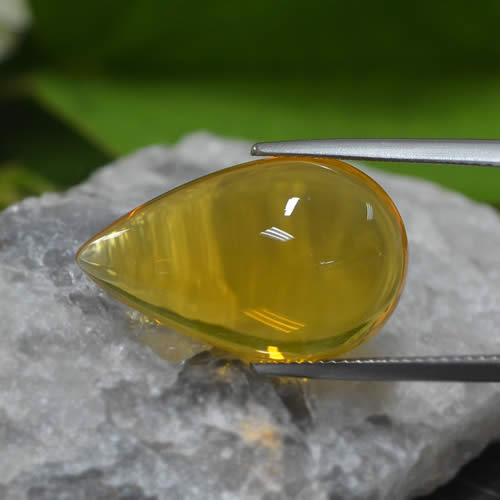 Once the technology and skill was available to facet gemstones, why were cabochons still produced? The question is an interesting one because different gems are cut as cabs for different reasons. In many cases it is because the gem has special properties that are displayed only when it is cut as a cabochon. Examples are gems that display optical phenomena such as asterism (the star effect), chatoyancy (the cat's eye effect), iridescence (e.g., opal) or adularescence (e.g., moonstone). 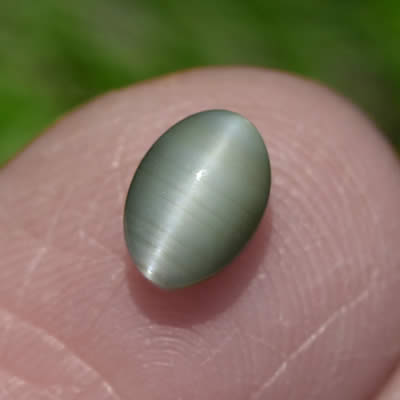 Most gems that are opaque are cut as cabochons rather than faceted. Also, lower grade material of gemstone types such as sapphire, ruby and garnet is cut as cabs. If the gem material has very good color but is not sufficiently transparent or clean to be faceted, it can still be shaped and polished into very attractive cabochons. It is also common to cut softer stones as cabs, since gems with a hardness score of less than 7 (on the Mohs scale) can easily be scratched by the quartz in dust and grit. Minute scratches show much less on a cabochon than on a faceted stone. This Page in Other Languages
About Us
Overall Rating -> 10 I particularly like information about product provided with purchase. Posted By Dick in May, 2023 Source: Bizrate Overall Rating -> 10 Easy to find the stones I was looking for. Always good quality stones Posted By Erin in June, 2023 Source: Bizrate Overall Rating -> 10 The website is easy to search, the variety of gems is excellent and the educational information is interesting and helpful! Love browsing and shopping the GemSelect website! Posted By Happiness in January, 2024 Source: Bizrate Overall Rating -> 10 the searching format was easy to find what i needed. It helped to be able to sort Lowest price to Highest because i wasnt looking to spend too much but i did want an actual stone and not imitation. Posted By PixelComposer in January, 2024 Source: Bizrate Overall Rating -> 10 Gem Select has gems at afffordable prices. Posted By George in March, 2024 Source: Bizrate Overall Rating -> 10 Website was incredibly easy and fast to use. Navigation and product outlay was simple and enjoyable to browse. Thank you and have a blessed day! Posted By Devi in October, 2023 Source: Bizrate Related Articles Fire Opal Info Fire Opal Gemstone - A Mexican sunset captured in a gem Star Ruby Info Star Ruby Gemstone Information - GemSelect Lapis Lazuli: Ancient Stone Lapis Lazuli: Gem of Ancient Times & Modern Beauty Faceted Gemstones Faceted Gemstones Obsidian Volcanic Glass Obsidian Volcanic Glass: Nature's Sharp Wonder |
| STAY IN TOUCH | NEWSLETTER |
| *You're signing up to receive GemSelect promotional email. |


Copyright © 2005-2024 GemSelect.com all rights reserved.
Reproduction (text or graphics) without the express written consent of GemSelect.com (SETT Company Ltd.) is strictly prohibited.
408


