FREE SHIPPING
|
|
Reviewed By Andreas Zabczyk
Hematite and Pyrite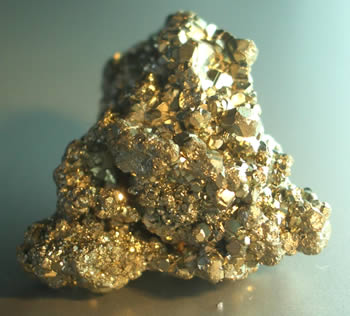
Pyrite from Peru
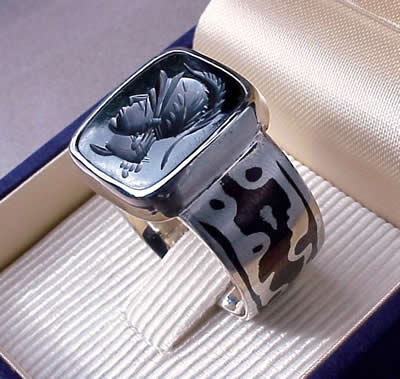
Gemologists use a set of technical terms to refer to luster or the light reflected from a gemstone's surface. These terms include adamantine (like diamond), vitreous (like glass), silky, resinous, greasy and metallic. The most common luster, typical of transparent faceted gems like sapphire, spinel, beryl, quartz and tourmaline, is vitreous. The highest or most reflective luster is known as metallic, indicating a reflective surface similar to polished metal. Gemstones with a metallic luster typically have a refractive index from about 2.6 to more than 3.0, substantially higher than even diamond, which has a refractive index of 2.4. Very few gems have a metallic luster. The best known are hematite and pyrite, two iron-based minerals that are often used for ornamental purposes. Hematite is iron oxide that gets its name from the Greek word for blood, since it is red when sliced thinly or powdered. Hematite forms in the rhombohedral crystal system, which is the same crystal structure as sapphire and ruby. Hematite is always opaque and is typically a blackish grey. It is commonly cut as cabochons, faceted or sold in the form of engravings, which are particularly popular. Hematite was a traditional material for signet rings. When highly polished it can sometimes look like silver.
Hematite deposits are found in the UK (Cumberland), Bangladesh, Brazil, China, New Zealand, the Czech Republic and the USA (Minnesota). Hematite has also been found on the planet Mars by NASA spacecraft. Since hematite is usually found in aqueous environments on Earth, it has led to speculation that there was once water on Mars. Pyrite (also known as iron pyrite) is iron sulphide, which is usually brass-yellow or gray-yellow, earning it the nickname of "fool's gold". Its name comes from the Greek for fire, since it produces sparks when struck by steel or flint. Historically, pyrite was widely used in jewelry, but it is not so often seen today. Pyrite can be found in the form of carvings, as side stones in ring settings, and sometimes in pendants in a disk-like form with a distinctive radial pattern. Pyrite has a reasonably good level of hardness (6 to 6.5 on the Mohs scale) but is quite brittle. Pyrite deposits are found in Peru, Bolivia, Mexico, Sweden, Romania and the USA (Colorado).
About Us
Overall Rating -> 10 The site is very easy to use and I will continue to shop here. The quality is superb Posted By Genia in January, 2024 Source: Bizrate Overall Rating -> 10 Love Gem select. great gems for the price. Can't beet them Posted By Apps in September, 2023 Source: Bizrate Overall Rating -> 10 My first order. I am anxious to see if what I ordered is what I receive. Posted By KRJ in July, 2023 Source: Bizrate Overall Rating -> 9 making my own jewelry for my birth stone Posted By LoveGeo in July, 2023 Source: Bizrate Overall Rating -> 9 It was simple and clear to understand. Posted By Thora007 in December, 2023 Source: Bizrate Overall Rating -> 9 My first purchase went well. I will purchase more gems in the future. Posted By NoHalalAl in March, 2024 Source: Bizrate Related Articles Sapphire Info Sapphire Gemstone: What is Sapphire? Sapphire Color and more Precious Beryl Info Precious Beryl Info - There is more to precious beryl than emeralds Emerald Info Emerald Information - Vivid green gemstones of unequaled quality Spessartite Garnet Info Spessartite Garnet: The Best Orange Garnet, A Detailed Guide Zircon Info Zircon Information - A gemstone as old as the earth itself Birthstones by Month Birthstones by Month, Every Birthstone, Zodiac & Anniversary Carat Weight Gemstone Carat Weight - Gemstone Information - GemSelect Caring for Gemstones Gemstone Care - Gemstone Information - GemSelect Color Basics Gemstone Color - A Quick Guide to Colors Gemstone Clarity and Cut Clarity and Cut - Gemstone Information - GemSelect Minerals, Rocks and Gems Minerals, Rocks and Gems Refractive Index Chart Refractive Index Chart of Gemstones - What does it mean and how do... Botryoidal Gemstones Discover the Beauty of Botryoidal Gemstones - Nature's Artwork |
| STAY IN TOUCH | NEWSLETTER |
| *You're signing up to receive GemSelect promotional email. |


Copyright © 2005-2024 GemSelect.com all rights reserved.
Reproduction (text or graphics) without the express written consent of GemSelect.com (SETT Company Ltd.) is strictly prohibited.
686