
FREE SHIPPING
|
|
Reviewed By Andreas Zabczyk
About Gemstone Matched PairsMatched pairs are highly sought after in the gemstone world, especially for earrings, and also for rings and pendants. However, matched pairs can be difficult to find because a lot of work is required to produce them. 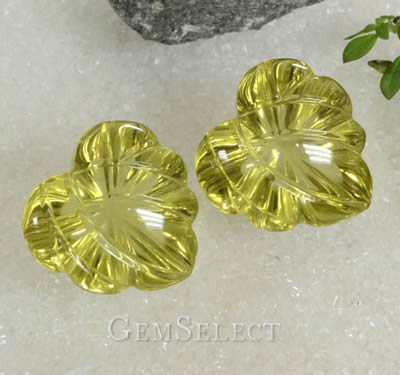
Fancy Carved Yellow Quartz Matched Pair
Putting together matched pairs requires a highly skilled professional sorting through hundreds of stones to find good candidates, and then careful cutting to make sure the pieces are well coordinated. A finely matched pair will be as similar as possible, and that can be a challenging task. Matching the size is not that difficult, since a larger piece can be cut to match the smaller one. But finding two pieces with identical color and clarity is always difficult. Then the gems must also be faceted with the same angles to achieve the same brilliance. 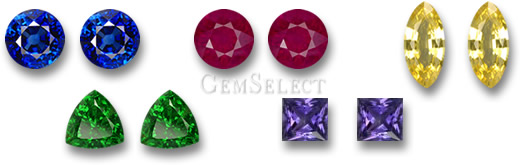
Matching Gem Pairs
One trick of the trade is to cut a matched pair from a single piece of rough, sawn in half. However, this option is not always possible. If a matching pair of 1 carat sapphires is required, for example, it would not be advisable to use an extremely valuable 4 carat rough stone to do it! It is more economical to find two smaller pieces that have a good color match. Some gemstone varieties are more difficult to match because of subtle color variations. For example, tourmaline is famous for its subtle color zoning and pleochroism. Trying to produce a matched pair of watermelon tourmaline gems is extremely difficult. Even an apparently 'solid' colored tourmaline displays different colors from different angles. That is why matched pairs of tourmaline gemstones are quite rare. Precious gemstones, diamonds, sapphires, emeralds, rubies, are among the frequently paired gemstones that enjoy widespread popularity. Semi-Precious gemstones that are often found as matched pairs are citrine, amethyst, garnet and peridot. 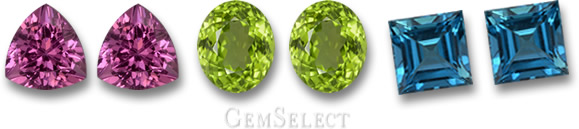
Matched Gemstone Pairs
In general, the cost of matched pairs is higher on a price per carat basis. One reason is rarity - it's more difficult to find a pair of stones that are matched for color, clarity and cut. This is not the only reason. Usually one of the pieces has to be reduced in size to match another stone. So this means that the cutter has sacrificed valuable material to create the pair. Therefore, the price per carat must be higher to compensate. Most matched pairs will have a total carat weight of 0.5 to 2.0 carats. Larger sizes are more difficult to match, even in gems like quartz, where larger sizes are abundant. Matched pairs in calibrated sizes are even harder to find, since it usually means that the cutter has to reduce the size of both pieces to achieve the desired size. So calibrated matched pairs tend to be even more expensive. This Page in Other Languages
About Us
Overall Rating -> 9 Never bought anything on this website before, but it probably won't be my last purchase. Definitely one of the easiest to use and most informative sites I've ever been to. Posted By Bob in November, 2023 Source: Bizrate Overall Rating -> 10 Found the stone I wanted which was delivered quickly and met expectations. Posted By GemGrammy in January, 2024 Source: Bizrate Overall Rating -> 10 I particularly like information about product provided with purchase. Posted By Dick in May, 2023 Source: Bizrate Overall Rating -> 10 Always have good experience Posted By Ginnie in September, 2023 Source: Bizrate Overall Rating -> 10 I was looking for a source for affordable genuine gemstones for my grandson who is currently very interested in rocks and gems. I was quite surprised and pleased to find GemSelect and finding the right stones at the right price couldn't have been simpler. Posted By Papa in December, 2023 Source: Bizrate Related Articles Emerald Info Emerald Information - Vivid green gemstones of unequaled quality GemSelect Newsletters GemSelect Newsletters Rare Chrome Tourmaline Rare Chrome Tourmaline Gemstone Jewelry Colored Gemstone Jewelry Information from GemSelect |
| STAY IN TOUCH | NEWSLETTER |
| *You're signing up to receive GemSelect promotional email. |


Copyright © 2005-2024 GemSelect.com all rights reserved.
Reproduction (text or graphics) without the express written consent of GemSelect.com (SETT Company Ltd.) is strictly prohibited.
411


