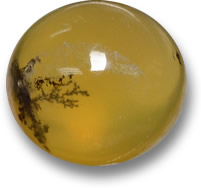
Moss Opal Gemstone Information
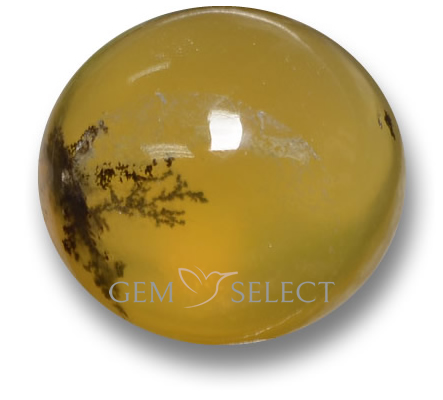
Buy Moss Opal Gemstones
About Moss Opal - History and Introduction
Moss opal is a milky white to brownish opal with dark greenish inclusions that resemble moss. Moss opal may also be referred to as "dendritic opal" because of the tree-like appearance of the inclusions, or "dendrites", which comes from the Greek word, "dendron", meaning "tree".
The word "opal" is thought to originate from the Sanskrit word "upala", meaning "precious stone". Opals have long been used as gemstones and were thought to possess supernatural powers. In the Middle Ages, opals were considered lucky and some even believed that an opal wrapped in a bay leaf would provide the owner with the power of invisibility. Opal by definition is hydrated silicon dioxide, always containing three to thirty percent water. That characteristic and its relative softness with a rating of 5.5 to 6.5 on Mohs Hardness Scale, means that this gemstone requires some special care.
Moss opal can be identified by its milky white to brownish color, with dark-green inclusions that appear like moss. These inclusions are typically caused by hornblende.
The most important deposits of opal are located in Australia. Around 95 percent of the world's supply of white precious opal is mined "down under." Famous deposits in New South Wales are at Lightning Ridge and White Cliffs, and in South Australia at Coober Pedy and Andamooka. Various deposits are also found in Queensland. Other deposits are found in Brazil, Guatemala, Honduras, Indonesia, Japan, Mexico, Russia and the United States (Idaho and Nevada).
Buying Moss Opal and Determining Moss Opal Gemstone Value Back to Top
Moss Opal Color
Like common opal, moss opal shows no play of color. But moss opal has some unique characteristics - the body carries dark green moss-like patterns. Moss opal is a milky white to brownish opaque material, with dark greenish contrasting inclusions. The most desirable body color of moss opal is milky white.
Moss Opal Clarity and Lustre
Moss opal is opaque and very rarely translucent. Its lustre is usually vitreous (glassy), but it can also be pearly or waxy. Moss opal features desirable inclusions in the form of dark-greenish, moss-like dendrites.
Moss Opal Cut and Shape
Due to its opacity, moss opal is mostly round or cabochon cut. It is also sometimes tumbled, fancy cut or drilled.
Moss Opal Treatment
Moss opal is occasionally impregnated with oil, wax, or plastic. However, natural moss opal can also be found.
| Chemical Formula: |
SiO2 _nH2O Hydrous silicon dioxide |
| Crystal Structure: |
Amorphous; kidney-shaped or grape-shaped aggregates |
| Color: |
Milky-white to brownish with dark-greenish inclusions |
| Hardness: |
5.5 - 6.5 on the Mohs scale |
| Refractive Index: |
1.37 ? 1.52 |
| Density: |
1.98 ? 2.50 |
| Cleavage: |
None |
| Transparency: |
Transparent, opaque |
| Double Refraction or Birefringence: |
None |
| Lustre: |
Usually vitreous, but can also be pearly or waxy |
| Fluorescence: |
White, bluish, brownish, greenish |
Please refer to our Gemstone Glossary for details of gemmology-related terms.
 |
| Multicolor Dendritic Agate |
Moss opal is related to the other opal types; precious opal, fire opal and common opal. Moss opal can appear similar to dendritic agate, which has inclusions that are typically caused by iron and manganese ions, whereas opal inclusions are typically a result of hornblende.
Moss Opal Gemstone Mythology, Metaphysical and Healing Powers Back to TopFor centuries, opal has been revered for its healing properties. In the Middle Ages, opals were considered symbols of luck, with some believing that wrapping an opal in a bay leaf could grant the wearer the power of invisibility. Opal is said to have the ability to alleviate depression, aid in finding true love, and is the birthstone for those born in October. Moss opal, in particular, is believed to assist in fulfilling desires, aiding in recovery from past lives, and promoting spiritual growth. It is also thought to have benefits for circulatory disorders.
| Disclaimer: Metaphysical and Alternative Crystal Healing Powers and Properties are not to be taken as confirmed advice. Traditional, Ceremonial and Mythological Gemstone Lore is collected from various resources and does not represent the sole opinion of SETT Co., Ltd. This information is not to replace the advice of your doctor. Should you have any medical conditions, please see a licensed medical practitioner. GemSelect does not guarantee any claims or statements of healing or astrological birthstone powers and cannot be held liable under any circumstances. |
Moss Opal Gemstone and Jewellery Design Ideas Back to TopMoss opals are best suited for earrings, brooches and pendants. Due to the delicate nature of opals, they are not recommended to be worn daily as rings or other types of jewellery that are subject to hard knocks. Moss opals can be drilled to make attractive pendants for necklaces or earrings. They can also be bezel set or wire-wrapped for occasional wear rings and bracelets or necklace pendants. Tumbled moss opals also make eye-catching beads.
Note: Buy colored gemstones by size and not by carat weight. Colored stones vary in size-to-weight ratio. Some stones are larger and others are smaller than diamonds by weight in comparison.
Moss opals like common opals have gained no particular fame. However, some other noble members of the opal family have. "The Olympic Australis Opal" was unearthed at Coober Pedy, Australia, in 1956. It weighs a staggering 17,000 carats and was valued at $2,500,000 Australian dollars in 2005. "The light of the world," a white precious opal of 40 grams, 2,250 carats, also found in Australia, is considered to be the most colorful white precious opal of all time. The "Andamooka Desert Flame" found in 1969 with a weight of 6,843 kilograms is the largest opal ever brought to the light of day.
Moss Opal Gemstone Jewellery Care and Cleaning Back to Top Moss opals are delicate gemstones. Their most significant vulnerability has to do with their water content. If an opal is allowed to dry, it will crack and fade. If you live in a very dry climate, or keep them in a dehumidified room, some precautions are necessary. Keeping them in a tight plastic bag, with a damp piece of cotton or fabric will prevent dehydration. Due to their water content, opals are also highly sensitive to sudden changes in temperature. Being somewhat soft, they scratch easily. A large component of dust is quartz, which scores 7 on the Mohs scale of hardness. At 5.5 to 6 in hardness, simply wiping the dust off an opal will gradually reduce its polish. The solution is to clean opals using a soft cloth. Moss opals are delicate gemstones. Their most significant vulnerability has to do with their water content. If an opal is allowed to dry, it will crack and fade. If you live in a very dry climate, or keep them in a dehumidified room, some precautions are necessary. Keeping them in a tight plastic bag, with a damp piece of cotton or fabric will prevent dehydration. Due to their water content, opals are also highly sensitive to sudden changes in temperature. Being somewhat soft, they scratch easily. A large component of dust is quartz, which scores 7 on the Mohs scale of hardness. At 5.5 to 6 in hardness, simply wiping the dust off an opal will gradually reduce its polish. The solution is to clean opals using a soft cloth.
As with most gemstones, ultrasonic cleaners and steamers are not recommended. Always remove any jewellery or gemstones before cleaning or engaging in harsh physical activities such as sport. Store opal gemstones away from other gemstones to avoid scratches. It is best to wrap gemstones in soft cloth or place them inside a fabric-lined jewellery box.
|