

 Free Report
Included
Free Report
Included
 Worldwide
Shipping
Worldwide
Shipping
 30 Day
Returns
Free Report
Included
Worldwide
Shipping
30 Day
Returns
30 Day
Returns
Free Report
Included
Worldwide
Shipping
30 Day
Returns
GemSelect Newsletter - November 2008In our newsletter this month:
Gemstone Videos Back to Top
Unless you happen to live in Chanthaburi, Thailand or Jaipur, India, the best priced quality gemstones are only found online. You'll not only find the best prices, but also, you will see the widest selection. The only tricky part is that you have to make your selections based on photographs. And that can be a challenge. Our high quality gemstone photos have always been a distinguishing feature of our website. We photograph each and every gemstone we sell - not a simple task when we have more than 10,000 gems in stock. We also shoot each gem from 3 different angles, so you can get a good sense of the cut and proportions. One of the virtues of still photos is that they can provide a lot of information. A still camera with a macro lens can get very close to the subject, so that very fine details can be seen. A good gemstone photo can be almost as detailed as looking at a stone under 10x magnification with a jeweler's loupe. 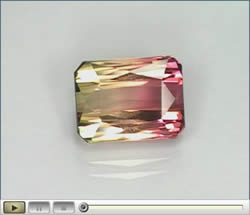
Tourmaline Gemstone Video
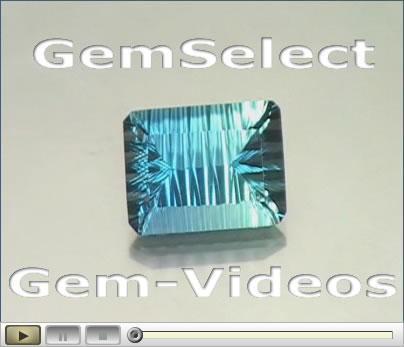
However, still photos have their limits. It's hard to capture the brilliance and luster of a gemstone in a still photograph. Gems reflect light best when they are moving. Many gems are pleochroic and display different colors from different angles. The multiple colors of tourmaline, in particular, are tough to capture with a still camera. For a long time we've wanted to include video clips on our website to give our customers a more true-to-life experience of our gems. But high quality video was simply too slow for the Internet, and we didn't want to lower our quality standards or slow down our website. Recent innovations in video compression, combined with faster Internet connections, are now making it practical for us. Starting this month you will start to find video clips on our gem detail pages. If you have the industry-standard Adobe Flash Player installed, you'll see a video window when you visit a gem detail page that has a video clip. Just click the start button to play the video. If you don't have Flash installed, our detail pages will show you our still photos. If a video is available, you'll see a "play video" button. Click on it and you'll have the option to install the Flash player. Or you can just click here to install Flash. We'll not only be shooting videos of many of our new gems, but we'll also be adding videos for selected items in our current inventory. We're still perfecting our video production. New Content at GemSelect Back to Top
We add hundreds of new gems to our inventory every day. We also add new content to our website every month, in the form of articles and reference material. Recently we've added new articles on topics, including seeing gemstone stars, identifying country of origin, gems from Pakistan and rocks as gems. If you've wondered why you don't see Kashmir sapphire for sale, read our new article on the most famous sapphires in the world. Click the link to see all our gemstone articles. Rare and Unusual Gems Back to Top
Each month we focus on a rare and unusual gem from our inventory. This month we feature a rare green zircon from Sri Lanka. 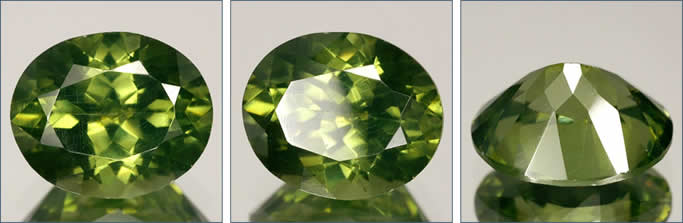
Natural Green Zircon from Sri Lanka
Natural zircon is typically golden brown, orange or reddish-brown. Blue and white zircon gems are produced by heat treatment. But the rare green zircon is a special case. The green color occurs naturally, but only in a few places in the world, principally Sri Lanka and Burma. In some zircon gems, radioactive uranium and thorium cause a partial disruption of the crystal lattice. Most of these so-called metamict zircon materials are not clean enough to be cut as gemstones. However, some green specimens are an exception, and are highly prized by collectors. This 3.64 carat zircon from Sri Lanka displays a strong, slightly yellowish green with good clarity and excellent luster. Customer Questions Back to Top
Every month we answer questions of general interest from our customers. Please feel free to send your questions or suggestions to our support team at help@gemselect.com! Question
I noticed you have some really interesting bloodstone on your website, with a lot more color in it than I usually see. Can you provide some more information about these stones? BW, USA.
Answer
We recently bought some bloodstone rough from Madagascar and have been cutting it in our own shop. The rough material has a high iron oxide content, and that's why this bloodstone displays a lot of red. Some pieces have yellow and white spots as well. Our cutters have turned out some impressive pieces, including some faceted stones that you will rarely find.
Question
Do you have a printed catalogue? I would appreciate if you would send me a copy. Thank you. JSR, Indonesia.
Answer
Almost all our gemstones are one-of-a-kind, and our stock is constantly changing. So that makes it impossible for us to have a printed catalog that is current and complete. But our website is actually an electronic catalog. All of the gems shown online are in stock and ready for delivery, and gems are removed from the website as soon as they are sold. You can browse our website not only by gem type, but also by color, size, shape, weight, price and even country of origin. You can't do that with a printed catalog!
Keep up with our new arrivals before they hit the newsletter by joining our thousands of fans and followers on our social networking pages. We love interacting with our customers - you can visit us on Tumblr, LinkedIn, Twitter, Facebook or Pinterest! To ensure you can receive our emails, please be sure to add help@gemselect.com to your list of safe contacts, or you add us into your email address book! Please feel free to contact us with any questions, comments and queries! We respond to each and every email we receive. Happy Gem Hunting!
About Us
Overall Rating -> 10 good navigation and simple interface. Posted By Dave in April, 2026 Source: Bizrate Overall Rating -> 10 The citrine gems are beautiful. I appreciated that each stone was individually shown on the website so I could see exactly what I was getting. No mystery person selecting random stones for me. The documentation included with each gem was high quality as well. Great price and arrived as expected. Posted By Jen in December, 2025 Source: Bizrate Overall Rating -> 10 Great site for finding specific stones and sizes for individual pieces of jewelry Posted By Designer in December, 2025 Source: Bizrate Overall Rating -> 10 selection was broad and the check out was quick. Great site Posted By JC Karl in September, 2025 Source: Bizrate Overall Rating -> 10 Love the precise descriptions and calibrations of hte loose gemstones. Would like to have seen more variety in the size gem I was looking for. Posted By RenoRose in January, 2026 Source: Bizrate Overall Rating -> 9 Always a good quality stone. Priced fairly and shipped promptly. Answers emails quickly Posted By Ron T in November, 2025 Source: Bizrate Related Articles Sapphire Gemstone Information Sapphire Gemstone Guide: Colors, Meanings, Prices in 2026 Tourmaline Gemstone Information Tourmaline Information - The most colorful gem on Earth Aquamarine Gemstone Information Aquamarine Gemstone Information: Colors, Meaning & More Emerald Gemstone Information Emerald Gemstone Information: Colors, Meaning, Prices Fire Opal Gemstone Information Fire Opal Gemstone Information: History, Properties and More Iolite Gemstone Information Iolite Gemstone: Facts, Benefits, Properties and More Jade Gemstone Information Jade Gemstone Information - GemSelect Kunzite Gemstone Information Kunzite Gemstones - The must-have pink gem for evenings Orthoclase Gemstone Information Orthoclase Gemstone Information: Unveil Its Natural Beauty Peridot Gemstone Information Peridot Gemstone: Value, Meaning, and Healing Benefits Rhodolite Garnet Gemstone Information Rhodolite Garnet: Rose-Red Gemstone Guide | GemSelect Ruby Gemstone Information Ruby Gemstone Information: Colors, Sources, Meaning and More Ruby-Zoisite Gemstone Information Ruby-Zoisite Information - A unique gemstone mixture Spessartite Garnet Gemstone Information Spessartite Garnet: Guide to the Fiery Orange Gemstone Sphene Gemstone Information Sphene Gemstone Information - GemSelect Spinel Gemstone Information Spinel Gemstone Information: Colors, History, Value & More Tanzanite Gemstone Information Tanzanite Gemstone Information: Discovery, Value & More Topaz Gemstone Information Topaz Gemstone Information: Colors, History, Value and Guide Zircon Gemstone Information Zircon Gemstone Guide: Colors, Properties, and Buying Tips Lapis Lazuli Gemstone Information Lapis Lazuli Information: Meaning, Properties, Value & Price Moss Opal Gemstone Information Moss Opal Gemstone Information: The Complete Guide Mystic Topaz Gemstone Information Mystic Topaz Information - A kaleidoscope of colors Star Ruby Gemstone Information Star Ruby Gemstone Information - GemSelect Birthstones by Month Birthstones by Month, Every Birthstone, Zodiac & Anniversary Caring for Gemstones Gemstone Care - Gemstone Information - GemSelect Color Basics Gemstone Color - A Quick Guide to Colors Diffusion Treatment Diffusion Treatment for Gemstones - GemSelect Irradiation Treatment Irradiation Treatment - Gemstone Information - GemSelect Gemstone Hardness Explained Gemstone Hardness | Mohs Scale with Images and Charts Precious and Semi-Precious Gemstone Glossary Gemstone & Mineral Glossary - Gem Information | GemSelect Medicinal Gemstones Medicinal Gemstone Information - GemSelect Fracture Filled Fracture Filled Treatment - Gemstone Information - GemSelect Gem Market Chanthaburi International Gemstone Market in Chanthaburi, Thailand Gemstone Prices Gemstone Prices: A review of what decides the amount you pay Loose Gemstones from Mine to Market Loose Gemstones From Mine to Market - Gems and Jewelry Info Precious Stones Precious & Semi-Precious Gemstone History, Legends & Myths Rare Tourmaline Rare Tourmaline Gemstones - Unique and distinctive varieties The Secret of Spinel The Secret of Spinel: Discover the Hidden Gemstone Allure of Yellow Sapphire Yellow Sapphire: Meaning, Properties & Benefits | GemSelect Kunz and Tourmaline Kunz and Tourmaline - Creating the colored gemstone market Gem Mining in Madagascar Sapphire and Ruby Gemstone Mining in Madagascar Rare Garnets Rare Garnets: Tsavorite, Demantoid, Uvarovite & More Colored Gemstone Business Understanding the Colored Gemstone Business Tanzanite Prices The Story of Tanzanite: Discovery, Properties, Market & More Gemstone Names Gemstone Names | Gem Name Origins, History, Lists and More Jean-Baptiste Tavernier Jean-Baptiste Tavernier Tension Settings Tension Settings Types of Gem Settings Types of Settings for Gemstones - Gem Settings Uniqueness of Gold Uniqueness of Gold Varieties of Jade Varieties of Jade Gemstones About Chrysocolla Chrysocolla Gemstones: Meaning, History & Healing Properties Gemstone Trade Names Gemstone Trade Names Tourmaline in America Tourmaline in America - The US's home grown colorful gems. Jet Black Gems Jet Black Gems Gems from Pakistan Gemstones from Pakistan Green Amethyst Green Amethyst |