

 Free Report
Included
Free Report
Included
 Worldwide
Shipping
Worldwide
Shipping
 30 Day
Returns
Free Report
Included
Worldwide
Shipping
30 Day
Returns
30 Day
Returns
Free Report
Included
Worldwide
Shipping
30 Day
Returns
GemSelect Newsletter - February 2009In our newsletter this month:
Pink Gemstones Back to Top
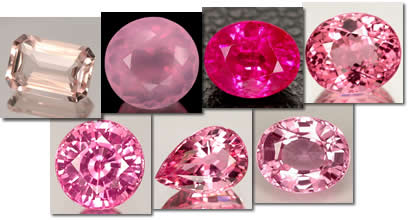
We sell about 100 different varieties of gemstones and we've learned from experience that it's impossible to predict what varieties people will want to buy at any given time. So we try to keep an extensive inventory with well over 10,000 gems in stock. If we can't predict what types of stones our customers want, one thing we've learned is that pink gems are always in demand. Pink is a color that has long been associated with love and with femininity, but also with good health and happiness, as in the English idiom in the pink. The brighter pinks are youthful and exciting, while the vibrant pinks are as sensual and passionate as red. The soft and delicate pinks are romantic and innocent. So what are your choices in pink gemstones? The rarest are pink diamonds, usually selling for hundreds of thousands of dollars per carat. Fine pink sapphire is much less expensive, though pink is actually one of the rarest sapphire colors. Pink sapphire is usually found only in small sizes and finding a clean stone can be difficult. Pink spinel is an excellent substitute, since it's easier to find larger pieces with excellent clarity. Don't forget to look at ruby as well, since many rubies occur in pink-red. Pink, after all, is just a desaturated red. Tourmaline is undoubtedly the gemstone most associated with the color pink. If you're looking for a really saturated pink - such as hot pink or a vibrant red pink - you're mostly likely to find it in a pink tourmaline. You'll also find the widest range of pink hues in tourmaline, from pastel pink to rose and pink-violet. You'll also find interesting multicolor pieces including the distinctive watermelon tourmaline. The pale pink gems kunzite and morganite have a different attraction. Their delicate color and excellent clarity is displayed to best advantage when finely cut. Kunzite occurs in pale pink to lilac hues, while morganite tends more to the salmon pink or orange pink. Both have good hardness and the lighter tones display good brilliance. Kunzite, the pink form of spodumene, can often be found in large sizes as well. Morganite is a rare pink beryl, belonging to the same family as emerald and aquamarine. It is typically found in small sizes but with excellent clarity. Rare and Unusual Gems Back to Top
Each month we feature a rare and unusual gem from our inventory. This month we would like to show you an outstanding color-change sapphire from Tanzania: 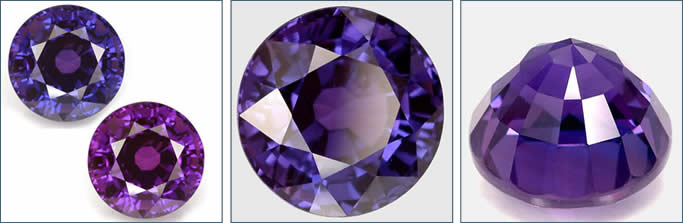
Color-Change Sapphire
Some rare sapphires exhibit a color-change under different lighting. Color-change sapphires are typically blue in natural light and violet or purple under incandescent indoor light. All color-change sapphires are rare, but finding them in large sizes is especially difficult. This round, 4.6 carat color-change sapphire from Tanzania is unusual not only for its size, but also because it is completely untreated. Customer Questions Back to Top
Every month we answer questions of general interest from our customers. Please feel free to send your questions or suggestions to our support team at help@gemselect.com! Question
Do you sell green amethyst? I don't see it on your website. Thanks for your answer. TP, Australia.
Answer
Amethyst, by definition, is violet to purple colored quartz. So there is really no such thing as green amethyst. The gem sometimes sold as green amethyst is what gemologists call prasiolite, which is a leek-green quartz produced by heating amethyst to about 500 degrees centigrade. Unfortunately the color is known to fade when exposed to strong sunlight, so peridot would be a much better choice in this color range. You may also see green quartz in a vivid mint green or blue-green hue, but this is almost always synthetic material produced by the hydrothermal method.
Question
I've wondered, why do some gems show a color change? What causes it?
Answer
Color change gems have two approximately equal-sized transmission windows. A blue gemstone appears blue because it absorbs all frequencies of light except for blue. A gemstone that absorbs both blue and red light will appear blue when the light is rich in blue wavelengths (e.g.,sunlight or fluorescent light), and red or purple when the light is rich in red wavelengths (e.g., incandescent light).
Keep up with our new arrivals before they hit the newsletter by joining our thousands of fans and followers on our social networking pages. We love interacting with our customers - you can visit us on Tumblr, LinkedIn, Twitter, Facebook or Pinterest! To ensure you can receive our emails, please be sure to add help@gemselect.com to your list of safe contacts, or you add us into your email address book! Please feel free to contact us with any questions, comments and queries! We respond to each and every email we receive. Happy Gem Hunting!
About Us
Overall Rating -> 10 selection was broad and the check out was quick. Great site Posted By JC Karl in September, 2025 Source: Bizrate Overall Rating -> 10 Easy picking, fast checkout, secure shipping. Cana't ask for anything more than efficiency and a good price. Posted By Beman in September, 2025 Source: Bizrate Overall Rating -> 10 I feel Gemselect is a trustworthy company to buy from Posted By Becky in October, 2025 Source: Bizrate Overall Rating -> 8 I visited several online loose stone shops trying to find rare stones. I finally found one that I've been looking for here, and very satisfied. Looking forward to receive the item in 3 weeks. Posted By Atsu in December, 2025 Source: Bizrate Related Articles Sapphire Gemstone Information Sapphire Gemstone Guide: Colors, Meanings, Prices in 2026 Tourmaline Gemstone Information Tourmaline Information - The most colorful gem on Earth Aquamarine Gemstone Information Aquamarine Gemstone Information: Colors, Meaning & More Fire Opal Gemstone Information Fire Opal Gemstone Information: History, Properties and More Iolite Gemstone Information Iolite Gemstone: Facts, Benefits, Properties and More Jade Gemstone Information Jade Gemstone Information - GemSelect Kunzite Gemstone Information Kunzite Gemstones - The must-have pink gem for evenings Orthoclase Gemstone Information Orthoclase Gemstone Information: Unveil Its Natural Beauty Peridot Gemstone Information Peridot Gemstone: Value, Meaning, and Healing Benefits Rhodolite Garnet Gemstone Information Rhodolite Garnet: Rose-Red Gemstone Guide | GemSelect Ruby Gemstone Information Ruby Gemstone Information: Colors, Sources, Meaning and More Ruby-Zoisite Gemstone Information Ruby-Zoisite Information - A unique gemstone mixture Spessartite Garnet Gemstone Information Spessartite Garnet: Guide to the Fiery Orange Gemstone Sphene Gemstone Information Sphene Gemstone Information - GemSelect Spinel Gemstone Information Spinel Gemstone Information: Colors, History, Value & More Tanzanite Gemstone Information Tanzanite Gemstone Information: Discovery, Value & More Topaz Gemstone Information Topaz Gemstone Information: Colors, History, Value and Guide Zircon Gemstone Information Zircon Gemstone Guide: Colors, Properties, and Buying Tips Lapis Lazuli Gemstone Information Lapis Lazuli Information: Meaning, Properties, Value & Price Moss Opal Gemstone Information Moss Opal Gemstone Information: The Complete Guide Mystic Topaz Gemstone Information Mystic Topaz Information - A kaleidoscope of colors Star Ruby Gemstone Information Star Ruby Gemstone Information - GemSelect Birthstones by Month Birthstones by Month, Every Birthstone, Zodiac & Anniversary Caring for Gemstones Gemstone Care - Gemstone Information - GemSelect Color Basics Gemstone Color - A Quick Guide to Colors Diffusion Treatment Diffusion Treatment for Gemstones - GemSelect Irradiation Treatment Irradiation Treatment - Gemstone Information - GemSelect Gemstone Hardness Explained Gemstone Hardness | Mohs Scale with Images and Charts Precious and Semi-Precious Gemstone Glossary Gemstone & Mineral Glossary - Gem Information | GemSelect Medicinal Gemstones Medicinal Gemstone Information - GemSelect Gem Market Chanthaburi International Gemstone Market in Chanthaburi, Thailand Gemstone Prices Gemstone Prices: A review of what decides the amount you pay Loose Gemstones from Mine to Market Loose Gemstones From Mine to Market - Gems and Jewelry Info Precious Stones Precious & Semi-Precious Gemstone History, Legends & Myths Rare Tourmaline Rare Tourmaline Gemstones - Unique and distinctive varieties The Secret of Spinel The Secret of Spinel: Discover the Hidden Gemstone Allure of Yellow Sapphire Yellow Sapphire: Meaning, Properties & Benefits | GemSelect Kunz and Tourmaline Kunz and Tourmaline - Creating the colored gemstone market Sources for Fine Ruby Gems Sources for Fine Rubies: Origins, Characteristics and More Gem Mining in Madagascar Sapphire and Ruby Gemstone Mining in Madagascar Rare Garnets Rare Garnets: Tsavorite, Demantoid, Uvarovite & More Colored Gemstone Business Understanding the Colored Gemstone Business Tanzanite Prices The Story of Tanzanite: Discovery, Properties, Market & More Gemstone Names Gemstone Names | Gem Name Origins, History, Lists and More Tension Settings Tension Settings Types of Gem Settings Types of Settings for Gemstones - Gem Settings Uniqueness of Gold Uniqueness of Gold Varieties of Jade Varieties of Jade Gemstones About Chrysocolla Chrysocolla Gemstones: Meaning, History & Healing Properties Tourmaline in America Tourmaline in America - The US's home grown colorful gems. Gems from Pakistan Gemstones from Pakistan Violet Charoite Violet Charoite - Rare and Beautiful Gemstones Pink Tourmaline Gems Pink Tourmaline Gemstones - Hot Pink, Soft, big or small Natural Gemstones Natural Gemstones Botryoidal Gemstones Explore the Beauty of Botryoidal Gemstones: Nature's Artwork Gem Silica Gemstone Silica |