Pyrope Garnet Gemstone Information
Buy Pyrope Garnet Gemstones from GemSelect
About Pyrope Garnet - History and Introduction
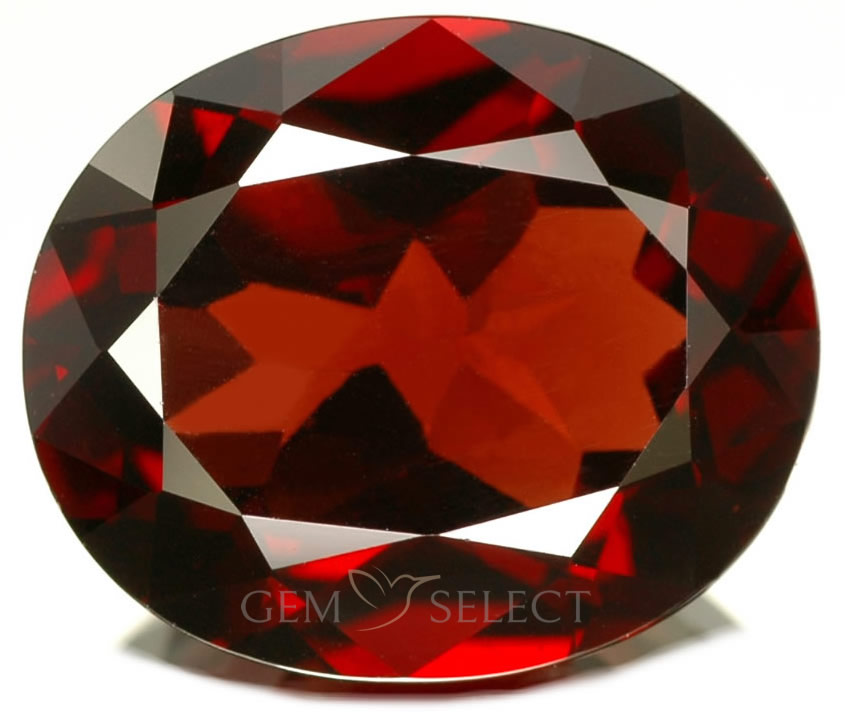
Pyrope garnet is the best known of the red garnets. It has a distinctive red color that can often resemble that of ruby or pomegranate seeds. Like all garnet, pyrope is rarely ever pure; most contain traces of almandine, which is another popular red garnet. They share the same physical properties and can be found in very similar (if not identical) colors, but they have different chemical compositions, Pyrope lends more magnesium content, while iron content is the leading constituent found in almandine. Those with fairly equal amounts are often traded as rhodolite garnet, but typically only those which have stronger violet or purple hues are normally marketed as rhodolite garnet. The word "pyrope" comes from the Greek word "puropus", made up of "pur" (fire) and "ops" (eye) meaning "fiery-eyed". This refers to the impressive brilliance of pyrope garnet, which is a result of its high refractive index.
The use of red garnet dates back thousands of years when it was used by Egyptian pharaohs for both decorative and ceremonial purposes. The ancient Romans also wore garnet rings and traded garnet gemstones. In ancient times, garnet and other red gemstones cut en cabochon were called "carbuncles", which is not the prettiest of names because it was also used to define pus-filled boils. Nowadays, any natural red gemstone cabochon can be traded as carbuncle gemstones.
The Latin word, "carbunculus" alludes to a burning piece of coal or ember. This may have been used to refer to garnet because of its bright color large deposits of pyrope garnet were discovered in Bohemia (Central Europe) around the 16th century, which became the focus of the jewelry industry in the area. Bohemian pyrope garnet from the Czech Republic continues to be mined today.
Pyrope garnet is magnesium aluminum garnet. Iron can substitute for the magnesium and become more like almandine, which is iron aluminum garnet. Pure pyrope and pure almandine are rare in nature and most specimens are a mixture of the two. The change in density from almandine (4.3) to pyrope (3.6) is the only good test to determine a specimen's likely identity. Garnet can be distinguished from other gem types by its occurrence in metamorphic rock, its hardness (6.5 - 7.5 on the Mohs scale), color, refractive index and cubic crystal structure. However, the quickest way to identify garnet is with the use of strong neodymium magnets. Garnet is attracted to neodymium magnets because it contains high concentrations of iron and/or manganese.
Pyrope garnet sources include China, Madagascar, Myanmar, South Africa, Sri Lanka, Tanzania and the United States. Deposits in the Czech Republic do still exist but are not mined commercially like African sources. Czech garnets are often referred to as 'Bohemian garnet' or 'Prague garnet' and they are known for their especially deep red color. The history of Prague garnets dates back to the 17th century.
Buying Pyrope Garnet and Determining Pyrope Garnet Gemstone Value Back to Top
Pyrope Garnet Color
The characteristic dark-red of pyrope garnet is found in small sized stones. Bigger gems tend to be very dark, coming close to black.
Pyrope Garnet Clarity and Luster
Pyrope garnet is often inclusion free, so buyers should seek an "eye clean" stone. Pyrope garnet has a beautiful glossy vitreous luster.
Pyrope Garnet Cut and Shape
Pyrope garnet is versatile and can be cut into a wide variety of shapes. Pyrope garnet is not often seen in large sizes. It can be faceted or cut en cabochon. Faceted cuts best exhibit the beauty of pyrope garnet.
Pyrope Garnet Treatment
Pyrope garnet is not known to be treated or enhanced in any way, but buyers should beware of 'fakes' available when it comes to buying locality specific garnet, such as those from the Czech Republic.
| Chemical Formula: |
Mg4Al2(SiO4)3 Magnesium aluminum silicate |
| Crystal Structure: |
Cubic, rhombic dodecahedron, icositetrahedron |
| Color: |
Red, often with a brown tint |
| Hardness: |
6.5 to 7.5 on the Mohs scale |
| Refractive Index: |
1.720 - 1.756 |
| Density: |
3.62 - 3.87 |
| Cleavage: |
Indistinct |
| Transparency: |
Transparent to opaque |
| Double Refraction or Birefringence: |
Usually none |
| Luster: |
Vitreous |
| Fluorescence: |
Mostly none |
Please refer to our Gemstone Glossary for details of gemology-related terms.
Pyrope Garnet: Related or Similar Gemstones Back to Top
Since pyrope garnet is a member of the large garnet group of gemstones, it is closely related to many other garnet varieties, including andradite garnet (melanite, demantoid and topazolite), almandine garnet, spessartite garnet, grossularite garnet (hydrogrossular, hessonite, leuco garnet and tsavorite) and uvarovite garnet.
Mixed garnets are also hugely popular, including color-change garnet, Mali garnet, Malaia (Malaya) garnet, rhodolite garnet and star garnet. Pyrope garnet and almandine garnet are the most classic when it comes to red garnet. They are both among the most affordable varieties, but best of all, are completely natural and untreated from the mine to the market. Pyrope garnet from the Czech Republic is often sold under unofficial marketing names, such as 'Prague garnet' and 'Bohemian garnet'.
Pyrope Garnet Gemstone Mythology, Metaphysical and Alternative Crystal Healing Powers Back to Top
Garnet has long been thought of as a travelers' stone. In fact, Noah's Ark is said to have had a garnet lantern to help navigate during the night. In traditional Hindu belief systems, garnet is associated with Muladhara, or the "root chakra", which is positioned at the base of the spine. The root chakra when clear is associated with healthy sexual activity and feelings of security and stability. Garnet is also thought to promote successful business, encourage compassion and aid self-confidence. Garnet is said to have the ability to heal the blood and encourage good circulation. Garnet is the traditional birthstone for January, the zodiacal stone for Aquarius and the second anniversary stone.
|
Disclaimer: Metaphysical and Alternative Crystal Healing Powers and Properties are not to be taken as confirmed advice. Traditional, Ceremonial and Mythological Gemstone Lore is collected from various resources and does not represent the sole opinion of SETT Co., Ltd. This information is not to replace the advice of your doctor. Should you have any medical conditions, please see a licensed medical practitioner. GemSelect does not guarantee any claims or statements of healing or astrological birthstone powers and cannot be held liable under any circumstances. |
Pyrope Garnet Gemstone and Jewelry Design Ideas Back to Top
Pyrope's fiery and often slightly bronze colored red was the gemstone fashion color in the 18th and 19th century. Renowned worldwide in those days were the "Bohemian garnets" from the north-eastern part of the former Kingdom of Bohemia - small stones in a wonderful color In Europe they were frequently used for jewelry in Victorian times. Traditional pyrope garnet jewelry from the Bohemian mines of Central Europe typically features small, closely-set stones that appear like ripe, glistening pomegranate seeds. These vintage styles showcase pyrope garnet's glossy deep red hue. Garnet has also been worked into various modern designs, such as drilled garnet stacked earrings, square cut garnets, or garnets set into smooth, sleek silver. Garnets are also mixed with other gemstones of contrasting color to create an innovative modern look. Pyrope garnets can be set in gold, silver, drilled or wire-wrapped for a huge selection of jewelry styles to suit any taste. Pyrope garnet, like all other varieties of garnet, is suitable for ring-wearing owed to its excellent durability. Pyrope garnet rings are very popular, featuring either faceted or cabochon stones. Pyrope offers an inexpensive alternative to red ruby, and with its dark saturated color, it goes well in men's jewelry accessories.
Note: Buy colored gemstones by size and not by carat weight. Colored stones vary in size-to-weight ratio. Some stones are larger and others are smaller than diamonds by weight in comparison.
An antique pyrope garnet hairpin is exhibited at the Smithsonian Museum of Natural History, USA. This is a stunning example of Bohemian garnets; the pyrope garnets set into the hairpin originated in the mines of Bohemia, Czech Republic.
Pyrope Garnet Gemstone Jewelry Care and Cleaning Back to Top
 Pyrope garnet gemstones are quite tough and durable. Proper care for pyrope garnets includes protecting them from hard blows, which could damage them. To clean your pyrope garnets, simply use warm soapy water and a soft cloth. Be sure to rinse well to remove soapy residue. As with most gemstones, ultrasonic cleaners and steamers are not recommended. Pyrope garnets should not be exposed to sudden changes in temperature. Always remove any jewelry or gemstones before exercising, cleaning or engaging in harsh physical activities such as sport. Store pyrope garnets away from other gemstones to avoid scratches. It is best to wrap gemstones in soft cloth or place them inside a fabric-lined jewelry box. Pyrope garnet gemstones are quite tough and durable. Proper care for pyrope garnets includes protecting them from hard blows, which could damage them. To clean your pyrope garnets, simply use warm soapy water and a soft cloth. Be sure to rinse well to remove soapy residue. As with most gemstones, ultrasonic cleaners and steamers are not recommended. Pyrope garnets should not be exposed to sudden changes in temperature. Always remove any jewelry or gemstones before exercising, cleaning or engaging in harsh physical activities such as sport. Store pyrope garnets away from other gemstones to avoid scratches. It is best to wrap gemstones in soft cloth or place them inside a fabric-lined jewelry box.
|




 Pyrope garnet gemstones are quite tough and durable. Proper care for pyrope garnets includes protecting them from hard blows, which could damage them. To clean your pyrope garnets, simply use warm soapy water and a soft cloth. Be sure to rinse well to remove soapy residue. As with most gemstones, ultrasonic cleaners and steamers are not recommended. Pyrope garnets should not be exposed to sudden changes in temperature. Always remove any jewelry or gemstones before exercising, cleaning or engaging in harsh physical activities such as sport. Store pyrope garnets away from other gemstones to avoid scratches. It is best to wrap gemstones in soft cloth or place them inside a fabric-lined jewelry box.


