
|
|
Reviewed By Andreas Zabczyk
Hydrothermal QuartzQuartz is one of the most common minerals in nature, and the price of natural quartz is quite low. Only the special colored varieties, such as violet amethyst and yellow citrine, command prices over a few dollars a carat. Given the low price for natural quartz varieties, it may come as a surprise that there is a large industry producing synthetic quartz using a method known as hydrothermal transport and recrystallization. 
Synthetic Hydrothermal Ametrine Quartz
Though the cost of producing synthetic quartz is not much less than mining natural quartz, a large industry has developed to create synthetic quartz for modern technology. Massive quantities of quartz are used as a piezoelectric material in oscillators, gauges, microphones, clocks and watches. The hydrothermal transport method uses a large autoclave; an electrically heated, pressure-sealed container 3 meters or more in height. The autoclave contains an aqueous solution of sodium carbonate or hydroxide. Small fragments of quartz that act as a source material are placed on the bottom. The upper portion of the container is a cage that supports numerous small seed crystals of quartz. When the temperature is raised to about 400 degrees centigrade, the quartz fragments dissolve and crystallize onto the seeds in the cooler upper portion of the container. 
Synthetic Hydrothermal Citrine Quartz
This method was designed to produce colorless quartz for industrial applications. But it can also be used to grow quartz for gemstones, particularly when large sizes or well-matched sets of uniformly colored stones are needed. It is also possible to grow synthetic quartz in colors not found in nature, including unusual multicolored combinations. 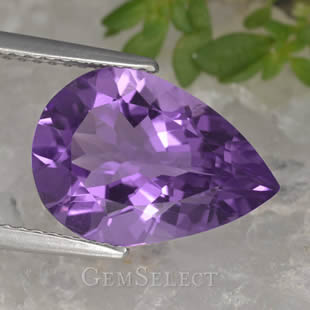
Natural Amethyst Gemstone from GemSelect
Though the synthetic quartz is real quartz composed of crystals of silicon dioxide just like natural quartz, reputable gem dealers will not sell this material unless it is appropriately identified. In many cases it can be difficult to distinguish the synthetic material, but gemologists can usually identify the presence of seed crystals in synthetic quartz. Untwinned crystals are also a mark of synthetic amethyst, though it is now possible to produce twinned crystals by the hydrothermal method. 
Synthetic Hydrothermal Amethyst Quartz
The best way for consumers to identify synthetic quartz is by size, color and clarity. You will often see synthetic amethyst or citrine in extraordinarily large sizes with perfect clarity. Natural amethyst or citrine will typically exhibit color zoning that you won't find in the synthetic material. The synthetic ametrine is often found in colors that you won't see in nature; either the color is extraordinarily vivid, or you will find hues such as blue and green that do not occur naturally. This Page in Other Languages
About Us
Overall Rating -> 10 Super easy to do business for great products. Posted By BoBBy in January, 2024 Source: Bizrate Overall Rating -> 10 The website is very easy to use. The search function, filter and sort functions are very helpful. Posted By Sboro in August, 2023 Source: Bizrate Overall Rating -> 10 Very large selection of items and we used the stones to have several pieces of jewelry made for us. Posted By Joe in January, 2024 Source: Bizrate Overall Rating -> 10 The site is very easy to use and I will continue to shop here. The quality is superb Posted By Genia in January, 2024 Source: Bizrate Overall Rating -> 8 I am currently pleased. I like the layout of the website. Posted By RayPoppa in January, 2024 Source: Bizrate Overall Rating -> 7 I feel pretty good so far, pending the delivery of the item ordered. Posted By Steve in November, 2023 Source: Bizrate Overall Rating -> 10 I have received emails for about a year and today is the condition that had me decide on the purchase Posted By Tim in April, 2024 Source: Bizrate Related Articles Tanzanite Info Tanzanite Information - Africa's wonder risen from the ashes Gemstone Identification Gemstone Identification Gemstone Testers Gemstone Testers Detecting Synthetic Quartz Detecting Synthetic Quartz Advanced Gem Analysis Advanced Gem Analysis Synthetic Moissanite Synthetic Moissanite - Diamond Substitute or Gem on its Own? Dumortierite Quartz Guide: Uses & Properties Dumortierite Quartz Gems Certified Gemstones Certified Gemstones |
| STAY IN TOUCH | NEWSLETTER |
| *You're signing up to receive GemSelect promotional email. |


Copyright © 2005-2024 GemSelect.com all rights reserved.
Reproduction (text or graphics) without the express written consent of GemSelect.com (SETT Company Ltd.) is strictly prohibited.
528


