

 Free Report
Included
Free Report
Included
 Worldwide
Shipping
Worldwide
Shipping
 30 Day
Returns
Free Report
Included
Worldwide
Shipping
30 Day
Returns
30 Day
Returns
Free Report
Included
Worldwide
Shipping
30 Day
Returns
GemSelect Newsletter - October 2008In our newsletter this month:
Gemstone Certificates Back to Top
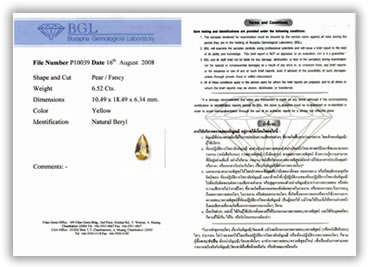
The gemstone business has traditionally been based on trust, where deals were sealed with a handshake and a dealer's word was his bond. We still think of our own business in those traditional terms, but we recognize that the world is changing. With so much business being conducted on the Internet, buyers and sellers rarely have the chance to look each other in the eye and establish trusting relationships. We have always tried to be scrupulously accurate and complete in the description of our gems, and we back it up with an unconditional money-back guarantee. But for those customers who want the added confidence of third party verification, we are now offering gemstone certificates from a respected authority here in Thailand, the Burapha Gemological Laboratory (BGL) and the Asian Institute of Gemological Sciences (AIGS). We test samples from nearly every parcel of gems we buy, so we have a high degree of confidence in the descriptions we provide on our website. But if you'd like a test report for the specific gemstones you purchase from us, you now have an opportunity to purchase a certificate for most gem varieties when you put an item in your shopping cart. When we receive your order, we'll take your gems to the Burapha Lab and have them tested, then send you the certificates with your order. The certificates are what is known in the trade as identification reports. They describe the specific gem by weight, size, color, cut and shape, and identify it by type, such as 'natural sapphire'. The certificate also includes a small photo of the gem. The cost to produce this type of report is very reasonable, and we are currently offering these certificates for USD $15 (BGL) - $30 (AIGS) per gem tested. That is much less than you would pay at a lab in Europe or America, and we also save you the work of obtaining the certificate. Please note that if you request a certificate for an item that is a pair or lot, the lab will test just one of the gems in the pair or lot. It is important to note what these certificates do not include. They do not cover gem treatments, except those which are easy to detect such as fracture-filling. Testing for treatments such as beryllium diffusion requires specialized equipment and additional lab time. The certificates also do not certify country of origin, since this is an opinion that only a small number of labs in the world can offer with any confidence. It is also important to note that they are not appraisal certificates; they scientifically identify the gemstone, but they can't tell you the market value of the gemstone. But if you (or your customer) need assurance that you are buying a natural gemstone of a specific type, these certificates will do the job at minimal expense.
Rare and Unusual Gems Back to Top
Each month we feature a rare and unusual gem from our inventory. This month we feature a very large aquamarine from Mozambique. 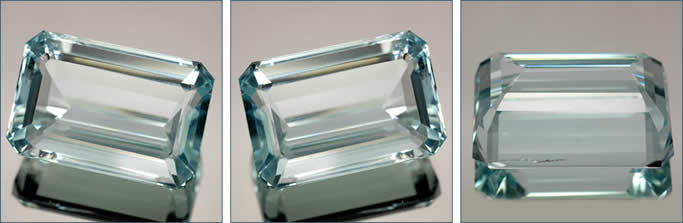 Natural Octagon Facet Aquamarine
Aquamarine is a member of the beryl family along with emerald, morganite and golden beryl. With a hardness of 7.5 to 8 on the Mohs scale, all the beryls are excellent jewelry stones. But where emerald can be fragile due to its many inclusions, aquamarine tends to be much cleaner. Even so, very large aquamarine gems are rarely found with perfect clarity. This 19.12 carat piece from Mozambique is an exception. Graded IF, it has the classic aquamarine blue and a very well executed step cut. It is certainly one of the nicest large aquamarine stones we've seen in recent years.
Customer Questions Back to Top
Every month we answer questions of general interest from our customers. Please feel free to send your questions or suggestions to our support team at help@gemselect.com! Question
In your September newsletter you talked about Burmese jadeite. Is jadeite the same thing as jade? Thanks, FB, Australia.
Answer
What was traditionally called jade is in fact two separate and distinct minerals; jadeite and nephrite. They have different chemical compositions, levels of hardness and densities. They even have different crystal structures. Jadeite comes mainly from Burma. The rarest and most valuable jadeite is called imperial jade, and is colored by traces of chromium. It has a color that rivals fine emerald, though imperial jade is slightly more yellow in tone. Jadeite is generally very expensive, while nephrite is still quite affordable.
Question
Is all red tourmaline called "rubellite"? Or only some? I'm confused about this, so your help is appreciated. JN, USA.
Answer
It's a very good question, but not an easy one to answer because there is no clear agreement in the gemstone business about the meaning of "rubellite." Some think the term refers to any red tourmaline; others claim it should be used only for tourmaline with a vivid ruby-like red. We recently published an article on the topic of the rubellite rubric; click the link to read it.
Keep up with our new arrivals before they hit the newsletter by joining our thousands of fans and followers on our social networking pages. We love interacting with our customers - you can visit us on Tumblr, LinkedIn, Twitter, Facebook or Pinterest! To ensure you can receive our emails, please be sure to add help@gemselect.com to your list of safe contacts, or you add us into your email address book! Please feel free to contact us with any questions, comments and queries! We respond to each and every email we receive. Happy Gem Hunting!
About Us
Overall Rating -> 10 Easy picking, fast checkout, secure shipping. Cana't ask for anything more than efficiency and a good price. Posted By Beman in September, 2025 Source: Bizrate Overall Rating -> 10 Web site is very simple to navigate Selection is terrific Posted By ToRa.62 in April, 2026 Source: Bizrate Overall Rating -> 10 good navigation and simple interface. Posted By Dave in April, 2026 Source: Bizrate Related Articles Sapphire Gemstone Information Sapphire Gemstone Guide: Colors, Meanings, Prices in 2026 Tourmaline Gemstone Information Tourmaline Information - The most colorful gem on Earth Aquamarine Gemstone Information Aquamarine Gemstone Information: Colors, Meaning & More Emerald Gemstone Information Emerald Gemstone Information: Colors, Meaning, Prices Fire Opal Gemstone Information Fire Opal Gemstone Information: History, Properties and More Iolite Gemstone Information Iolite Gemstone: Facts, Benefits, Properties and More Jade Gemstone Information Jade Gemstone Information - GemSelect Kunzite Gemstone Information Kunzite Gemstones - The must-have pink gem for evenings Orthoclase Gemstone Information Orthoclase Gemstone Information: Unveil Its Natural Beauty Peridot Gemstone Information Peridot Gemstone: Value, Meaning, and Healing Benefits Rhodolite Garnet Gemstone Information Rhodolite Garnet: Rose-Red Gemstone Guide | GemSelect Ruby Gemstone Information Ruby Gemstone Information: Colors, Sources, Meaning and More Ruby-Zoisite Gemstone Information Ruby-Zoisite Information - A unique gemstone mixture Spessartite Garnet Gemstone Information Spessartite Garnet: Guide to the Fiery Orange Gemstone Sphene Gemstone Information Sphene Gemstone Information - GemSelect Spinel Gemstone Information Spinel Gemstone Information: Colors, History, Value & More Tanzanite Gemstone Information Tanzanite Gemstone Information: Discovery, Value & More Topaz Gemstone Information Topaz Gemstone Information: Colors, History, Value and Guide Zircon Gemstone Information Zircon Gemstone Guide: Colors, Properties, and Buying Tips Lapis Lazuli Gemstone Information Lapis Lazuli Information: Meaning, Properties, Value & Price Moss Opal Gemstone Information Moss Opal Gemstone Information: The Complete Guide Mystic Topaz Gemstone Information Mystic Topaz Information - A kaleidoscope of colors Star Ruby Gemstone Information Star Ruby Gemstone Information - GemSelect Birthstones by Month Birthstones by Month, Every Birthstone, Zodiac & Anniversary Caring for Gemstones Gemstone Care - Gemstone Information - GemSelect Color Basics Gemstone Color - A Quick Guide to Colors Diffusion Treatment Diffusion Treatment for Gemstones - GemSelect Irradiation Treatment Irradiation Treatment - Gemstone Information - GemSelect Gemstone Hardness Explained Gemstone Hardness | Mohs Scale with Images and Charts Precious and Semi-Precious Gemstone Glossary Gemstone & Mineral Glossary - Gem Information | GemSelect Medicinal Gemstones Medicinal Gemstone Information - GemSelect Fracture Filled Fracture Filled Treatment - Gemstone Information - GemSelect Gem Market Chanthaburi International Gemstone Market in Chanthaburi, Thailand Gemstone Prices Gemstone Prices: A review of what decides the amount you pay Loose Gemstones from Mine to Market Loose Gemstones From Mine to Market - Gems and Jewelry Info Precious Stones Precious & Semi-Precious Gemstone History, Legends & Myths Rare Tourmaline Rare Tourmaline Gemstones - Unique and distinctive varieties The Secret of Spinel The Secret of Spinel: Discover the Hidden Gemstone Allure of Yellow Sapphire Yellow Sapphire: Meaning, Properties & Benefits | GemSelect Kunz and Tourmaline Kunz and Tourmaline - Creating the colored gemstone market Sources for Fine Ruby Gems Sources for Fine Rubies: Origins, Characteristics and More Gem Mining in Madagascar Sapphire and Ruby Gemstone Mining in Madagascar Rare Garnets Rare Garnets: Tsavorite, Demantoid, Uvarovite & More Colored Gemstone Business Understanding the Colored Gemstone Business Tanzanite Prices The Story of Tanzanite: Discovery, Properties, Market & More Gemstone Names Gemstone Names | Gem Name Origins, History, Lists and More Prong Vs. Bezel Settings Prong Vs. Bezel Settings Tension Settings Tension Settings Types of Gem Settings Types of Settings for Gemstones - Gem Settings Uniqueness of Gold Uniqueness of Gold Varieties of Jade Varieties of Jade Gemstones Gemstone Trade Names Gemstone Trade Names Tourmaline in America Tourmaline in America - The US's home grown colorful gems. Gems from Pakistan Gemstones from Pakistan Culet in Cut Gems Culet in Cut Gems |