|
Your Details
Forgot your password?
|
|
Your Details
GemSelect Newsletter - January 2008In our newsletter this month:
Zircon and Zirconology Back to Top
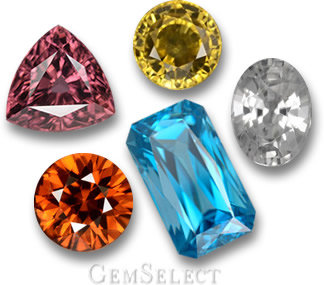
You'll often see advertisements for tanzanite, touting it as the gemstone that is "585 million years old". It's not clear exactly why that is a selling point for the gemstone buyer, since most minerals are hundreds of millions of years old. But if you're interested in a truly ancient mineral, look at zircon. The oldest known zircon samples, from Western Australia, are more than 4.4 billion years old. 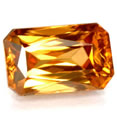
Top Grade Natural Golden Zircon
Zircon is actually the oldest known mineral on earth. Considering that the Earth formed 4.56 billion years ago, the oldest zircon gems represent the earliest record of the Earth's crust. Zircon was the first crystal to form in molten granite as it cooled to form rock. The ancient granitic rock has long eroded away; the only record that is left is zircon in the form of tiny grains. This means that zircon is in fact the oldest thing on earth; the oldest samples are even older than the moon, which formed about 4 billion years ago.
Zircon is thus a tremendously important mineral. For gemologists, zircon is fascinating. It is a remarkably dense mineral; about 50% denser than diamond. That means if you have a diamond and a zircon gemstone of similar size, if the diamond weighs 1 carat, the zircon will weigh about 1.5 carats. Therefore, the dimensions of any zircon gems should be carefully checked before purchase, since the stone may be smaller than expected. 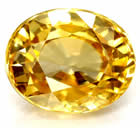
Yellow Golden Zircon from Africa
Zircon also has very marked birefringence. Birefringence is a measurement for gemstones that are doubly refractive; that is, gems which have two different refractive indices. When a beam of light enters a doubly refractive gem, it is split into two beams, each travelling at a different speed and on a different path through the crystal. Birefringence is a measurement of the difference between the two refractive indices in such gems. Zircon has such high birefringence that a zircon gemstone may appear fuzzy or display 'facet-doubling' when it is viewed through the table. Special cutting skills are In addition to its notable birefringence, zircon has a very high refractive index (1.810 to 2.024), which is somewhat close to that of diamond (2.417 to 2.419). Zircon also has impressive dispersion; the tendency to split white light into the spectral colors. This means that zircon is an exceptionally brilliant gem. It's not surprising that in the days before diamond simulants, white zircon was often used as a substitute for diamond. Zircon should not be confused with cubic zirconia, a well known diamond simulant. Cubic zirconia is a recent invention of man; zircon is the oldest natural thing on our planet. It's a stone that every gem collector should have in his or her collection. Gemstones Worth Knowing Back to Top
Each month we focus on one of the lesser known gemstones. This month's featured stone is chrome diopside. 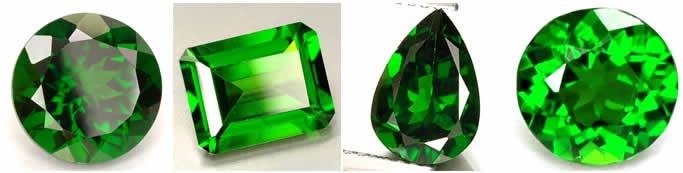
Chrome Diopside from Russia
Until recently, fine chromium-bearing green gemstones were retricted to emerald, tsavorite garnet and chrome tourmaline. All were very expensive. In 1988 in Russia, there was a major find of chrome diopside, a chromium-rich variety of calcium magnesium silicate. The saturated green of diopside is easily the rival of tsavorite and chrome tourmaline, but the price is substantially lower. The only limitation is that chrome diopside is a softer stone (with a score of 5 to 6 on the Mohs scale), which means that it's not suitable for everyday rings. But it is very well suited for earrings and pendants, and looks stunning when set in gold. For more information see our chrome diopside information page and our recent feature article on diopside. Customer Questions Back to Top
Every month we answer questions of general interest from our customers. Please feel free to send your questions or suggestions to our support team at help@gemselect.com! Question
As I understand it, both ruby and emerald are colored by chromium. How can chromium produce both red and green colors? I would really like to know, so thanks in advance for your answer. BB, Canada.
Answer
Both corundum (ruby and sapphire) and beryl (emerald) are colorless in their pure form. Like many gemstones, they are colored by impurities. In the case of both ruby and emerald, it is chromium that produces the color. In fact in both cases, aluminum atoms are replaced by chromium. The difference in color is a result of differences in bond strength, which affects the absorption and transmission of light. In ruby, violet light is strongly absorbed along with green-yellow light. Blue light and red light are transmitted. Transmission of red, however, is much stronger than that of blue, so the ruby looks red. In the case of emerald, violet light is still absorbed but the green-yellow absorption band of ruby shifts to absorption of yellow-red light in emerald. This diminishes the transmission of red light so that the transmission of blue-green light (corresponding to the weak transmission blue light in ruby) is now strongest and determines the color of the emerald. This variation is even more interesting in the case of chromium-rich chrysoberyl (alexandrite), which has bond strengths between ruby and emerald. Alexandrite can transmit blue-green light in daylight and red under incandescent light.
Question
My friend has a diamond tester which he says can tell real diamonds from fake ones. Do these really work? FG, USA.
Answer
Many of these diamond testers do work, but it's important to understand how they work and what they are testing. The original diamond testers performed a thermal conductivity test, and could distinguish genuine diamond from simulants such as cubic zirconia. But then moissante, a new diamond simulant, came on the market, and it has thermal conductivity values that are very close to diamond, and first generation diamond testers could not identify it. A second generation tester that also tests for electrical conductivity can distinguish moissanite, since moissanite conducts electricty and genuine diamond does not. Just remember that synthetic diamonds are genuine diamonds and will be identified as such by these simple testers, since their thermal and electrical conductivity is the same as natural diamond.
Keep up with our new arrivals before they hit the newsletter by joining our thousands of fans and followers on our social networking pages. We love interacting with our customers - you can visit us on Tumblr, LinkedIn, Twitter, Facebook or Pinterest! To ensure you can receive our emails, please be sure to add help@gemselect.com to your list of safe contacts, or you add us into your email address book! Please feel free to contact us with any questions, comments and queries! We respond to each and every email we receive. Happy Gem Hunting!
About Us
Overall Rating -> 10 Excellent selection and easy to use, well done site Posted By Steph in December, 2024 Source: Bizrate Overall Rating -> 10 Very good Hoping you will increase your inventory especially in the 6mm Thanks Posted By Ibie in February, 2025 Source: Bizrate Overall Rating -> 9 Been using them for years! Very satisfied with the products. Posted By PI SC in May, 2025 Source: Bizrate Overall Rating -> 10 I love the quality, presentation and the price of the stones. I love the identification card - report they send with each stone. Posted By Dia in March, 2025 Source: Bizrate Overall Rating -> 10 I am never let down by GemSelect. I love that you get the exact stone you want. Shipping is always in a few days. I have spread the word about GemSelect on social media jewelry creating groups that I attend. This sapphire is going to make one gorgeous ring Posted By Desertchick in April, 2025 Source: Bizrate Overall Rating -> 10 Always excellent quality and service from GemSelect Posted By Mike B. in September, 2024 Source: Bizrate Related Articles Sapphire Gemstone Information Sapphire Gemstone Guide: Colors, Meanings, Prices, and More in 2025 Tourmaline Gemstone Information Tourmaline Information - The most colorful gem on Earth Aquamarine Gemstone Information Aquamarine Gemstone Information: Colors, Meaning, Price & More Emerald Gemstone Information Emerald Gemstone Information: Colors, Meaning, Prices, and More Fire Opal Gemstone Information Fire Opal Gemstone Information: History, Properties, and Care Guide Iolite Gemstone Information Iolite Gemstone: Facts, Benefits, Properties, and Jewelry Guide Jade Gemstone Information Jade Gemstone Information - GemSelect Kunzite Gemstone Information Kunzite Gemstones - The must-have pink gem for evenings Orthoclase Gemstone Information Orthoclase Gemstone Information: Unveil Its Natural Beauty Peridot Gemstone Information Peridot Gemstone: Properties, Value, Meaning, and Healing Benefits Rhodolite Garnet Gemstone Information Rhodolite Garnet: Rose-Red Gemstone Guide | GemSelect Ruby Gemstone Information Ruby Gemstone Information: Colors, Varieties, Sources, Meaning and More Ruby-Zoisite Gemstone Information Ruby-Zoisite Information - A unique gemstone mixture Spessartite Garnet Gemstone Information Spessartite Garnet: Guide to the Fiery Orange Gem | GemSelect Sphene Gemstone Information Sphene Gemstone Information - GemSelect Spinel Gemstone Information Spinel Gemstone Information: Colors, History, Value & More Tanzanite Gemstone Information Tanzanite Gemstone Information: Discovery, Colors, Value & Buying Guide Topaz Gemstone Information Topaz Gemstone Information: Colors, Types, History, and Buying Guide Zircon Gemstone Information Zircon Gemstone Guide: Colors, Properties, and Buying Tips Lapis Lazuli Gemstone Information Lapis Lazuli Gemstone Information: Colors, Meaning, Properties & Price Moss Opal Gemstone Information Moss Opal Gemstone Information: History, Properties, and Care Mystic Topaz Gemstone Information Mystic Topaz Information - A kaleidoscope of colors Star Ruby Gemstone Information Star Ruby Gemstone Information - GemSelect Birthstones by Month Birthstones by Month, Every Birthstone, Zodiac & Anniversary Caring for Gemstones Gemstone Care - Gemstone Information - GemSelect Color Basics Gemstone Color - A Quick Guide to Colors Diffusion Treatment Diffusion Treatment for Gemstones - GemSelect Irradiation Treatment Irradiation Treatment - Gemstone Information - GemSelect Gemstone Hardness Explained Gemstone Hardness | Mohs Scale with Images and Charts Precious and Semi-Precious Gemstone Glossary Gemstone & Mineral Glossary - Gemstone Information - GemSelect Medicinal Gemstones Medicinal Gemstone Information - GemSelect Gemstone Treatments All About Gemstone Treatments - Information - GemSelect Fracture Filled Fracture Filled Treatment - Gemstone Information - GemSelect Gem Market Chanthaburi International Gemstone Market in Chanthaburi, Thailand: Shopping f... Gemstone Prices Gemstone Prices - A review of what influences the amount you pay Loose Gemstones from Mine to Market Loose Gemstones From Mine to Market - Gems and Jewelry Information... Precious Stones Precious & Semi-Precious Gemstone History, Legends & Myths Rare Tourmaline Rare Tourmaline Gemstones - Unique and distinctive varieties The Secret of Spinel The Secret of Spinel: Discover the Hidden Gemstone Allure of Yellow Sapphire Yellow Sapphire: Meaning, Properties & Benefits | GemSelect Kunz and Tourmaline Kunz and Tourmaline - Creating the colored gemstone market Sources for Fine Ruby Gems Sources for Fine Ruby Gems: Origins, Characteristics, and Treatments Gem Mining in Madagascar Sapphire and Ruby Gemstone Mining in Madagascar Healing Gemstones Healing Gemstones: Could Gems Have Special Powers? Rare Garnets Rare Garnets: Discover Tsavorite, Spessartite & Rhodolite Gems Colored Gemstone Business Understanding the Colored Gemstone Business Tanzanite Prices The Story of Tanzanite: Discovery, Properties, Market, and Future Insights Star Gemstones Star Gemstones About Chrome Diopside Discover the Beauty and Properties of Chrome Diopside Gems Varieties of Jade Varieties of Jade Gemstones Cheap Gemstones Cheap Gemstones Rutile in Gems Rutile in Gems |