Your Details
Forgot your password?
Your Details
|
Reviewed By Andreas Zabczyk
Tourmaline Names: Gemstone vs. Mineral VarietiesThe tourmaline group refers to a number of related gemstone varieties and mineral species. The most commonly used names in the gemstone business, like Paraiba tourmaline (copper-bearing neon blue-green), rubellite tourmaline (purplish to red tourmaline) and indicolite (blue tourmaline), are actually tourmaline gemstone trade names, rather than their corresponding gemological mineral or species names.  Paraiba, Indicolite and Rubellite Tourmaline
The gemological mineral names used to identify and distinguish the several different tourmaline varieties are classified according to their chemical composition, rather than their color. This is the same convention used in distinguishing the many different members of the garnet group, where the term andradite, for example, is used to pick out the calcium iron silicates of the garnet family.
The majority of gem-quality tourmaline available for sale is elbaite, a type of lithium-rich tourmaline found in transparent and translucent crystals displaying a diverse array of colors. Elbaite derives its name from the Island of Elba in Italy, where Napoleon was exiled following his abdication in 1814. Varieties of gem-grade elbaite include green verdite, pink tourmalines, red tourmaline, blue tourmalines, and others. Another variety of tourmaline that is commonly found is schorl, an iron rich type of tourmaline that is opaque and black. Schorl is widely available in the form of black tourmaline - it accounts for more than 90% of the tourmaline in nature - and because of its common occurance, it is rather inexpensive. It is extremely popular as a jewelry gemstone because it takes a good polish and large stones can be had for very affordable prices.
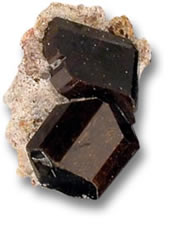
The less common tourmaline varieties include buergerite, dravite, liddicoatite and uvite. Buergerite, named after the MIT mineralogist Martin Buerger, is an iron-rich tourmaline variety that occurs in bronze, brown and black hues. Dravite is magnesium tourmaline that is dark-yellow to brownish-black in color. It is named after the Drava River area of what is now Slovenia. The most well-known gemstone variety of dravite is chrome tourmaline, or sometimes referred to as chrome dravite. Liddicoatite is a type of calcium tourmaline, named in honor of Richard Liddicoat, the GIA gemologist who invented the diamond grading system. It is found in a range of colors, including blue, brown, green, pink and red. Uvite is magnesium/iron-rich tourmaline and was named after a province in Sri Lanka. It is usually dark-green to black in color. One of the unusual features of uvite is that it tends to form stubby crystals rather than long prismatic crystals like most other tourmaline varieties.
About Us
Overall Rating -> 8 The website was easy to use and there were a lot of good options, I was satisfied. Posted By Brielly in January, 2026 Source: Bizrate Overall Rating -> 9 the gems were smaller than I thought but I was at fault for not reading the complete discrimination Posted By Tim in May, 2025 Source: Bizrate Overall Rating -> 10 My experience was done with ease Posted By Barb in October, 2025 Source: Bizrate Overall Rating -> 10 Great selection. Maybe too great i kept adding and deleting stuff because i found better looking ones Posted By Edsor works in October, 2025 Source: Bizrate Related Articles Tourmaline Gemstone Information Tourmaline Information - The most colorful gem on Earth Natural Gem, Unnatural Name Natural Gemstones, Unnatural Names Tourmaline Buying Guide Tourmaline Buying Guide - What to look for in tourmaline? Mozambique Tourmaline Mozambique Tourmaline Gemstones - One man's lucky strike. Tourmaline in America Tourmaline in America - The US's home grown colorful gems. Tourmaline Value Tourmaline Value - Which is the most valuable variety? Hemimorphite Gems Hemimorphite Gems Paraiba Tourmaline Gems Paraiba Tourmaline Gemstones - Brazil's dazzling discovery Chrome Tourmaline Gemstone Information Chrome Tourmaline Information - an extremely rare green gem Mikimoto Kokichi Mikimoto Kokichi: Legendary Jeweler, Cultured Pearl Inventor Native American Jewelry Native American Navajo Tribal Jewelry |