





 Free Report
Included
Free Report
Included
 Worldwide
Shipping
Worldwide
Shipping
 30 Day
Returns
Free Report
Included
Worldwide
Shipping
30 Day
Returns
30 Day
Returns
Free Report
Included
Worldwide
Shipping
30 Day
Returns
GemSelect Newsletter - September 2007In our newsletter this month:
Understanding Gem Treatments Back to Top
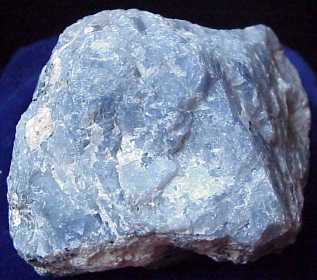
Rough Sapphire from Madagascar
If you're new to buying colored gemstones, one of the first things you'll learn is that many gems have been treated or enhanced in some way - heated, fracture-filled, irradiated or dyed, to mention just some of the common treatments. This leads many buyers to wonder, Should I buy a treated stone? Or should I spend more and get a truly natural gem? This month we begin a series of articles on understanding gem treatments. Here is one response to the question: Gemstones are a wondrous product of nature, and their natural beauty should not be enhanced or improved in any way. Some say that if you don't care about buying a truly natural product, you should buy a synthetic or a treated gemstone. But only nature can produce a true ruby, sapphire or emerald. Many gemstone buyers would endorse this point of view. But it is actually quite naive. After all, you don't see many people wearing unprocessed minerals on their fingers or around their necks. We expect natural minerals to be improved by skillful cutting and polishing. Gems don't come out of the ground with a facet cut! If you've seen rough, uncut sapphire (see the photo above for an example) you were probably amazed that a brilliant blue sapphire could be produced from that clump of dull aluminum oxide crystals. As we think about this further, we realize that gemstones are a product of the human crafting of natural materials. The pertinent question is, what kinds of enhancements are acceptable? And how do these enhancements affect the price and value of a gemstone? One common misconception is that only inexpensive gems are treated. However, many valuable gem varieties are routinely treated. Tanzanite, for example, is an increasingly rare and valuable gem. A great deal of the tanzanite on the market is heat treated, since untreated tanzanite can have brown or yellowish tones. The heat eliminates these undesirable hues and enhances the blue-violet color. The situation with emerald is similar - even very expensive emeralds are oiled to fill fractures that are characteristic of the raw material. Many relatively inexpensive gem varieties, on the other hand, are rarely, if ever, treated. Garnet, amethyst, peridot, fire opal, fluorite, iolite, moonstone, quartz and prehnite are just some of the many gemstones that are almost always untreated. There are two main reasons why gemstones are treated. In the case of some gems, the treatment is essential to the gemstone's character as we know it. Blue topaz, for example, would not exist in vivid colors without irradiation treatment, since naturally occurring blue topaz is virtually nonexistent and has very subtle colors. Similarly, the characteristic banded patterns of many agates would not be so striking if these gems were not dyed using methods first discovered in ancient Rome. The other reason why gems are treated is to improve their color and clarity. In the case of a gem like emerald, the raw material tends to be quite included and fractured, and filling the fractures with oil or resin greatly improves the appearance of the gem. Thus fracture-filling has become a standard treatment for nearly all emeralds. In the case of ruby and sapphire, untreated stones of good color and clarity do exist, but they are increasingly rare and expensive. So heat treatment is used to improve the color and clarity of lesser quality material. The value of a ruby or sapphire enhanced by heating is, not surprisingly, lower than that of an unenhanced specimen with the same color and clarity. Unenhanced gems, of course, are extremely rare. Without the enhancements produced by heating, the supply of eye-clean ruby and sapphire of good color would be so limited that these gems would be available only to a tiny number of wealthy customers. So gem treatments are a way of dealing with market realities - the fact that the supply is scarce and demand is high. Next month we'll look at heat treatment in more detail; how and why it works, how it can be detected, and how it affects the integrity and stability of a gemstone. New in Gems Back to Top
Our buyers are always busy searching for the best value gems for our customers. Here are some of the excellent buys we've made in the last few weeks: Morganite from Afghanistan: Morganite is the pink variety of beryl, which belongs to the same family as emerald. It's quite hard to find, but a very lovely gem. We've found a small number of pieces in very good color, in weights from 1 to 2.5 carats. Peridot from Burma and China: We've expanded our selection of peridot with some excellent new pieces. Our new acquisitions include some interesting pairs and lots, in addition to our many large single pieces. Aquamarine from Mozambique: We have just bought 3 pieces of the finest aquamarine gems we have ever had the pleasure to own. These have very strong color, top clarity, and are a remarkable size - 2 pieces weigh around 6 carats and another weighs almost 12 carats! If you have ever wanted to own a really special aquamarine, these are for you. Ametrine from Bolivia: We've added many new pieces to our growing collection of this popular violet golden gem. Our latest additions are mainly in the 2 to 6 carat range, in a nice selection of shapes. These are very attractive pieces at a very affordable price. Cornflower Blue Sapphire from Sri Lanka and Africa: We've been buying some outstanding blue sapphire recently, in the finest cornflower blue. There are a nice range of pieces, with weights up to 3.35 carats, and some terrific matching pairs as well. We don't think sapphire of this quality will be available at these prices for long, so we are buying them as often as we can find them. Tsavorite Garnet from Tanzania: Some excellent tsavorite from Tanzania has appeared on the market recently, with top color and clarity. One of our best buys were some wonderful matched pairs in cushion cuts. If you've always wanted tsavorite earrings, here is your chance to create a really stunning pair. Spinel from Burma and Tanzania: We've recently found some of the finest spinel we have ever been offered at GemSelect. We've bought a wonderful range of really outstanding colors, especially red, violet, blue and pink. There are some very well-cut pieces in large sizes, as well as some first-rate matched pairs. Tourmaline from Mozambique and Nigeria: We are very active buyers of tourmaline and we add new pieces to our collection every week. We now have over 300 pieces of tourmaline in stock, in a huge variety of colors, shapes and sizes. Apatite from Madagascar: We've just bought some new stock in this hard-to-find gem, including some lovely light-green to forest green pieces that we haven't stocked before. A variety of shapes are available, in weights up to about 3.5 carats, including some matched pairs and lots. Lapis Lazuli from Afghanistan: This week we found some outstanding lapis lazuli in the richest of royal blue. Here's your chance to own a really fine specimen of one of the most traditional of gem materials. Sphene from Sri Lanka: We have added some new pieces to our stock of this rare gemstone that is famous for its remarkable dispersion. These are bright yellowish-green pieces in interesting shapes and cuts, mainly in the 2 to 3 carat range. Amethyst from Brazil: We've been finding some very good buys in Brazilian amethyst recently, including some excellent matching pairs in larger sizes (up to 9 carats per pair). We also have a nice selection of cabochons in addition to our many faceted pieces. Staff Selections Back to Top
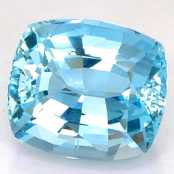
6.15-Ct VVS Aquamarine from Mozambique
Recently we were lucky enough to buy a few exceptional pieces of Mozambican aquamarine in large sizes. This 6-carat piece has excellent color saturation and superb brilliance. It is very well cut with no windowing. It is really a gorgeous gem. 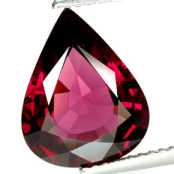
4.1-Ct VVS Spinel from Tanzania
Red spinel weighing 4 carats is rarely seen. Burmese red spinel is hardly ever found over 2 carats, but some larger pieces from Africa are occasionally seen. This purplish red pear-shaped gem is very clean with a wonderful luster. 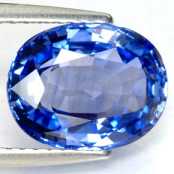
3.35-Ct VVS-VS Sapphire from Sri Lanka
This is a classic cornflower blue sapphire from Ceylon, but in an exceptionally large size - this gem weighs over 3.3 carats. We have found some extremely nice 2 carat pieces recently but clean blue sapphire with good color has become a rarity over 1.5 carats. Gemstones Worth Knowing Back to Top
Each month we focus on one of the lesser known gemstones. This month's featured stone is andalusite. 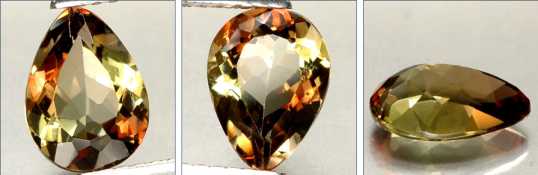
Andalusite
Andalusite is a strongly pleochroic gem, which means that it displays different colors when viewed from different angles. While it is a strikingly beautiful gem, it is largely unknown by the gem-buying public. With a hardness of 7 to 7.5 on the Mohs scale, it is suitable for all kinds of jewelry. Its pleochroism means that it shows shades of brown, green and reddish-brown, depending on the viewing angle. This can be enhanced by specific orientation and cut. Cuts with a long axis, such as an oval, marquis or emerald-cut, tend to show one color near the center and a second, usually darker color near the ends of the gem. Square and round cuts usually blend the colors into a mosaic. Most specimens contain some inclusions, the most common being rutile needles. Brazil is the chief producer of andalusite, but Sri Lanka, Russia, Spain and the USA also have deposits. For more information see our andalusite info page. Customer Questions Back to Top
Every month we answer questions of general interest from our customers. Please feel free to send your questions or suggestions to our support team at help@gemselect.com! Question
Thanks for your interesting article last month about gemology. What is the best way to start learning about the different gemstones? Can you suggest a book? GT, USA.
Answer
There are many fine introductions to gemstones and gemology, but the book we use every day in our business is Walter Schumann's classic Gemstones of the World (New York: Sterling Publishing, revised edition 2000). It is very comprehensive, quite readable and has excellent gem photos. It's one of the few books that is useful for novices as well as experts.
Question
I recently purchased some gemstones and they were smaller than I expected. Can you help me? AJ, USA.
Answer
While we can't make your gems larger, we think we know what went wrong. There is a lesson we all have to learn - weight is not the same as size in gemstones! Different gemstone materials have different densities (specific gravity), so some gems weighing 1 carat will appear larger than others. For example, a 1 carat sapphire is smaller than a 1 carat diamond because sapphire is a denser material. We have a weight comparison chart that allows you to compare the weight of different gemstones in calibrated sizes. We always give the exact dimensions of our gemstones in millimeters on our website, so don't forget to check the size as well as the weight!
Keep up with our new arrivals before they hit the newsletter by joining our thousands of fans and followers on our social networking pages. We love interacting with our customers - you can visit us on Tumblr, LinkedIn, Twitter, Facebook or Pinterest! To ensure you can receive our emails, please be sure to add help@gemselect.com to your list of safe contacts, or you add us into your email address book! Please feel free to contact us with any questions, comments and queries! We respond to each and every email we receive. Happy Gem Hunting!
About Us
Overall Rating -> 10 Love, and have always loved, your website. Posted By Aberabic in July, 2025 Source: Bizrate Overall Rating -> 10 I was looking for high-quality amethyst on this site, and I was able to compare size, color, and weight in detail before making a purchase. Posted By Atsuhisa in January, 2026 Source: Bizrate Overall Rating -> 9 Everything was good, the purchase was what I expected and what they show is what you get. Posted By Mr. in March, 2026 Source: Bizrate Overall Rating -> 10 I have shopped at Gemselect for nearly 20 years. I especially like that you see pictures of the exact gem you are purchasing. You are a trusted source. Posted By DNaber in October, 2025 Source: Bizrate Overall Rating -> 9 Easy to use. Many options to find the right gemstone Posted By Liz in May, 2026 Source: Bizrate Related Articles Sapphire Gemstone Information Sapphire Gemstone Guide: Colors, Meanings, Prices in 2026 Apatite Gemstone Information Apatite Gemstone Information - Natural Striking Colors Aquamarine Gemstone Information Aquamarine Gemstone Information: Colors, Meaning & More Emerald Gemstone Information Emerald Gemstone Information: Colors, Meaning, Prices Fire Opal Gemstone Information Fire Opal Gemstone Information: History, Properties and More Iolite Gemstone Information Iolite Gemstone: Facts, Benefits, Properties and More Orthoclase Gemstone Information Orthoclase Gemstone Information: Unveil Its Natural Beauty Rhodolite Garnet Gemstone Information Rhodolite Garnet: Rose-Red Gemstone Guide | GemSelect Ruby-Zoisite Gemstone Information Ruby-Zoisite Information - A unique gemstone mixture Spessartite Garnet Gemstone Information Spessartite Garnet: Guide to the Fiery Orange Gemstone Sphene Gemstone Information Sphene Gemstone Information - GemSelect Spinel Gemstone Information Spinel Gemstone Information: Colors, History, Value & More Tanzanite Gemstone Information Tanzanite Gemstone Information: Discovery, Value & More Topaz Gemstone Information Topaz Gemstone Information: Colors, History, Value and Guide Zircon Gemstone Information Zircon Gemstone Guide: Colors, Properties, and Buying Tips Mystic Topaz Gemstone Information Mystic Topaz Information - A kaleidoscope of colors Star Ruby Gemstone Information Star Ruby Gemstone Information - GemSelect Birthstones by Month Birthstones by Month, Every Birthstone, Zodiac & Anniversary Caring for Gemstones Gemstone Care - Gemstone Information - GemSelect Gemstone Hardness Explained Gemstone Hardness | Mohs Scale with Images and Charts Precious and Semi-Precious Gemstone Glossary Gemstone & Mineral Glossary - Gem Information | GemSelect Medicinal Gemstones Medicinal Gemstone Information - GemSelect Gemstone Treatments All About Gemstone Treatments - Information - GemSelect Fracture Filled Fracture Filled Treatment - Gemstone Information - GemSelect Gem Market Chanthaburi International Gemstone Market in Chanthaburi, Thailand Gemstone Prices Gemstone Prices: A review of what decides the amount you pay Loose Gemstones from Mine to Market Loose Gemstones From Mine to Market - Gems and Jewelry Info Precious Stones Precious & Semi-Precious Gemstone History, Legends & Myths Rare Tourmaline Rare Tourmaline Gemstones - Unique and distinctive varieties The Secret of Spinel The Secret of Spinel: Discover the Hidden Gemstone Gemstone Names Gemstone Names | Gem Name Origins, History, Lists and More About Chrome Diopside Discover the Beauty and Properties of Chrome Diopside Gems Apatite Gemstones Apatite Gemstones: Complete Guide to Colors, Uses & More Gemstone Meanings Gemstone Meanings - What are their powers and symbolic use? Blue Sodalite Gems Blue Sodalite Gemstones - Royal Blue from the snowy north |


