





 Free Report
Included
Free Report
Included
 Worldwide
Shipping
Worldwide
Shipping
 30 Day
Returns
Free Report
Included
Worldwide
Shipping
30 Day
Returns
30 Day
Returns
Free Report
Included
Worldwide
Shipping
30 Day
Returns
|
Reviewed By Andreas Zabczyk
All About Rutile in GemstonesRutile, a mineral composed primarily of titanium dioxide, plays a significant role in the gemstone industry due to its unique properties and aesthetic appeal. Often found as needle-like inclusions within other gemstones, such as quartz, rubies and sapphires, rutile in gemstones can enhance the visual characteristics of these stones, contributing to their beauty and desirability. Additionally, rutile is the primary cause of optical effects like asterism (the star effect) and chatoyancy (the cat's eye effect). These unusual phenomena are created by microscopic rutile inclusions within the gemstones. In rutilated quartz, rutile becomes visible through large needle-like inclusions, forming captivating and individualistic patterns. Browse through our rutile quartz for sale. 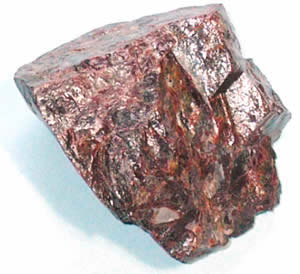
Rutile Rough Stone
But what exactly is rutile? Where does it come from? Can you buy gemstones made entirely from rutile? Rutile is a mineral composed primarily of titanium dioxide. Its refractive index is among the highest of any known mineral, at 2.616 to 2.903. Diamond, by contrast, has a refractive index of 2.417 to 2.419. Natural rutile varies in color and can be golden, blood red, reddish-brown or black, with the color resulting from the presence of iron (sometimes up to 10%). It has a density or specific gravity of 4.20 to 4.30 and a hardness rating of 6 to 6.5 on the Mohs scale. The most important rutile deposits are in Sierra Leone in West Africa where 30% of the world's supply is located. Other deposits are found in Minas Gerais, Brazil, the Swiss Alps and Arkansas in the USA. 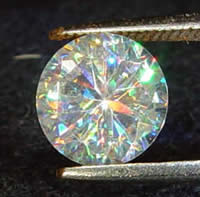
Synthetic Rutile
Natural rutile is rarely found as a gemstone (it is mostly seen as inclusions in other gems) and is classified as a collector's stone. Synthetic rutile was first produced in 1948, by a special variation of the Verneuil method, using extra oxygen. The high refractive index gives an adamantine luster and strong refraction that leads to a diamond-like appearance. Synthetic rutile was sold as a diamond simulant in the 1950s, under names such as Titania. However, because rutile is not especially hard, it was eventually replaced by more durable diamond simulants. Rutile has some important industrial applications. Finely powdered rutile produces a brilliant white pigment that is used in paint, plastic, paper, food, and other materials that call for a bright white color. Titanium dioxide is also a key ingredient in many sunscreen products. Nanoscale particles of rutile are transparent to visible light but are highly effective in the absorption of UV light. So sunscreens made with titanium dioxide can protect against UV induced skin damage.
About Us
Overall Rating -> 10 Great experience. I can't wait to explore on the website further. Posted By Kymmie in September, 2025 Source: Bizrate Overall Rating -> 9 Fast snd easy to find what I was looking for Posted By Bawb in May, 2026 Source: Bizrate Overall Rating -> 10 Had a great experience and the prices are great Posted By BuBx99 in November, 2025 Source: Bizrate Overall Rating -> 10 I had a very easy time navigating the web page and using filters to find what I was looking for. The varied selection was nice to see and pricing is clear and fair. Posted By Mattick in May, 2026 Source: Bizrate Related Articles Gemstone Type List Gemstone List - Names, Colors & Types of Gems | GemSelect Rutilated Quartz Prices Rutile Quartz Prices: Insights into Rutilated Gems Market Rutile in Gems Rutile in Gems Synthetic Moissanite Synthetic Moissanite - Diamond Substitute or Gem on its Own? White Gemstones White Gemstones: List of White Precious & Semi-Precious Gems Rutilated Topaz Rutilated Topaz Information: Facts and Insights Rutile Topaz Gemstone Information Rutile Topaz Gemstone Information - GemSelect |


