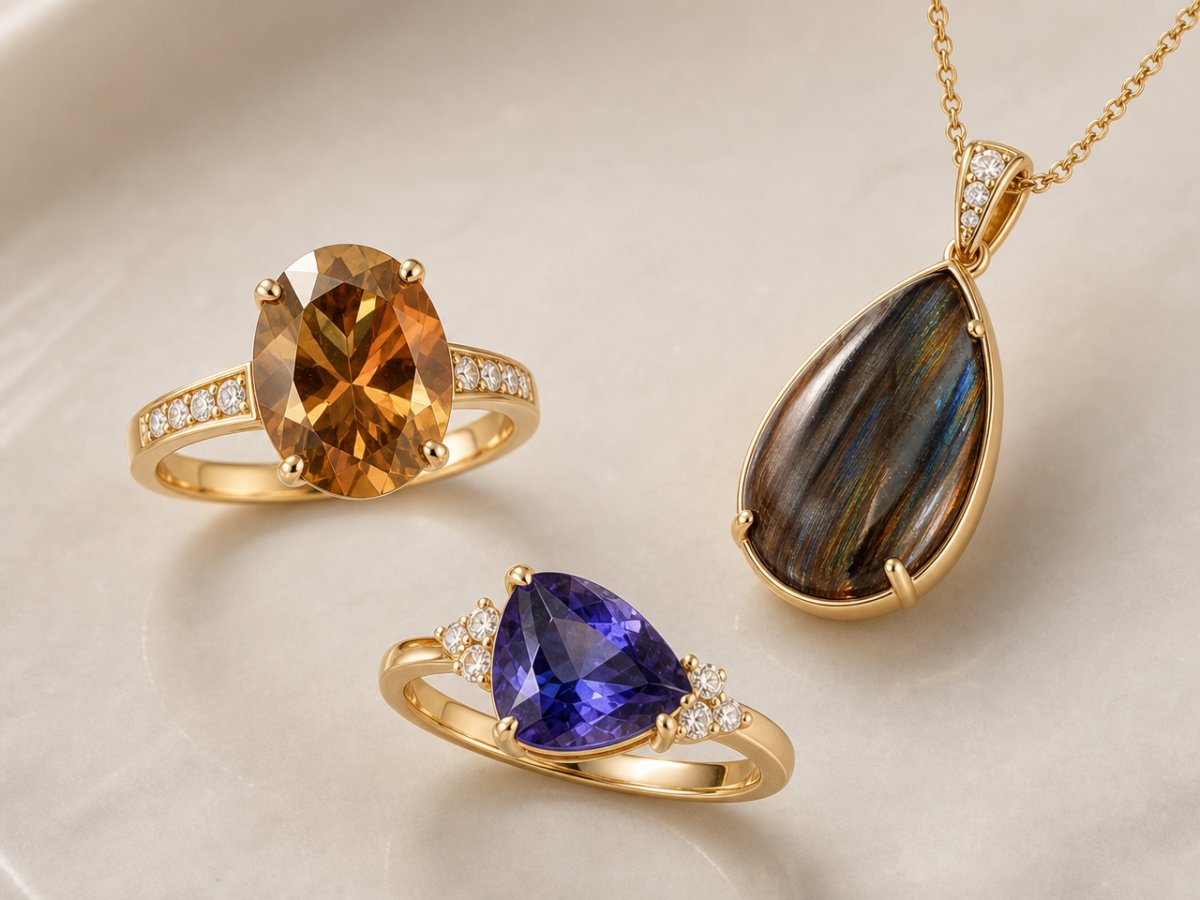


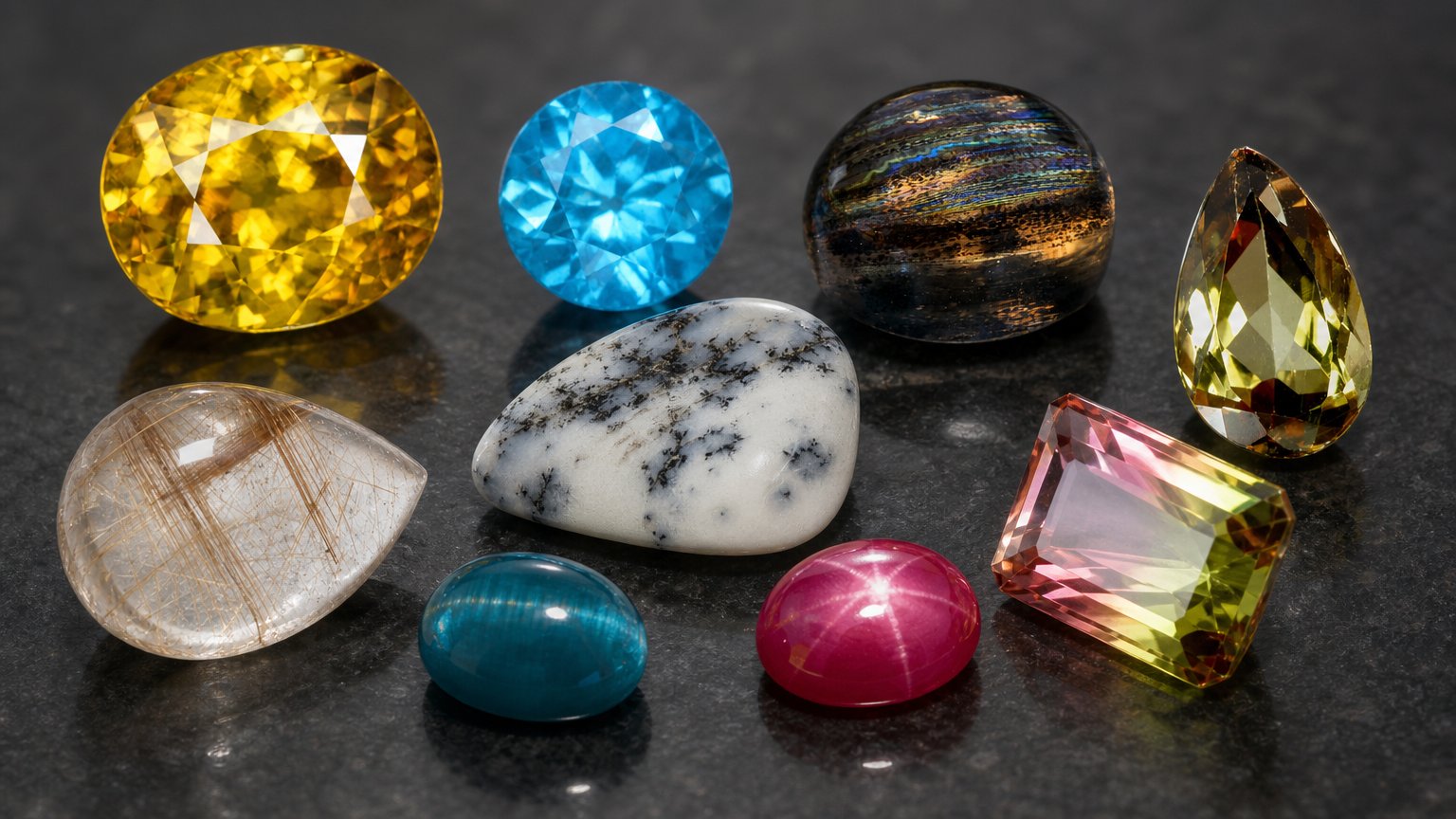
Handmade jewelry gives a gemstone room to be itself. Instead of forcing every stone into a calibrated commercial mounting, a jeweler can build the setting around the actual gem: its depth, outline, color zoning, inclusions, glow, or slightly awkward but interesting proportions.
That is why unusual gemstones are especially useful for independent jewelers, metalsmiths and small studios. Unusual does not have to mean extremely rare or expensive. It can mean a familiar gem family in an unexpected color, a cabochon with a strong optical effect, a transparent stone with dramatic pleochroism, or a quartz filled with needles, mossy inclusions or dendritic patterns.
The best unusual gemstone for handmade jewelry is not simply the strangest one. It is the stone that gives the maker a clear design idea.
Transparent gemstones with unusual color and light
Some less-common faceted gems are valuable to designers because they bring a different kind of light to a piece. They may not be the standard choices for mass-market rings, but in pendants, earrings, brooches and protected settings they can create a strong point of view.
Sphene: sharp color and strong fire
Sphene, also known as titanite, is prized by gem cutters and collectors for its strong dispersion, the optical effect that separates white light into flashes of spectral color. In yellow-green, golden, brownish or green tones, a well-cut sphene can look energetic and almost electric under the right lighting.
For jewelry design, sphene works well where light can enter the stone: open-backed pendants, earrings, carefully protected brooches or occasional-wear rings. Because sphene is relatively soft for a faceted jewelry stone and can be brittle, it is usually better kept away from exposed everyday ring settings. A bezel or protective setting can make it more practical while still allowing the stone to do what it does best: flash.
Zircon in champagne, honey, green and earth tones
Zircon is often thought of in blue, but its less-familiar colors can be more interesting for handmade jewelry. Champagne, cognac, honey, olive and earthy reddish-brown zircons can bring antique warmth or a mineral, almost architectural quality to a design. Zircon is also highly brilliant, so even a restrained color can look lively.
Designers can use these colors as alternatives to more familiar yellow or brown gems, especially in mixed-metal work. Warm zircon pairs well with textured gold, oxidized silver or bronze-toned design palettes. Zircon can show wear on facet edges if used roughly, so ring designs should protect corners and high points.
Apatite: vivid color with a softer jewelry role
Apatite is appealing because it appears in colors that can be difficult to find elsewhere, including intense blue-green, teal, yellow and green. In handmade jewelry, apatite can provide a fresh, saturated color accent without relying on the most common commercial gems.
Its limitation is durability. Apatite is not a tough everyday ring stone, so it is better suited to earrings, pendants, protected accent settings or occasional-wear pieces. Small apatite accents can be especially effective around more durable center stones, where the color does the work without asking the gem to take heavy wear.
Scapolite: soft golden, pink and violet tones
Scapolite has a gentler look than many mainstream faceted gems. Depending on the stone, it may appear in yellow, honey, pinkish, violet or near-colorless shades. It often suits designs that need a quiet transparent gem rather than a high-contrast focal point.
Because scapolite is not a standard commercial jewelry stone and is not among the harder gems, it is most practical in pendants, earrings and brooches. Its appeal is subtle: a soft colored center in a hand-fabricated setting, or a group of related but not identical stones in an asymmetrical composition.
Gems that change color as you move them
For makers, a gemstone that shifts color with orientation or lighting can become the central idea of the jewel. The setting, metal color and stone position all influence what the wearer sees.
Iolite: directional blue, violet and gray
Iolite is strongly pleochroic, meaning it can show different colors from different viewing directions. A stone may appear violet-blue from one angle and grayish or nearly colorless from another. This can be a challenge for cutting, but it is also a design opportunity.
A jewelry designer can use iolite where movement matters: dangling earrings, articulated pendants or rings designed to be viewed from more than one angle. Its cool blue-violet color works well with white metals, oxidized silver and restrained modern settings. Iolite is reasonably hard, but like many gems it still benefits from thoughtful protection, especially in rings.
Andalusite: mixed green, brown and reddish flashes
Andalusite is one of the most useful unusual faceted gems for designers who like complex color. It commonly shows pleochroic mixtures of brown, green, yellowish and reddish tones. Instead of presenting one simple color, the stone can look different across the crown as it moves.
This quality makes andalusite suitable for organic, woodland, autumnal and architectural designs. It can replace a simple brown or green stone when the piece needs more visual tension. Ovals, cushions and elongated shapes can all work well, especially when the metalwork frames the stone rather than competes with its shifting color.
Diaspore and other color-change gemstones
Color-change gemstones are especially engaging in handmade jewelry because the wearer experiences the stone differently in daylight, indoor lighting and low light. Diaspore is one example known for color shift, and color-change effects also occur in some garnets, sapphires and other gems.
When using color-change material, the practical question is not just the gem name but the actual degree and direction of the change. A stone that shifts from greenish to pinkish suggests a very different design than one that moves between warm brown, yellow or muted purplish tones. Designers should evaluate actual photos and, when possible, view the stone under more than one lighting condition.
Stones with internal drawings: inclusions as design features
In mass-market jewelry, inclusions are often treated mainly as flaws. In handmade jewelry, selected inclusions can become composition. The difference is intention. A clean, structurally sound included stone with visible pattern can be more useful than a technically clearer stone with no personality.
Rutilated quartz and tourmalinated quartz
Quartz with rutile needles or black tourmaline inclusions gives the designer line, direction and internal structure. Golden rutile can look like fine metallic threads suspended in clear or smoky quartz. Black tourmaline inclusions create stronger graphic contrast, often with a more modern or sculptural feel.
These stones work well in bezel-set pendants, large statement rings, cuff components and brooches where the surface area lets the inclusions be seen. Orientation matters: a rutile spray that points diagonally across a pear shape can suggest movement, while vertical inclusions in a long rectangle can feel architectural. The maker can choose the stone as if choosing a drawing.
Dendritic agate and patterned chalcedony
Dendritic agate and related patterned chalcedonies can show dark branching inclusions that resemble plant forms, smoke, coral or ink wash. No two stones are identical, which makes them especially suitable for one-of-a-kind pieces.
These materials are often cut as cabochons, tablets or freeforms. They suit bezel settings, backplates, shadowbox designs and asymmetrical metalwork. A jeweler can leave open space around the pattern, echo the branch lines with wire or engraving, or place the stone off-center so the pattern controls the composition.
Included quartz, mossy stones and scenic cabochons
Included quartz and mossy or scenic cabochons can suggest landscapes, underwater plants, clouds or mineral textures. Their usefulness depends heavily on the individual stone. Some inclusions look balanced and intentional; others may appear cloudy, distracting or structurally concerning.
For handmade jewelry, these stones are strongest when the setting respects the image inside the gem. A low bezel, a simple frame or a pendant with negative space can be more effective than a complicated mounting that interrupts the internal pattern.
Optical-effect gems for movement and surface drama
Some unusual gemstones are cut as cabochons because the visual effect depends on a domed surface. These stones do not need complex faceting; their interest comes from a band of light, a floating glow or a star that moves as the wearer moves.
Moonstone, labradorite and other feldspar varieties
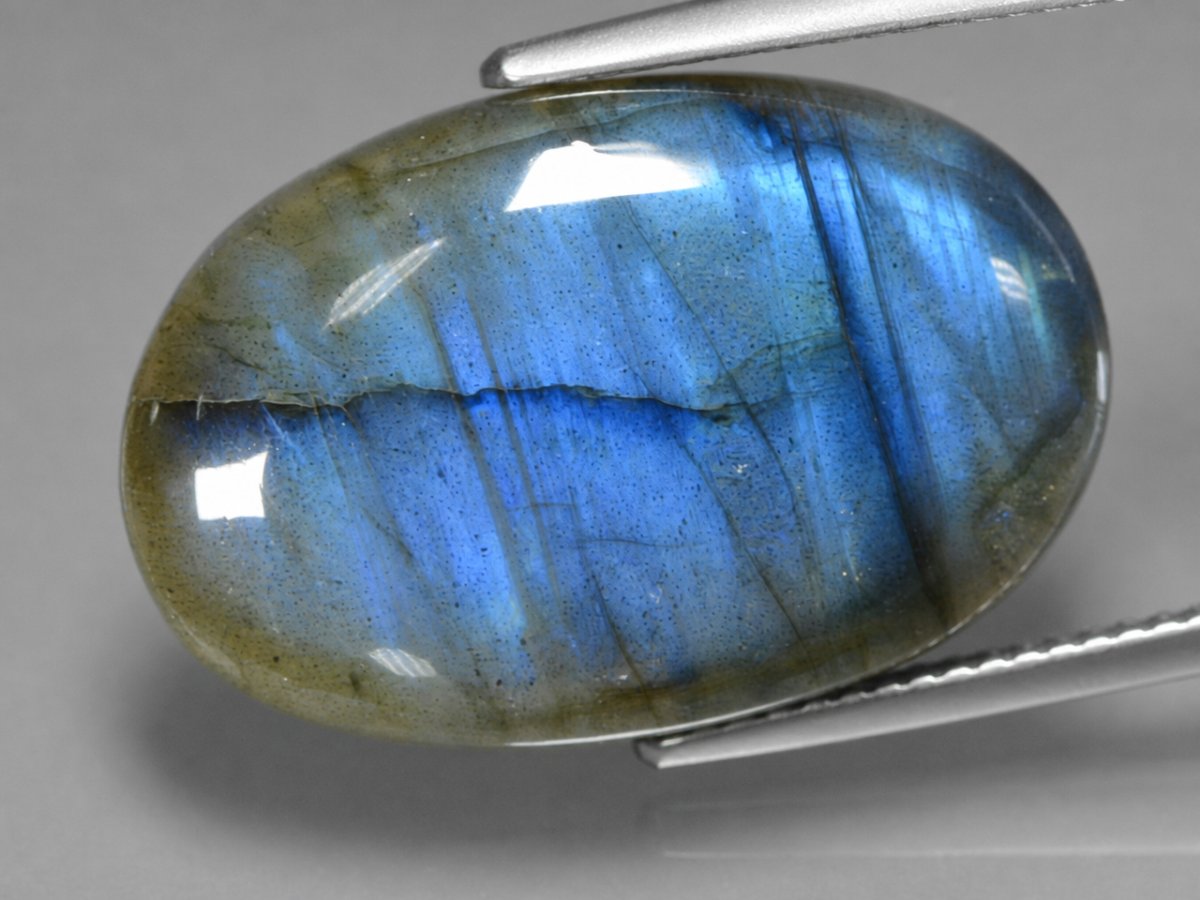
Moonstone is valued for adularescence, a floating glow that can appear white, blue or silvery depending on the stone. Labradorite shows labradorescence, often in blue, green, gold or multicolor flashes across a darker body. Both can be highly individual, and both reward careful orientation in the setting.
These feldspar gems are useful for pendants, earrings, brooches and protected rings. Their cleavage and moderate hardness mean exposed ring designs should be approached with care. A bezel, raised rim or recessed setting helps protect the dome while allowing the optical effect to remain visible.
Cat's-eye chrysoberyl and other cat's-eye gems
Cat's-eye gems display chatoyancy: a narrow band of light that appears to glide across the surface of a cabochon. Chrysoberyl is one of the best-known and more durable cat's-eye materials, while cat's-eye effects can also appear in quartz, tourmaline, apatite and other gems.
The design challenge is orientation. The line should be centered and visually intentional when the jewel is worn. Cat's-eye cabochons can be powerful in simple rings, signet-style designs, pendants and men's jewelry, but the setting should not hide the dome or distort the effect.
Star gemstones
Star gems show asterism, a star-like pattern of light caused by oriented inclusions and a suitable cabochon cut. Star sapphire and star ruby are well known, but star effects can also occur in other materials. The star is strongest when the stone is properly oriented and viewed under a direct light source.
In handmade jewelry, star stones work best when the design gives the cabochon visual importance. Heavy decorative prongs, tall bezels or busy surrounding stones can distract from the star. A clean protective setting often serves the effect better.
Unusual varieties within familiar gem families
A maker does not have to leave familiar gem families entirely to find unusual design material. Garnet and tourmaline, for example, offer a wide range of colors and optical personalities beyond their most common associations.
Unusual garnets
Garnet is more varied than the standard deep red image suggests. Rhodolite can offer raspberry and purplish tones; spessartite can bring orange to reddish orange; grossular varieties may appear green, yellowish or cinnamon-like; and some garnets show color-change behavior. Demantoid garnet is known for strong dispersion, though fine examples are often regarded as collector or high-end jewelry stones.
For designers, garnet's range allows color stories that feel familiar in durability but less expected in appearance. Mixed garnet clusters can create deliberate color transitions, while one unusual garnet can serve as a compact focal stone in a ring or pendant. As always, the exact variety, inclusions and cut affect suitability.
Bi-color and watermelon tourmaline
Tourmaline is especially useful when the stone preserves color zoning. Bi-color and watermelon tourmalines may show green, pink, red, yellowish or near-colorless zones in a single crystal. Slices, elongated cuts and step cuts can emphasize the zoning rather than hide it.
Custom metalwork is a major advantage here because many color-zoned tourmalines are cut in non-calibrated shapes. A pendant can follow a long crystal-like outline, while a ring can frame a rectangular or shield-shaped stone with a bezel that protects the edges. Tourmaline is suitable for many jewelry uses, but included or heavily fractured stones need individual assessment, especially for rings.
Kunzite and hiddenite
Kunzite and hiddenite are varieties of spodumene: kunzite is usually pink to lilac, while hiddenite is green. Both can show attractive pleochroism, and both can look especially graceful in elongated cuts.
The practical limitation is cleavage. Spodumene gems should be set and worn with care, and they are generally better for pendants, earrings or occasional-wear rings with protective settings. Kunzite is also known to be sensitive to prolonged strong light in some cases, so designs intended for constant sun exposure are not ideal.
Unusual cuts and custom settings
Many unusual gemstones appear in standard ovals, cushions, rounds and pears, and those conventional shapes can be ideal if the color or optical effect is already distinctive. But handmade jewelry also gives designers freedom to use stones that would be difficult in commercial mountings.
Freeforms, asymmetrical cuts, rose cuts, fantasy cuts, carved stones, briolettes, elongated rectangles and unusually deep gems can all become starting points for metalwork. Non-calibrated dimensions are not a problem if the maker is fabricating the setting from the stone outward.
Cabochons deserve particular attention. A patterned cabochon can behave almost like a small painting. A star or cat's-eye cabochon needs the dome exposed and the effect oriented correctly. A high-domed moonstone may need a taller bezel, while a flat-backed dendritic agate may suit a low frame or shadowbox setting.
Buying individual loose gemstones for handmade jewelry
With unusual material, the gemstone name is only the beginning. Two stones sold under the same variety name can look completely different because of color distribution, inclusions, cut, depth, orientation or optical effect. This is why selecting the actual individual gemstone matters.
When buying loose gemstones online, pay attention to actual photographs rather than relying only on the gem variety. Check exact dimensions, including depth, because a deep stone may require a custom setting or a raised design. Look at the outline, the position of color zoning, visible inclusions, the direction of chatoyancy or asterism, and whether the stone is sold singly, as a pair or as part of a lot.
Treatment disclosure is also important. Some treatments are common and accepted for particular gems, while others may affect care, durability or disclosure to your own customer. If a stone will be used in a ring, also consider whether its corners, cleavage directions, inclusions or exposed dome need extra protection.
GemSelect is useful for this kind of selection because jewelry makers can browse individual loose gemstones across many gem types, colors, shapes, cuts and dimensions. For unusual stones, being able to compare the actual pieces helps the designer choose the gem that fits the design rather than designing from a generic name.
A practical way to think about unusual gemstones
Unusual gemstones are not automatically better because they are scarce, expensive or unfamiliar. For handmade jewelry, a stone becomes valuable when it offers something to design around: a line of rutile, a drifting moonstone glow, a cat's-eye band, a green-brown pleochroic shift, a warm zircon flash or a cabochon pattern that exists only once.
The best approach is to let the gemstone suggest the structure of the jewel. Protect the materials that need protection, choose settings that serve the optical effect, and use natural variation deliberately. In artisan work, individuality is not an obstacle to production; it is often the reason the piece exists.