


Asterism is the star-shaped optical effect seen in certain sapphires. Under the right light, narrow bands of reflected light cross one another on the curved surface of the gem, forming a star that appears to float and move as the stone, the observer or the light source changes position.
The effect is beautiful, but it is not magic and it is not simply a mark drawn on the stone. In star sapphire, asterism comes from the organized relationship between the sapphire crystal, microscopic inclusions inside it, the way the gem is cut and the way light strikes the finished cabochon.
What Is Asterism?
Asterism is an optical phenomenon in which a gemstone displays a star-like pattern of light. In sapphire, the star is usually made of intersecting bright bands that cross over the top of a domed cabochon.
The simplest way to understand the process is:
- very fine oriented inclusions inside the sapphire,
- arranged in parallel systems,
- reflecting or scattering light into narrow bands,
- with several bands crossing one another,
- to create the visible star.
Sapphire is the gem variety of corundum. Asterism occurs only in some sapphires, when the stone contains large numbers of extremely fine inclusions aligned in specific directions within the corundum crystal.
What Does a Star Sapphire Look Like?
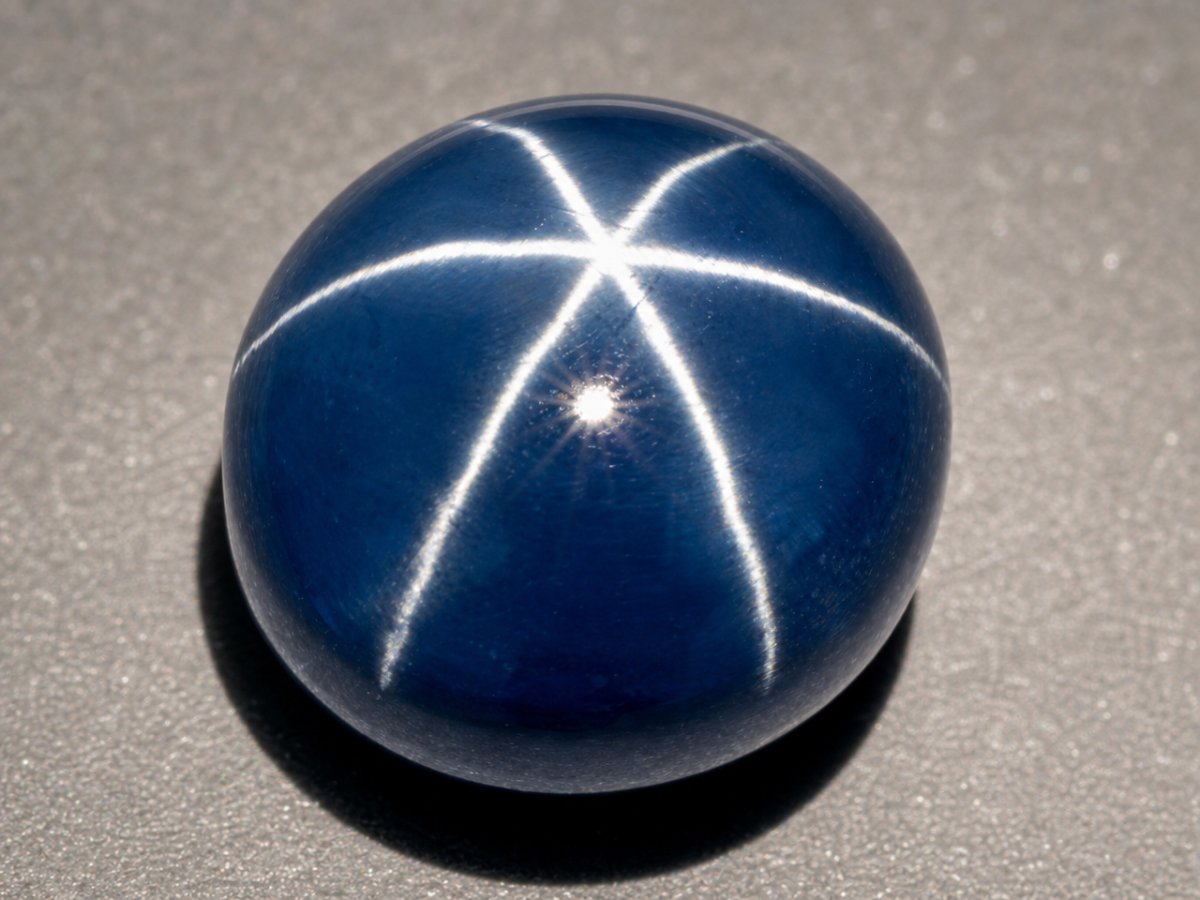
A well-formed star sapphire shows a star that appears to rest on, or just below, the curved dome of the gemstone. The star is not fixed like a painted line. It should shift smoothly across the surface when the cabochon is tilted under a single bright light.
Most star sapphires show six rays: three bright bands crossing through a central point, with each band extending in two directions. The appearance depends on the bodycolor of the sapphire, the quality of the star, the transparency of the stone and the lighting conditions.
The Microscopic Inclusions Behind the Star
Inclusions are materials or structural features enclosed within a gemstone. In many transparent faceted gems, visible inclusions may reduce clarity. In star sapphire, however, the right type of inclusion can create the gem's most important visual feature.
The inclusions responsible for asterism are typically too small to see individually without magnification. Their importance lies not only in their presence, but in their organization. Random particles scattered through sapphire would not create a clean star. To produce asterism, many fine inclusions must be directionally oriented so that they interact with light in an organized way.
What Is Rutile Silk?
In many natural star sapphires, the star is associated with microscopic needle-like inclusions commonly called silk. These needles are often rutile, a titanium dioxide mineral, although the exact inclusion story can vary from stone to stone.
The word silk is used because fine needles can give sapphire a soft, silky appearance. In a star sapphire, this silk is not just a haze. When the needles are arranged along specific crystallographic directions in the corundum, they can reflect or scatter light in a controlled pattern.
This is why it is not enough to say that rutile causes the star. Rutile needles can contribute to asterism, but their orientation within the sapphire crystal is essential. The inclusions must be arranged in the right directional systems, and the gemstone must be cut correctly for the star to appear clearly.
Why the Inclusions Must Be Oriented
Corundum has an orderly crystal structure. During growth and later geological processes, fine inclusions can develop along preferred directions that relate to that structure. In star sapphire, these inclusions are commonly grouped into sets of parallel needles.
One set of parallel inclusions can create one narrow band of reflected light. Several sets, each running in a different direction, can create several bands at the same time. Where those bands cross, the eye sees a star.
A useful mental image is three sets of microscopic lines inside the sapphire, each set running in a different direction but each line within a set remaining parallel. When light strikes the curved cabochon, each set contributes one bright band. The bands intersect at or near the top of the dome when the stone is properly cut.
How Reflected Light Creates the Star
The star is produced when light interacts with the oriented inclusions. Light entering or striking the domed sapphire is reflected or scattered more strongly from inclusion systems that are aligned in the right way relative to the light and the viewer.
Each parallel inclusion system creates a narrow luminous band. This is similar in principle to chatoyancy, the cat's-eye effect seen in some gemstones. In a chatoyant gem, one dominant band of light forms a single eye. In an asteriated gem, multiple bands from differently oriented inclusion systems appear together and cross, forming a star rather than one eye.
Why Do Most Star Sapphires Have Six Rays?
Most star sapphires display six rays because the oriented inclusion systems in corundum commonly produce three bright bands. Each band stretches across the dome in two opposite directions, so three bands create six visible rays.
This pattern is connected to the symmetry and crystallographic orientation of corundum. The internal inclusion directions follow the structure of the sapphire crystal, not random surface directions. When the rough is oriented correctly and cut as a cabochon, the three bands intersect to form the familiar six-rayed star.
Can Star Sapphires Have Four or Twelve Rays?
Yes, other star patterns can occur, but they are less typical than the six-rayed star. Four-rayed star sapphires may result from a different arrangement of inclusion systems. Twelve-rayed stars can involve additional or overlapping inclusion systems that produce more bands of light.
Unusual ray counts should be described carefully. Not every four-rayed or twelve-rayed star has the same cause, and the ray count alone does not identify origin, treatment or value. It simply shows that the stone's internal reflecting systems and cutting orientation are producing a different pattern.
Why Star Sapphires Are Cut as Cabochons
Star sapphire is normally cut as a cabochon: a smooth, rounded, unfaceted shape with a curved dome. This shape is essential because the dome provides the surface across which the reflected bands of light can gather and travel.
Facets break light into many small reflections. That can be desirable for brilliance in a transparent sapphire, but it usually prevents a clean star from forming. A continuous curved cabochon allows the inclusion-related bands to appear as flowing lines across the top of the stone.
How Cutting and Orientation Affect the Star
Cutting a star sapphire is not only a matter of shaping a dome. The cutter must orient the rough correctly relative to the internal inclusion directions. If the crystal is positioned properly, the star will be centered on the top of the cabochon. If not, the star may sit off to one side, appear incomplete or fail to show strongly.
The height and curvature of the cabochon also matter. A dome that is too shallow, too steep or unevenly shaped can distort the reflected bands. Good cutting helps produce a centered intersection, complete rays and smooth movement as the stone is tilted.
For a buyer or designer examining a star sapphire, useful observations include whether the star is centered, whether all rays reach across the dome, whether the rays remain visible from different angles and whether the cabochon shape supports the effect rather than fighting it.
Why Does the Star Move?
The star moves because asterism is a light effect, not a fixed object inside the gem. As the light source, gemstone and observer move relative to one another, the area where light is most strongly reflected from the oriented inclusions also changes.
On a curved cabochon, this changing reflection point appears as a star traveling across the dome. A good star should move naturally and smoothly when the stone is tilted under a small directional light.
Why Are Some Stars Sharp and Others Fuzzy?
A strong star usually has sharp, distinct rays; complete bands extending across the dome; good contrast against the sapphire's bodycolor; a centered intersection; and smooth movement when the stone is tilted.
Some stars look fuzzy or diffuse because the inclusions are too thick, too dense, unevenly distributed or imperfectly oriented. If the sapphire is very cloudy, the star may lack contrast. If the bodycolor is very dark, the rays may be harder to see. If the cutting orientation or cabochon curvature is poor, the star can appear off-center, broken or weak.
A soft star is not always unattractive. Some buyers enjoy a gentle, silky appearance. However, when evaluating the optical effect itself, sharper and more complete rays are generally easier to appreciate.
Transparency vs. Strength of Asterism
There is often a trade-off between transparency and asterism. The inclusions that create the star can also reduce transparency by scattering light inside the stone. For this reason, strongly asteriated sapphires are commonly translucent or opaque rather than highly transparent.
This is one reason inclusions in star sapphire should not automatically be treated as flaws. In this gem, the right inclusions in the right arrangement create the desirable phenomenon. Without them, there would be no star.
How to View Asterism Properly
A star sapphire usually shows its star best under a single, relatively small directional light source. Direct sunlight, a small flashlight or a focused lamp can reveal the star much more clearly than broad diffuse lighting.
To observe the effect:
- Place the cabochon under direct sunlight or a small bright flashlight.
- Hold the stone so the dome faces you.
- Move the light or gently tilt the gem.
- Look for intersecting bands that travel across the curved surface.
- Compare how the star appears under focused light versus cloudy daylight or large overhead lighting.
Diffuse light comes from many directions at once, so the reflected bands can lose contrast. Under a concentrated light source, the geometry is clearer and the star usually appears sharper.
How Heat Treatment Can Affect Asterism
Heat treatment can affect the inclusions that produce a star. Under certain heating conditions, rutile silk may be altered, reduced or dissolved, which can weaken or remove a natural star. This is one reason a sapphire that once contained visible silk may not display the same optical effect after treatment.
Conversely, some treatment processes can be used to create or enhance asterism by encouraging suitable inclusion or particle arrangements. The important point for understanding the phenomenon is that asterism depends on internal structures. If those structures are changed, the star can change too.
Natural vs. Induced Asterism
The presence of a star does not, by itself, prove that a sapphire is untreated. It also does not prove that the material is natural. Natural star sapphires exist, and induced or enhanced stars can also exist.
Reliable separation of natural, treated and synthetic star sapphires may require gemological testing. Simple at-home observations, such as checking whether a star moves or counting rays, are useful for seeing the optical effect but not reliable for determining origin or treatment.
Asterism vs. Other Optical Effects
Asterism is related to some optical effects but should not be confused with them:
- Chatoyancy: a single cat's-eye band caused by light reflecting from aligned internal structures.
- Asterism: multiple chatoyant-like bands intersecting to form a star.
- Adularescence: a soft floating glow, best known in moonstone.
- Labradorescence: flashes of color caused by light interference in minerals such as labradorite.
- Color change: a shift in bodycolor under different light sources.
- Aventurescence: glittery sparkle from reflective inclusions.
The key feature of star sapphire is the organized, star-shaped reflection created by oriented inclusion systems and cabochon cutting.
Other Gemstones That Can Display Stars
Sapphire is not the only gemstone capable of asterism. Ruby, which is also corundum, can show the same general type of star effect. Star effects are also known in several other gemstone species, including some quartz, garnet, spinel and diopside.
Even so, star sapphire remains one of the best-known examples because its corundum structure, silk inclusions and cabochon cutting can combine to produce a clear and attractive star.
Conclusion
A star sapphire is a gemstone where inclusions become part of the beauty. The star is created when fine, directionally oriented inclusions inside corundum reflect or scatter light as narrow bands. Multiple inclusion systems create multiple bands, and when those bands intersect on a properly oriented cabochon, the familiar star appears.
For anyone viewing or choosing a star sapphire, lighting and cutting are as important to understanding the effect as the inclusions themselves. A concentrated light source, a well-shaped dome and correct crystal orientation allow the asterism to appear clearly and move naturally across the gem.

