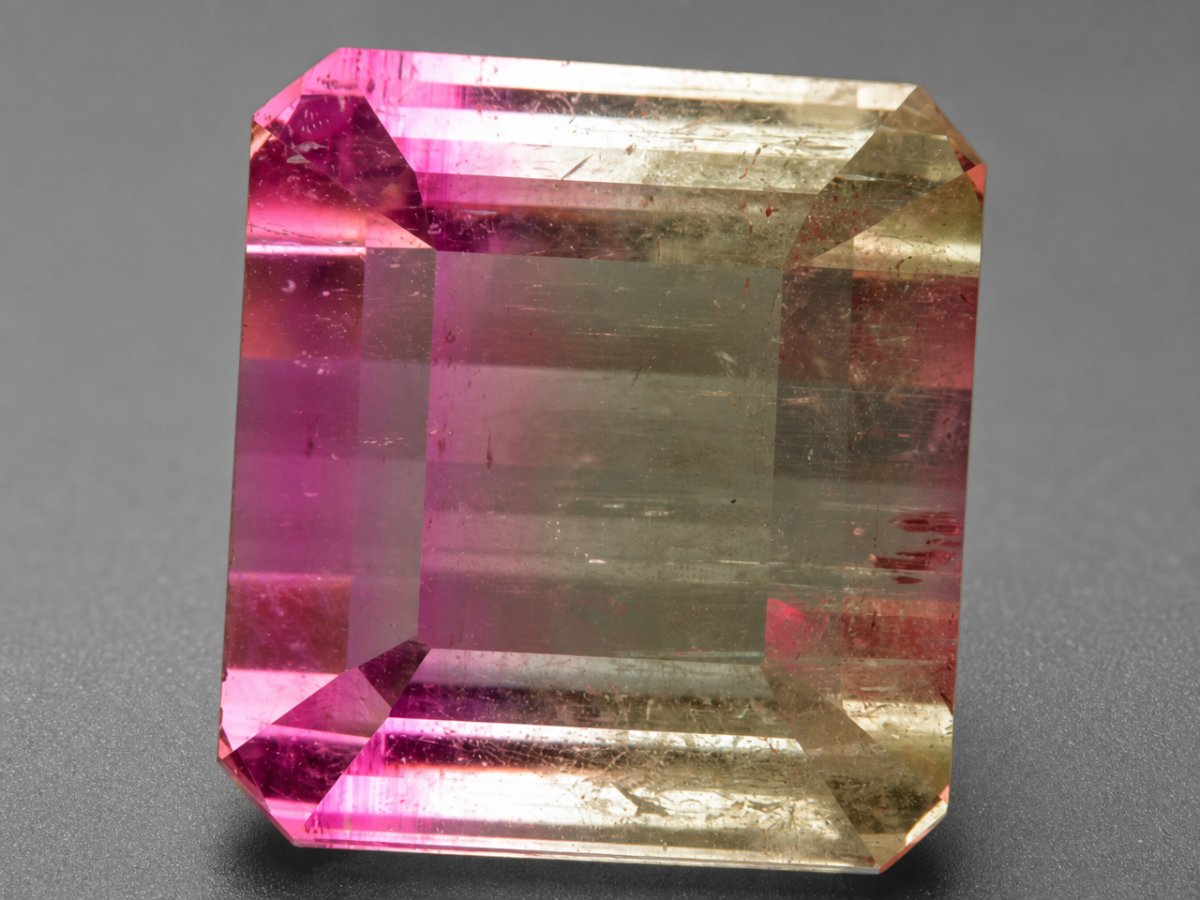


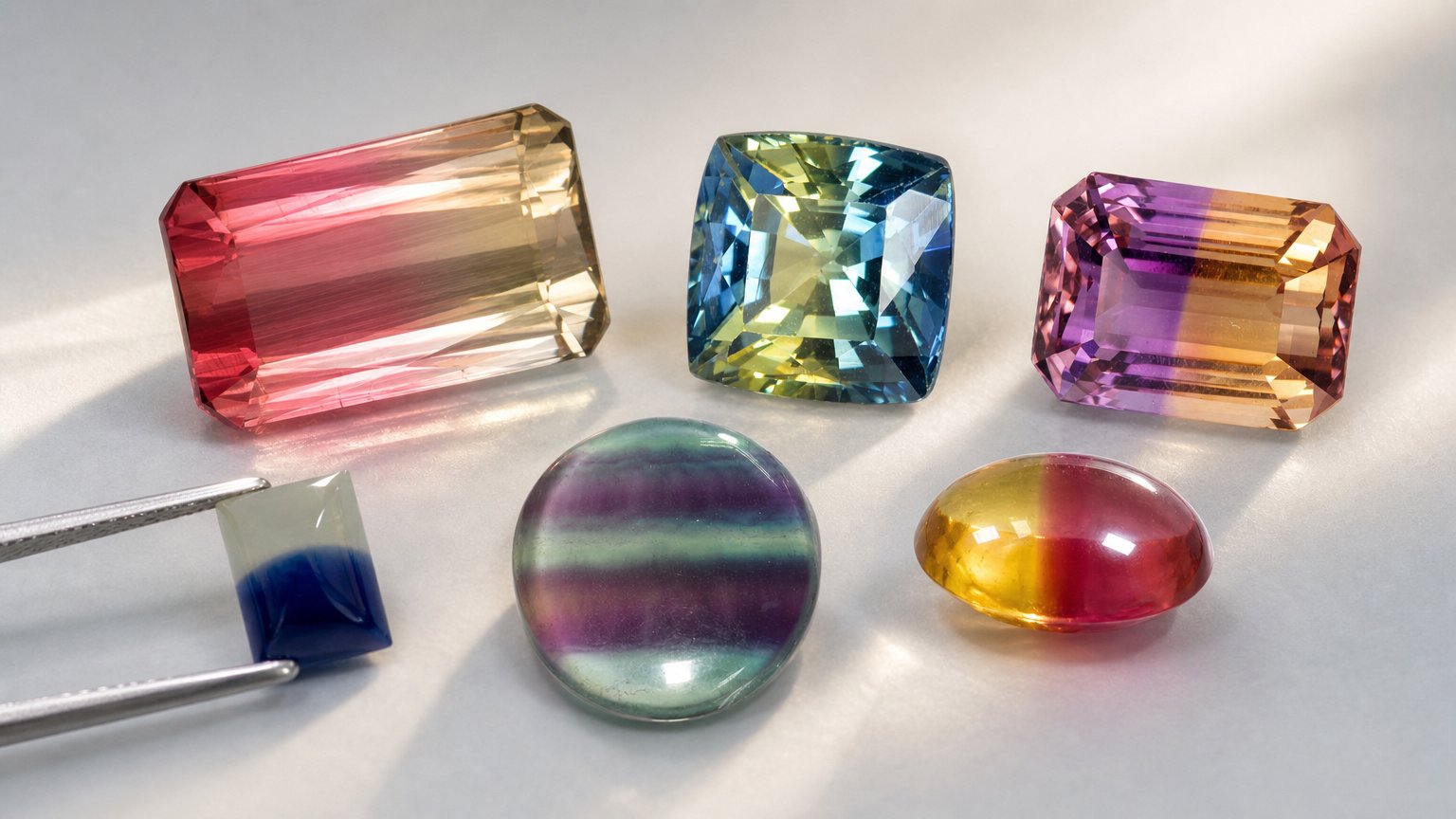
Bi-color gemstones bring a very different kind of beauty to an engagement ring. Instead of choosing one uniform color, you are choosing a natural gemstone where two colors share the same crystal, often in a visible boundary, gradient or patterned zone. In a well-cut stone, that zoning is not a flaw; it is the main design feature.
This guide focuses on natural loose gemstones that show two visibly distinct colors within a single stone, especially bi-color tourmaline, watermelon tourmaline, parti sapphire, bi-color sapphire, ametrine and other practical options. Because every bi-color gem has its own color layout, it is especially important to judge the actual gemstone from individual photographs, measurements and treatment information rather than relying only on the variety name.
What Is a Bi-Color Gemstone?
A bi-color gemstone displays two visibly different colors or strong two-color zoning within the same natural stone. The colors may be sharply divided, softly blended or arranged in irregular zones that follow the crystal growth.
The term bi-color is commonly used for gems with two distinct colors. Parti-colored, especially in sapphire, may describe two or more distinct color zones. These terms overlap in everyday jewelry language, but they are not always perfectly interchangeable in gemological descriptions.
This article is about natural color zoning in a single gemstone. It does not focus on doublets, triplets, composite stones, glued materials or two separate gemstones mounted together to create a two-color effect.
How Bi-Color Gemstones Form
Bi-color gemstones form when conditions change while a crystal is growing. Shifts in trace elements, chemistry, temperature, pressure or other growth conditions can cause one part of a crystal to develop a different color from another part.
Color zoning may follow natural growth patterns inside the crystal. When the rough is cut, the lapidary can decide how to orient those zones: end to end, side by side, diagonally, through the center or in a more blended face-up pattern. This is why two stones of the same species, size and color pair can look dramatically different.
Natural Color Zoning vs Assembled Two-Color Stones
A natural bi-color gemstone contains its color zones within one crystal or one natural gem material. By contrast, an assembled stone may be made from layers or separate pieces joined together. A ring can also use two separate gemstones side by side, but that is a jewelry design choice rather than a single bi-color gemstone.
For engagement rings, ask whether the stone is a single natural gem and check the treatment disclosure for that individual stone. Natural-looking color zoning does not automatically mean a gemstone is untreated.
Best-Known Bi-Color Gemstones for Engagement Rings
Bi-Color Tourmaline
Tourmaline is one of the best-known gemstone groups for distinct color zoning. Natural bi-color tourmaline can show combinations such as pink and green, red and green, pink and colorless, green and colorless, blue and green, yellow and green, and combinations involving multiple shades within the same stone.
For jewelry design, tourmaline offers some of the most expressive two-color patterns. Elongated crystals often cut well into rectangles, emerald cuts, octagons and long cushions, allowing the colors to appear side by side or end to end. Tourmaline has Mohs hardness around 7 to 7.5, making it wearable but less scratch-resistant than sapphire. For an engagement ring, it benefits from thoughtful settings, protected edges and sensible care.
Watermelon Tourmaline
Watermelon tourmaline is a recognizable type of color-zoned tourmaline, typically associated with pink or red and green. In crystal slices, it may show a pink or reddish center with a green outer zone, resembling a watermelon. Faceted stones may show the colors differently depending on how the rough is oriented.
Not every pink-and-green tourmaline has the classic visual arrangement associated with watermelon tourmaline. Some are simply attractive pink-and-green bi-color tourmalines with a side-by-side or blended pattern. When buying, evaluate the actual layout rather than the label alone.
Bi-Color Sapphire and Parti Sapphire
Sapphire can naturally display multiple colors or distinct zones, commonly involving blue, green and yellow. A parti sapphire may show two or more color areas in the same stone, while a bi-color sapphire more specifically suggests two visible colors.
For engagement rings, sapphire is one of the most practical bi-color choices. Corundum has Mohs hardness 9 and is highly suitable for frequent wear when properly set. Parti sapphires can also provide colors that feel distinctive without sacrificing the durability many buyers want in a daily ring.
Ametrine and Bi-Color Quartz
Ametrine is one of the clearest examples of a naturally bi-colored gemstone. It combines purple amethyst and yellow-to-orange citrine color zones within quartz. Cutters may orient ametrine to show a clear split between purple and yellow, or to create a softer blend through the center.
Quartz has Mohs hardness 7. It can be used in rings, but it requires more care than sapphire and may show wear sooner in a heavily worn engagement ring. Other bi-color quartz may be relevant when the zoning is clearly visible, but subtle tone variation alone is not the same as a strong bi-color effect.
Bi-Color Topaz
Topaz can occur with zoning or multiple colors, though strong natural bi-color examples are less central to engagement-ring buying than tourmaline, sapphire or ametrine. Topaz has Mohs hardness 8, but it also has perfect cleavage, meaning it can split if struck in the wrong direction. Protective settings and careful wear are important if topaz is chosen for a ring worn every day.
Bi-Color Fluorite
Bi-color fluorite can be beautiful, often showing attractive color banding or zoning. However, fluorite has Mohs hardness 4 and perfect cleavage, making it generally impractical for an engagement ring intended for frequent wear. It is better suited to collectors, occasional jewelry or designs where the owner understands the risk of scratching and damage.
Color Combinations to Consider
Bi-color gemstones work especially well when the two colors create a deliberate visual relationship. Some pairings feel high contrast, while others are softer and more atmospheric.
- Pink and green: strongly associated with tourmaline, including many watermelon-inspired looks.
- Blue and green: seen in some tourmaline and parti sapphire, often with an oceanic or teal effect.
- Blue and yellow: a striking sapphire combination that can appear bold or painterly depending on zoning.
- Green and yellow: common in parti sapphire and some tourmaline, often warm and lively.
- Purple and yellow: the classic ametrine combination, with strong contrast between amethyst and citrine zones.
- Pink and colorless or green and colorless: gives a lighter, more open appearance, particularly in tourmaline.
- Light and dark zones: even within related colors, contrast between saturation levels can create depth and movement.
Strong color boundaries can look graphic and modern. Gradual transitions can feel more organic. Neither is automatically better; the right choice depends on the individual stone and the ring design.
Practical Comparison of Bi-Color Gemstones
Mohs hardness measures resistance to scratching, not overall durability. Engagement-ring durability also depends on toughness, cleavage, brittleness, cut, setting protection and the wearer's lifestyle.
| Gemstone variety | Typical color combinations | Mohs hardness | Everyday-wear suitability | Relative affordability | Typical availability | Treatment considerations | Setting considerations |
|---|---|---|---|---|---|---|---|
| Bi-color tourmaline | Pink/green, red/green, pink/colorless, green/colorless, blue/green, yellow/green, multi-shade zoning | 7 to 7.5 | Possible for engagement rings with care; better for moderate lifestyles and protective designs | Varies widely by color, size and quality; often more accessible than comparable fine sapphire | Commonly sought in bi-color form, but each pattern is individual | Check individual disclosure; treatments can occur in tourmaline | Bezel, halo or protected prongs; avoid exposed corners on active-wear rings |
| Watermelon tourmaline | Pink or red with green, sometimes with pale or colorless areas | 7 to 7.5 | Wearable with care; durability is the same as tourmaline generally | Varies strongly with color pattern and appeal | Recognizable and popular, but classic patterns are not guaranteed in every stone | Review treatment disclosure for the specific gem | Choose a setting that displays the pink/green relationship clearly |
| Parti or bi-color sapphire | Blue/green, blue/yellow, green/yellow and mixed zoning | 9 | Excellent choice for frequent wear when well set | Often premium compared with quartz and many tourmalines; depends on the individual stone | Available in a range of patterns, but attractive zoning should be judged stone by stone | Heat treatment is common in sapphire; always check disclosure | Works well in solitaires, halos, bezels and three-stone rings |
| Ametrine | Purple/yellow to orange | 7 | Possible with care, but less ideal for hard everyday wear than sapphire | Often relatively accessible compared with many fine colored stones | Well known as a bi-color quartz variety | Check whether natural and review any treatment disclosure | Best with protective settings and designs that highlight the purple/yellow split |
| Bi-color topaz | Variable zoning where naturally present | 8 | Use caution because topaz has perfect cleavage | Varies by color, treatment and size | Natural strong bi-color examples are less central than tourmaline or sapphire | Topaz treatments are important to disclose, especially for some colors | Protect from sharp knocks; bezel or secure low-profile settings are preferable |
| Bi-color fluorite | Green/purple, blue/green, yellow/purple and banded colors | 4 | Generally impractical for engagement rings | Often relatively affordable as a collector gem | Available in attractive colors, but better for collectors than daily rings | Check disclosure as with any gem | Avoid for daily engagement rings unless worn only occasionally and protected |
Why Cut Matters So Much
Cut is especially important for bi-color gemstones because it determines how the colors appear face up. A cutter can place the color boundary through the center, create approximately equal zones, favor one color, produce a gradual transition, orient colors from end to end, use an asymmetrical outline to follow the original crystal, or position zones for a distinctive pattern.
Elongated and rectangular shapes often work well when the goal is to display two colors side by side. Emerald cuts, octagons, rectangles, elongated cushions and radiant-style shapes can make the zoning easy to read. Ovals, pears and trillions may create a softer or more dynamic effect. Freeform and fantasy cuts can be excellent when the rough has unusual zoning that would be lost in a standard outline.
No shape is universally best. The best cut is the one that gives the individual gemstone good face-up beauty, enough durability for the design and an appealing relationship between its colors.
Symmetrical vs Asymmetrical Color Zoning
Some buyers prefer an almost 50/50 color split because it looks balanced and intentional. Others prefer an unequal split, diagonal boundary, gradient or irregular pattern because it feels more natural and one of a kind.
This is primarily an aesthetic choice, not a universal quality rule. A centered boundary is not automatically better than an asymmetrical one. What matters is whether the color placement looks attractive in the actual stone and suits the ring design.
Ring Settings That Showcase Bi-Color Gemstones
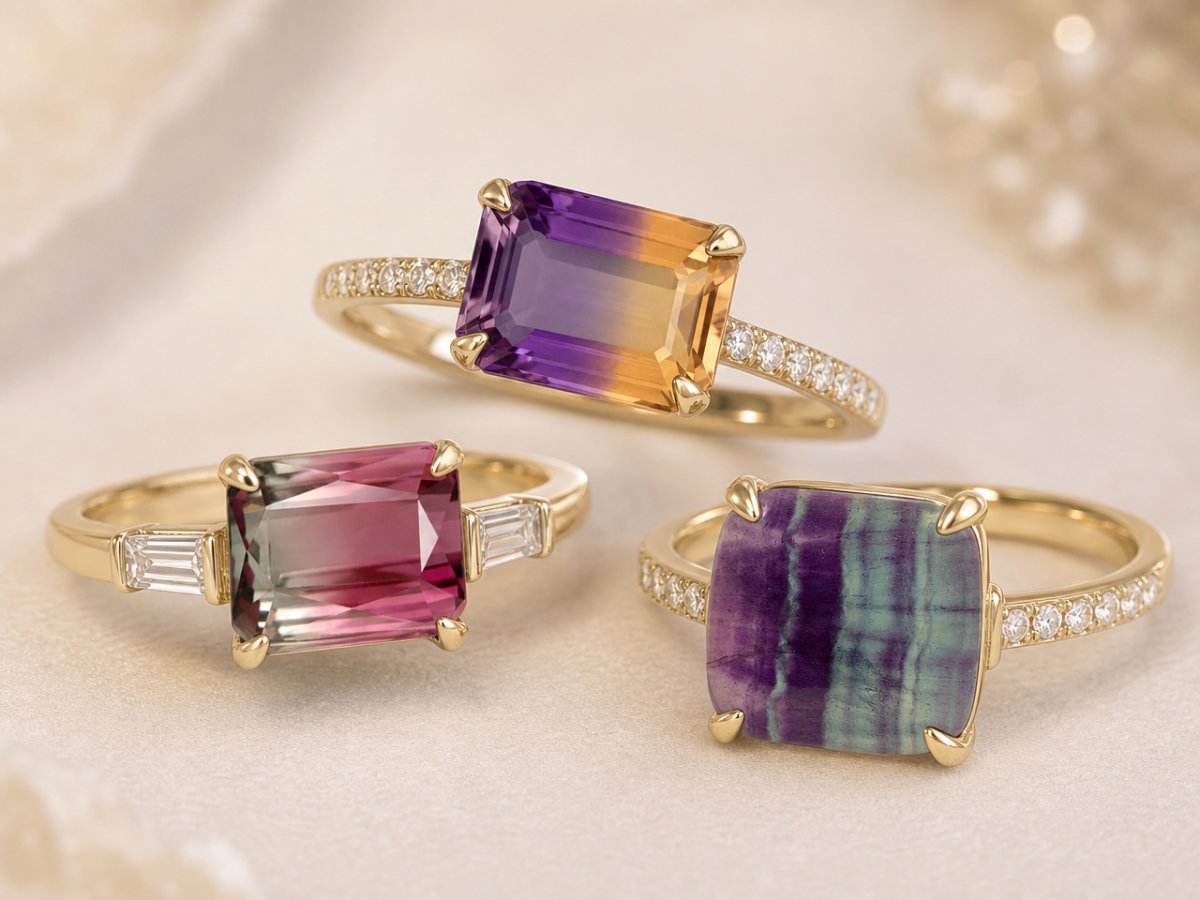
Bi-color gemstones can work beautifully in solitaires, bezel settings, halo rings, three-stone rings, geometric contemporary designs, asymmetrical rings, vintage-inspired designs and rings with colorless diamond or gemstone accents.
East-west settings deserve special attention for elongated bi-color gems. Setting a rectangular, emerald-cut, cushion or oval gemstone horizontally can showcase the transition between colors across the finger. This orientation often makes the color boundary more noticeable and gives the ring a distinctive profile without adding unnecessary complexity.
Bezels and partial bezels can protect vulnerable edges, especially for tourmaline, quartz and topaz. Halo settings can add visual size and protection while framing the center stone. Three-stone rings can use side stones to support one color zone or create contrast, but avoid accents that compete too strongly unless that is the design intention.
Metal Choices and Accent Stones
White gold and platinum provide a relatively neutral frame, which can be useful when the gemstone already contains two strong colors. Yellow gold can complement warmer combinations such as green/yellow, purple/yellow or stones with golden zones. Rose gold can be attractive with pink, red and other warm-toned combinations.
There is no universally superior metal for bi-color gems. The best choice depends on the specific two colors, the saturation of each zone and the overall ring style.
Colorless diamonds or other colorless gemstones are often effective accents because they frame the bi-color center stone without adding another dominant color. Carefully chosen colored accents can also work when they deliberately echo one zone, such as green side stones with a green-and-blue sapphire or pink accents with a pink-and-green tourmaline.
Gemstone Size, Carat Weight and Face-Up Presence
Do not compare carat weight directly across sapphire, tourmaline, quartz and other gemstones. Different gem species have different specific gravity, and cutting depth can vary widely. A one-carat sapphire, tourmaline and quartz may not have the same face-up size.
For engagement rings, compare actual millimeter dimensions, not only carat weight. Also look at depth, shape and the position of the color boundary. A slightly smaller gem with a better face-up color pattern may be more successful than a larger stone with poorly placed zoning.
Bi-Color Tourmaline vs Parti Sapphire
Bi-color tourmaline and parti sapphire are two of the strongest choices for buyers who want a natural two-color engagement ring, but they suit different priorities.
Tourmaline is especially known for dramatic color zoning, including pink-and-green, red-and-green, blue-and-green and colorless combinations. It is often cut in elongated shapes that make the zones easy to display. It can offer a very expressive, organic appearance, but it requires more care than sapphire in an engagement ring.
Parti sapphire usually emphasizes blue, green and yellow zones, sometimes with more than two visible colors. Its major advantage is durability: sapphire's hardness and wearability make it highly practical for frequent use. It may not offer the same pink-and-green combinations that attract many tourmaline buyers, but it is often the stronger choice for someone prioritizing daily wear.
Neither is universally better. Choose tourmaline if the color combination and zoning pattern are the main attraction and the wearer can care for the ring. Choose parti sapphire if frequent wear, hardness and long-term practicality are higher priorities.
Which Bi-Color Gemstone Is Best for an Engagement Ring?
The best choice depends on what matters most to the wearer:
- Maximum everyday durability: parti sapphire or bi-color sapphire.
- Strongest two-color contrast: bi-color tourmaline or ametrine, depending on the color pair.
- Pink-and-green combination: bi-color tourmaline or watermelon tourmaline.
- Blue-and-green combination: parti sapphire or blue-green tourmaline.
- Unusual one-of-a-kind appearance: tourmaline, parti sapphire and freeform-cut stones are especially worth comparing individually.
- Larger gemstone for the budget: quartz varieties such as ametrine may offer size advantages, though they need more care than sapphire.
- Clearly divided color zones: look for stones where the cutter oriented the boundary deliberately, often in rectangular or elongated shapes.
- Softer blended or gradient appearance: choose stones with gradual zoning rather than a sharp split.
Which Bi-Color Gemstones Need More Care?
Attractive color zoning does not change the underlying durability of the gemstone species. Sapphire remains the most practical frequent-wear option among the major bi-color choices discussed here. Tourmaline and quartz can be used in engagement rings, but they should be protected from hard knocks, abrasion and rough daily wear. Topaz needs special caution because of cleavage. Fluorite is generally too soft and cleavable for a daily engagement ring.
For any bi-color engagement ring, remove the ring before heavy work, sports, gardening or activities where the stone could be struck. Clean gently according to the needs of the specific gemstone and setting.
Treatment Disclosure and Buying the Individual Gemstone
Always check treatment disclosure for the exact gemstone. Sapphire is commonly heat-treated, and other gemstone types may also be treated depending on color and material. Do not assume a bi-color gemstone is untreated simply because the zoning appears natural.
When comparing loose bi-color gemstones at GemSelect or elsewhere, prioritize actual photographs, face-up and alternate viewing angles, millimeter dimensions, the position of the color boundary, the relative amount of each color, saturation, cut orientation, clarity, treatment disclosure and price. Individual photography is especially important because two stones with the same variety name and carat weight may have completely different color patterns.
Bi-Color vs Color-Change Gemstones
A bi-color gemstone displays two different colors or color zones within the stone at the same time. A color-change gemstone changes its apparent color under different lighting conditions, such as daylight and incandescent light. These are separate color phenomena. A gemstone may be interesting for either reason, but bi-color and color-change should not be confused when choosing a center stone.
Conclusion
Bi-color gemstones can make engagement rings feel highly personal because the color pattern is part of the identity of the individual stone. Parti sapphire is the most practical choice for frequent wear, while bi-color tourmaline offers some of the most distinctive and varied color zoning. Ametrine provides a clear purple-and-yellow quartz option, and other stones may be suitable when their durability and setting needs are understood.
The most important advice is simple: buy the actual gemstone, not just the gemstone name. Study the photos, measurements, color boundary, cut, clarity and treatment disclosure before deciding how it should be set.