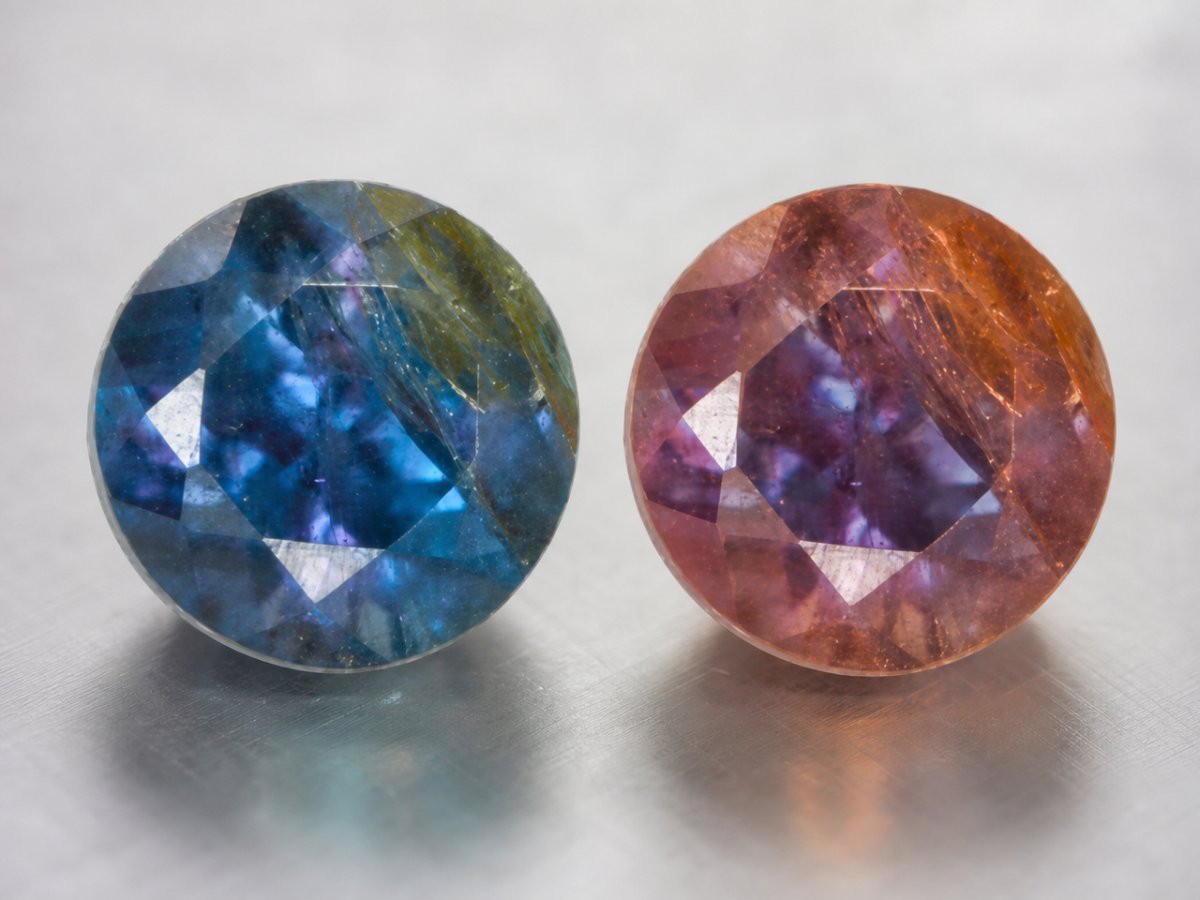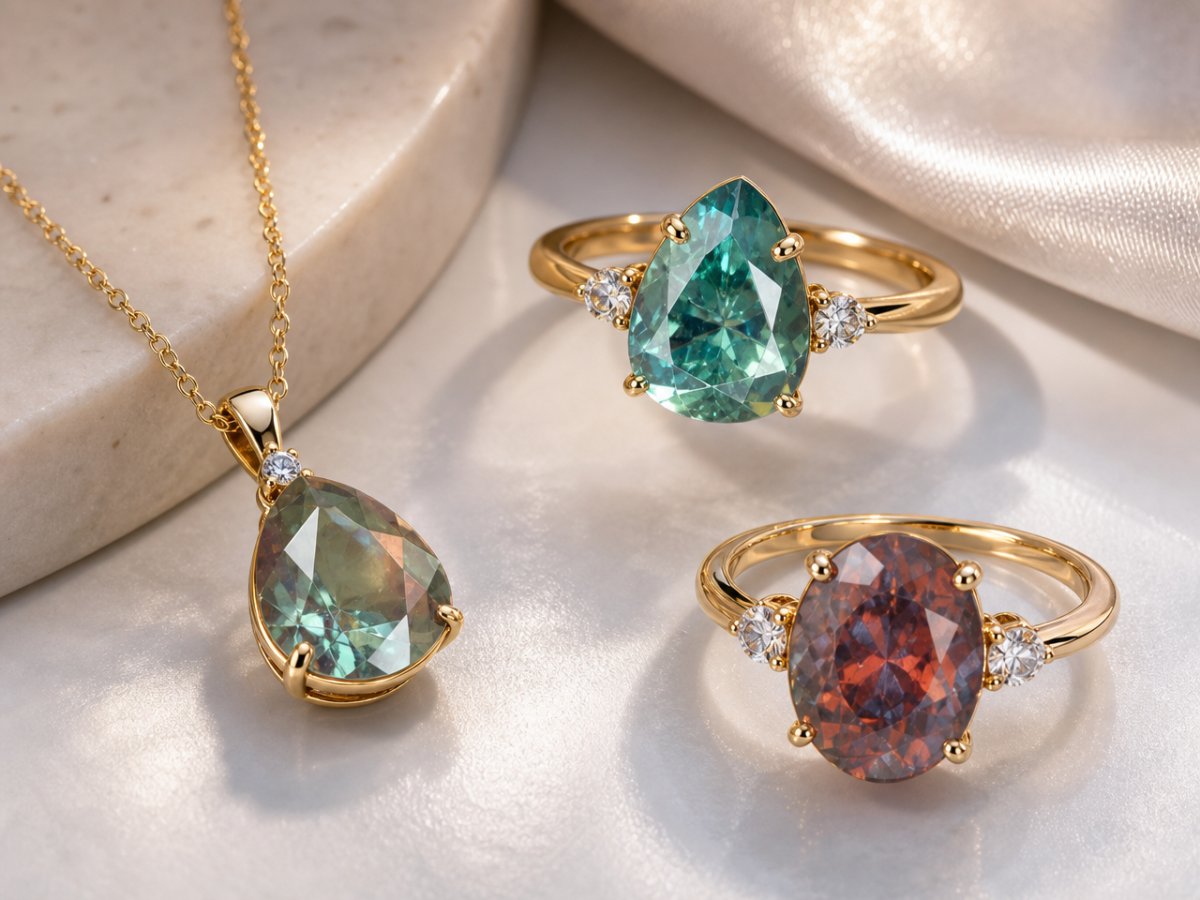


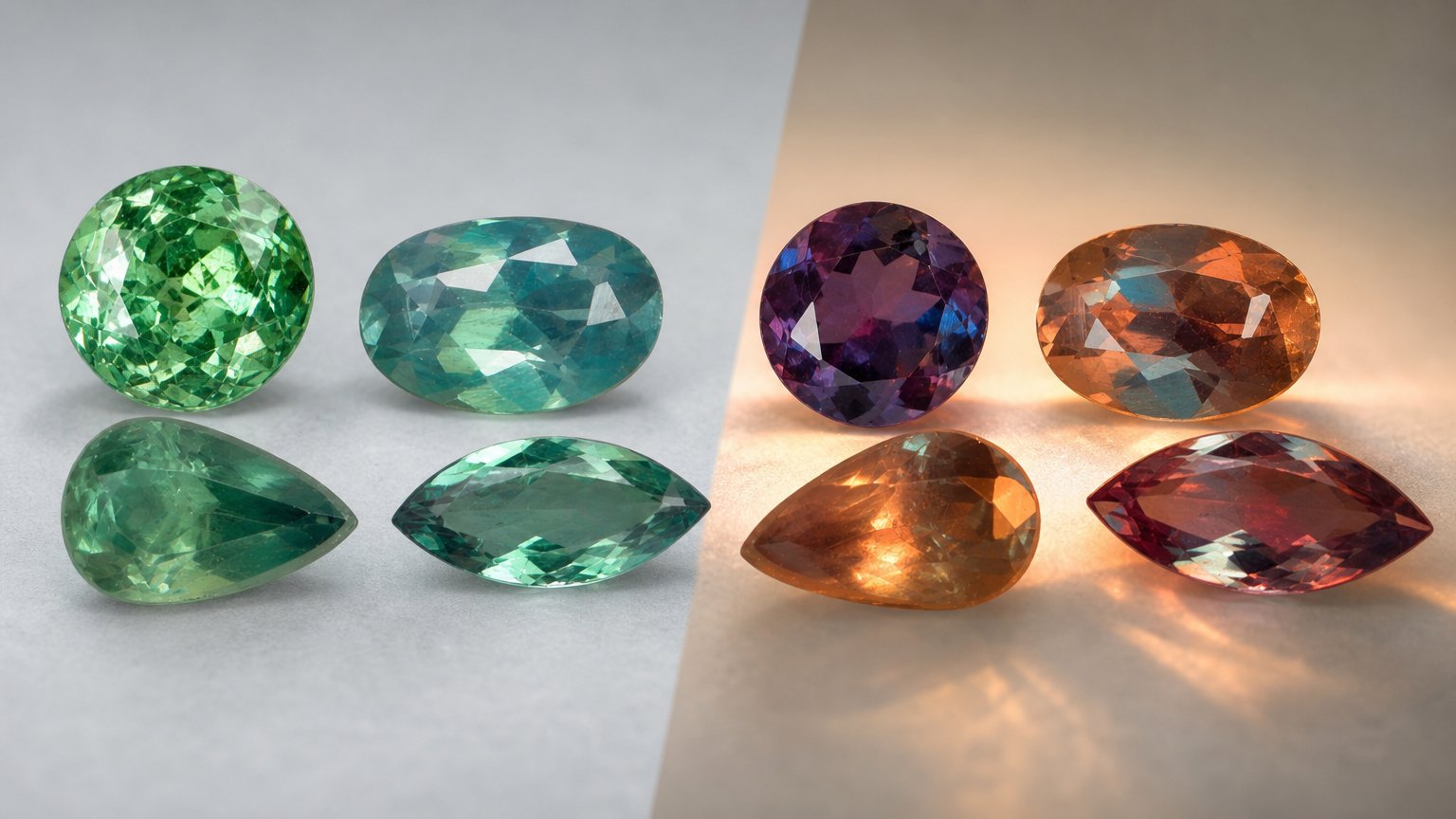
Alexandrite is famous because it can look like two different gemstones depending on the light. In daylight or daylight-equivalent illumination, many alexandrites appear green, bluish-green or greenish. Under warmer incandescent or candle-type light, the same stone may shift toward red, purplish-red, raspberry or reddish-purple. The exact colors vary from stone to stone, and not every alexandrite shows the textbook green-to-red change.
This dramatic effect is not magic and it is not simply a matter of the gem "reflecting one color indoors and another outdoors." It is the result of three things working together: the gem's chemistry and absorption pattern, the color balance of the light source, and the way human vision interprets color.
What Causes Alexandrite to Change Color?
Alexandrite is the chromium-bearing color-change variety of chrysoberyl . The important coloring agent is chromium in the trivalent state, written as Cr 3+ . Chromium is also responsible for color in several other well-known gems, but in alexandrite it interacts with the chrysoberyl crystal structure in a way that creates a very special optical response.
When white light enters an alexandrite, the gemstone does not transmit all wavelengths equally. It selectively absorbs parts of the visible spectrum, especially in the yellow region. At the same time, significant green to blue-green wavelengths and red wavelengths can still contribute to the color that reaches the eye. Because yellow is strongly reduced, the remaining balance can swing visually toward greenish colors in one light and reddish colors in another.
The Role of Chromium
Chromium is central to the alexandrite effect because it creates absorption features that divide the visible spectrum in a distinctive way. In plain language, chromium changes which colors of light are removed as light travels through the stone. The light that survives this journey is what contributes to the color we see.
The amount and environment of chromium matter, but it is not as simple as "more chromium equals better color change." Trace-element chemistry, absorption strength, transparency and the overall body color of the stone all influence the final appearance. A stone can contain chromium and still show a weak change if the absorption balance, saturation or clarity does not create a strong visual separation between daylight and warm-light colors.
Why Daylight and Incandescent Light Produce Different Colors
Different light sources contain different mixtures of wavelengths. Daylight is relatively richer in blue and green wavelengths compared with traditional incandescent or candle-type illumination. Warm incandescent light is relatively richer in red wavelengths.
Because alexandrite allows both green/blue-green and red wavelengths to play a major role, the light source changes which wavelengths dominate. In daylight, the available light supports the green or bluish-green side of the stone's response. Under a warm incandescent-type source, the stronger red content of the light can push the perceived color toward red, raspberry, purplish-red or reddish-purple.
How Human Vision Helps Create the Alexandrite Effect
The alexandrite effect depends on human color perception as much as it depends on the gem. Our eyes and brain do not measure wavelengths like laboratory instruments. They compare signals from color-sensitive cells in the eye and interpret a final color impression.
Alexandrite often sits near a visual tipping point because its absorption reduces the yellow region while leaving meaningful green/blue-green and red components. When the lighting changes, the balance of those components changes. The eye then interprets the dominant signal differently, making the shift appear dramatic.
This is why a precise scientific spectrum and a buyer's visual impression are related but not identical. The spectrum explains the optical behavior; the viewer experiences the result as a color change.
Color Change Is Not the Same as Pleochroism
Alexandrite is also pleochroic, meaning it can show different colors when viewed from different crystal directions. Pleochroism is a directional optical effect. If a gem is rotated, or if light travels through the crystal along a different direction, the observed color may vary.
The alexandrite effect is different. It is primarily an illumination-dependent color change. The stone appears one color family under daylight-type light and another under warm incandescent-type light. Pleochroism can influence the appearance of an individual cut stone, especially depending on orientation, but it does not cause the classic alexandrite color-change phenomenon.
Why Some Alexandrites Change Color More Dramatically
Some alexandrites show a strong and distinct change, while others show only a subtle shift. Several factors can affect the strength of the visual effect:
- Chromium and trace-element chemistry: The exact chemistry influences absorption and therefore the balance between green/blue-green and red response.
- Absorption characteristics: A strong reduction of yellow light combined with useful transmission in both green and red regions can support a more noticeable change.
- Saturation: A stone with richer, cleaner color in both lighting conditions often appears more dramatic than one with grayish or brownish modifiers.
- Transparency: Better transparency can allow light to travel through the gem more effectively, making the color response easier to see.
- Cut and light path: The route light takes through the stone affects how much absorption occurs before light returns to the eye.
- Orientation: Because alexandrite is pleochroic, the cutter's orientation can influence which color directions are emphasized in the finished gem.
These factors work together. A stone may have an attractive daylight color but a less distinct warm-light color, or it may show a noticeable hue shift but with low saturation. The most admired examples combine a clear change with attractive colors on both sides of the lighting comparison.
How Cut and Orientation Affect the Appearance
Cut does not create the alexandrite effect, but it can strengthen or weaken how the effect is seen. A well-planned cut can improve brightness, manage windowing and encourage enough light return for the color shift to be visible. If a stone is too shallow, too dark, heavily included or poorly oriented, the apparent change may be less impressive.
Light path length also matters. In a transparent faceted gem, light enters, reflects internally and exits back to the viewer. A longer path through the stone can increase absorption, sometimes deepening color. However, too much absorption can make a gem look overly dark. The best visual result is a balance between body color, brightness and distinct color response.
How to Test Alexandrite's Color Change at Home
To observe alexandrite properly, compare it under two clearly different light sources rather than in mixed lighting. Use daylight or a daylight-equivalent lamp first, then view the same stone under a warm incandescent-type source. Keep the gem clean, use a neutral background and allow your eyes a moment to adjust between lighting conditions.
Avoid judging the effect near a window while room lights are on, or under several different bulbs at the same time. Mixed lighting can blend the green and red responses, making the color change look weaker or confusing. For the clearest comparison, move the gem fully from one lighting environment to the other.
Why LED Lighting Can Give Different Results
Many buyers expect alexandrite to turn red under "indoor light," but modern indoor lighting is not all the same. Traditional incandescent bulbs have a continuous warm spectrum with strong red content. Candlelight behaves in a similar warm direction. Many modern LEDs, however, have different spectral distributions depending on design, color temperature and color rendering.
A warm-white LED may not produce the same result as an incandescent bulb, and two LEDs with similar-looking white light can affect alexandrite differently. Some LEDs may emphasize parts of the spectrum that make the stone look purplish, grayish, muted or only partly changed. This does not automatically mean the alexandrite is misrepresented; it may mean the light source is not producing the classic warm spectral balance.
What Does "Strong Color Change" Actually Mean?
Gem dealers often describe alexandrite color change using terms such as weak, moderate, strong, excellent or near-complete. Some descriptions also use percentages. These are practical observational and commercial descriptions, not a single universal scientific grading scale that every seller applies in exactly the same way.
In ordinary use, the description refers to how much the apparent color shifts between two defined lighting conditions and how distinct that shift looks to the eye. It also considers whether both colors are attractive. A stone that changes from slightly bluish-green to slightly purplish-gray may show a measurable shift, but it may not be described as strongly as one that changes from an obvious green or blue-green to an obvious red-purple.
Examples of Color-Change Strength
- Weak change: A greenish stone in daylight becomes slightly warmer, grayish or faintly purplish under warm light, but the overall impression remains similar.
- Moderate change: A bluish-green or greenish daylight color shifts noticeably toward purple, raspberry or reddish-purple, though some green or gray component may remain.
- Strong change: The stone moves clearly from a green or blue-green color family in daylight to a red, purplish-red or raspberry color family under warm incandescent-type light.
These examples are meant to help buyers understand the language. They should not be treated as fixed laboratory categories.
Why the Alexandrite Effect Is Rare and Desirable
A strong, attractive and distinct alexandrite color change is desirable because several conditions must align: the right chromium-related absorption, suitable transparency and saturation, favorable cutting and two appealing colors under different light sources. If one part of that balance is missing, the effect may be less dramatic.
This combination helps explain why fine color-change alexandrite is so highly regarded by collectors, jewelers and gem enthusiasts. The appeal is not simply that the stone changes color, but that it can do so in a clean, beautiful and unmistakable way.
Other Gemstones and the "Alexandrite Effect"
In gemology, the term "alexandrite effect" is sometimes used more broadly for illumination-dependent color change in other gemstones . Some garnets, sapphires, spinels, fluorites and other gems can show color change under different light sources. The mechanism and appearance vary by gem type and chemistry.
Even so, alexandrite remains the classic reference point because its color-change behavior is so closely associated with its identity. When comparing color-change gems on GemSelect or elsewhere, look at the stated lighting conditions and, when possible, compare images or observations made under both daylight-equivalent and warm light.
Conclusion
Alexandrite's famous color change is best understood as an interaction between chromium-bearing chrysoberyl, selective absorption of visible light, the spectral balance of the light source and human color perception. Daylight favors the green to blue-green side of the response, while warm incandescent-type light favors red to purplish-red impressions. Pleochroism, cut and orientation can influence how a particular stone looks, but the classic alexandrite effect is fundamentally a change with illumination.