
Your Details
Forgot your password?
Your Details
|
Reviewed By Andreas Zabczyk
Trilliant-Cut - Trillion Cut GemstonesTrillion cut gemstones are a striking and contemporary choice for jewelry enthusiasts, known for their unique triangular shape and exceptional brilliance. With a history that dates back to the late 20th century, this cut has gained popularity for its ability to showcase a stone’s color and clarity while providing a modern twist on traditional gemstone cuts. Discover our collection of loose trillion cut gemstones for sale. 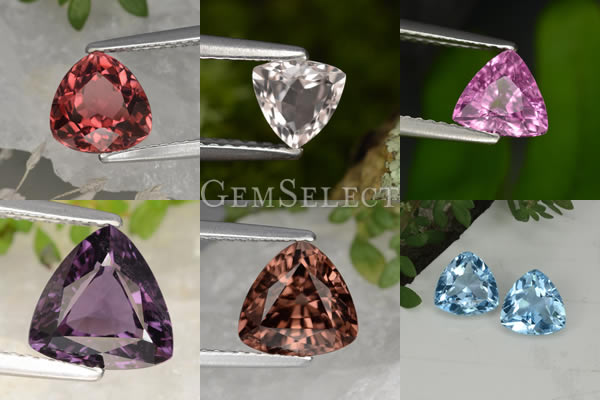
Trilliant-Cut GemStones from GemSelect
Trilliants work very well with light-colored gems - such as diamond, aquamarine, beryl and white sapphire - where cutters try to maximize brilliance. Some cutters use trilliants effectively to lighten and brighten the appearance of darker stones such as tanzanite, spessartite garnet, rhodolite garnet and amethyst gems. Trillion cut gems are rarely used for softer gems, such as apatite, unless the corners are rounded. The tips and culets of trilliants are pointed and thin, making them vulnerable to breakage. Some jewelers bezel-set trilliants, though prongs that protect tips work well and show more of the stone.
Trillion cut gemstones are almost always cut with a 1:1 length to width ratio. But there are some variations in shape, including rounded-corner triangles, straight sides and curved sides. Trillion cut gem with straight sides are usually used for side stones in a setting, while stones with slightly curved sides are used for center stones or solitaires. The trillion cut was introduced by the Asscher brothers in Amsterdam and was later trademarked by the Henry Meyer Diamond Company of New York in 1962. Now that the patent has expired, the term "trilliant cut" is used to refer to all triangular shaped gems, even step-cut and cabochon stones.
About Us
Overall Rating -> 10 I purchased from you before and I have never been disappointed. I always received what I expected and your products are very nice. Posted By MVK in July, 2025 Source: Bizrate Overall Rating -> 10 The site provided lots of detail, factual data, and good photos. I also like the availability of searching by price range as well as by the type of stone. Posted By SLIntuitive Donna in July, 2025 Source: Bizrate Overall Rating -> 9 I was looking for a small gift for a friend- the process is the same as every other time and was very simple, and she even got her gift early! On the downside, there's no way to easily keep track of multiple Shipping Addresses, so if I want to send a gift to Friend A and to Friend B, I have to overwrite everything and it's a fair bit clunky in that regard. Posted By Jezzi in June, 2025 Source: Bizrate Overall Rating -> 8 Site worked well and helped me find a rock that matched what I was looking for. Well within budget and I trust it will show up, so that's definitely positive. Not much else to it. Satisfied. Posted By Big Ricky in May, 2026 Source: Bizrate Overall Rating -> 10 selection was broad and the check out was quick. Great site Posted By JC Karl in September, 2025 Source: Bizrate Related Articles Emerald Gemstone Information Emerald Gemstone Information: Colors, Meaning, Prices Gemstone Clarity and Cut Clarity and Cut - Gemstone Information - GemSelect GemSelect Newsletters GemSelect Newsletters |




