


Kyanite Hardness and Properties
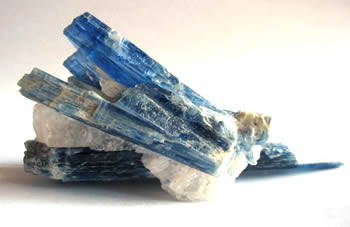
Understanding Anisotropism in Kyanite
Every gemstone has something special about it, and for kyanite, it’s a fascinating property called anisotropism. This means kyanite’s characteristics, like its hardness, change depending on how you look at it - or more specifically, how its crystals are oriented. Many minerals show slight variations in hardness, but kyanite’s variation is striking. When cut parallel to its long axis, kyanite’s hardness ranges from 4 to 4.5 on the Mohs scale. Slice it perpendicularly, though, and that same crystal can hit 6 to 7. That’s a big jump for a single stone, making it a unique challenge for gem cutters!
Color and Luster of Kyanite
Kyanite is best known for its stunning blue hues, often compared to sapphires, which are the most prized in the gem world. But it’s not always blue - you might find it in white, gray, or even green. The color can be uneven, showing up in blotches or streaks, which adds to its natural charm. Kyanite is usually cut into cabochons to show off its beauty, though high-quality pieces are sometimes faceted. This is no easy task, given that tricky hardness variation we mentioned. The stone has a vitreous to almost pearly luster, and here’s a cool fact: kyanite is always untreated, keeping its natural vibe intact.
Kyanite as a Polymorph
Kyanite has some interesting relatives in the mineral world. It’s a polymorph, meaning it shares the same chemical makeup - aluminum silicate - with minerals like andalusite and sillimanite, but its crystal structure is different. Kyanite rocks a triclinic crystal habit, while andalusite goes orthorhombic. It’s like they’re siblings with the same DNA but totally different personalities. This structural difference is what gives kyanite its unique properties compared to its mineral cousins.
Industrial Applications of Kyanite
Beyond its beauty, kyanite is a workhorse in the industrial world. Its ability to withstand high temperatures makes it a go-to material for all sorts of applications. You’ll find kyanite in glass manufacturing, burner tips, spark plugs, heating elements, high-voltage electrical insulators, and even ceramics. It’s the kind of gem that’s not just pretty but also pulls its weight in practical uses.
Global Mining Locations
Kyanite is found all over the globe, with significant kyanite deposits in Nepal, Brazil, India, Australia, Russia, and the United States. In the U.S., states like Virginia, North Carolina, and Georgia are key players in kyanite mining. It’s pretty amazing to think this gem is being unearthed in so many corners of the world, ready to shine in jewelry or power up industrial projects.
Frequently Asked Questions
What is kyanite?
Kyanite is a gemstone and aluminosilicate mineral, typically blue, known for its unique hardness variation and use in both jewelry and industry. Explore detailed kyanite gemstone information.
Why does kyanite have variable hardness?
Kyanite’s anisotropic nature means its hardness changes based on crystal orientation, ranging from 4–4.5 along one axis and 6–7 along another.
Is kyanite treated to enhance its color?
No, kyanite is always untreated, maintaining its natural color and luster.
Where is kyanite mined?
Kyanite is mined globally, with notable deposits in Nepal, Brazil, India, Australia, Russia, and U.S. states like Virginia and North Carolina.


