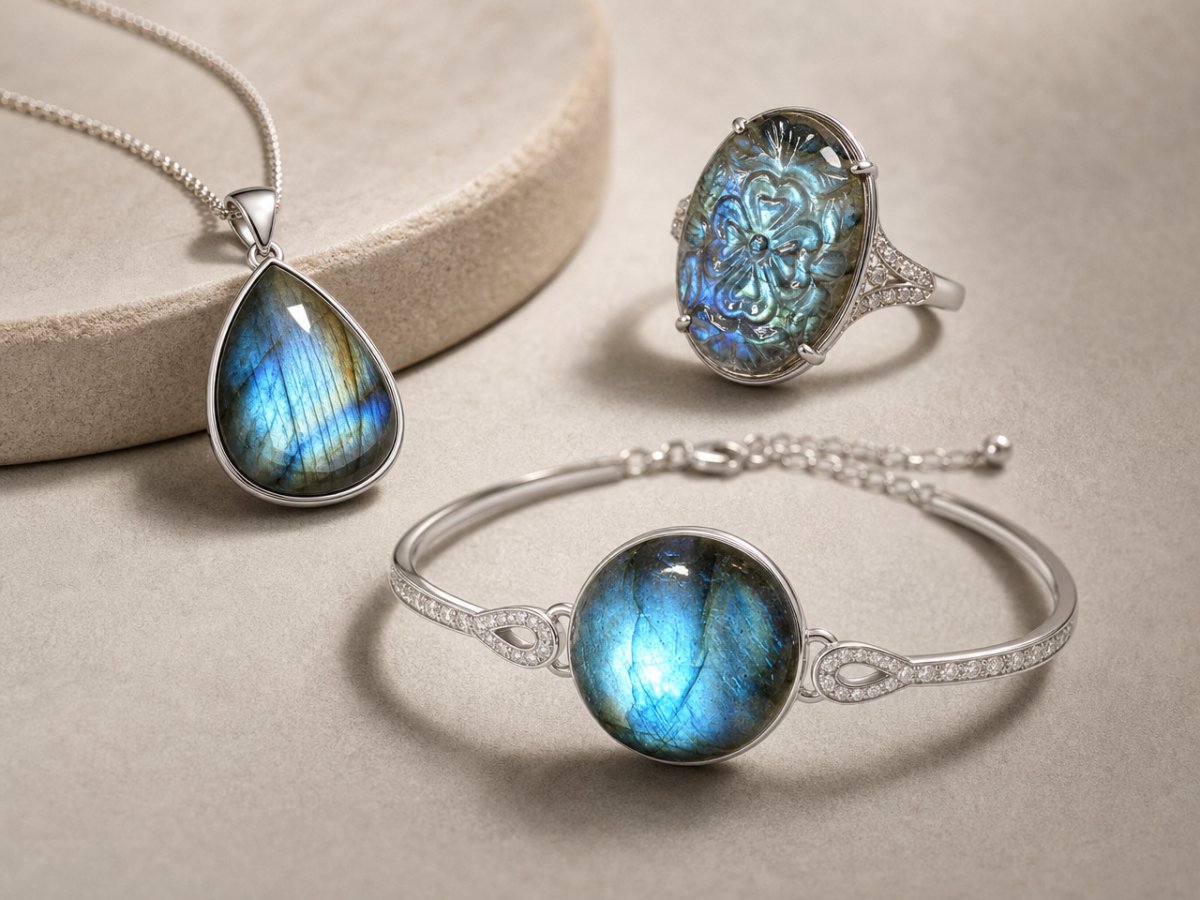


Labradorite is best known for its sudden flashes of blue, green, gold, orange and sometimes multiple colors across a darker base. This shifting display is called labradorescence. It is not simply the gemstone's body color, and it is not caused by dye or surface coating. It is an optical effect produced when light interacts with Labradorite's microscopic internal structure.
For buyers, collectors and jewelers, understanding labradorescence helps explain why one Labradorite may look mostly gray from one angle and then show a vivid blue flash when tilted, while another may show only a small, weak patch of color. The effect depends on structure, light, viewing angle and the way the stone has been cut.
What Is Labradorescence?
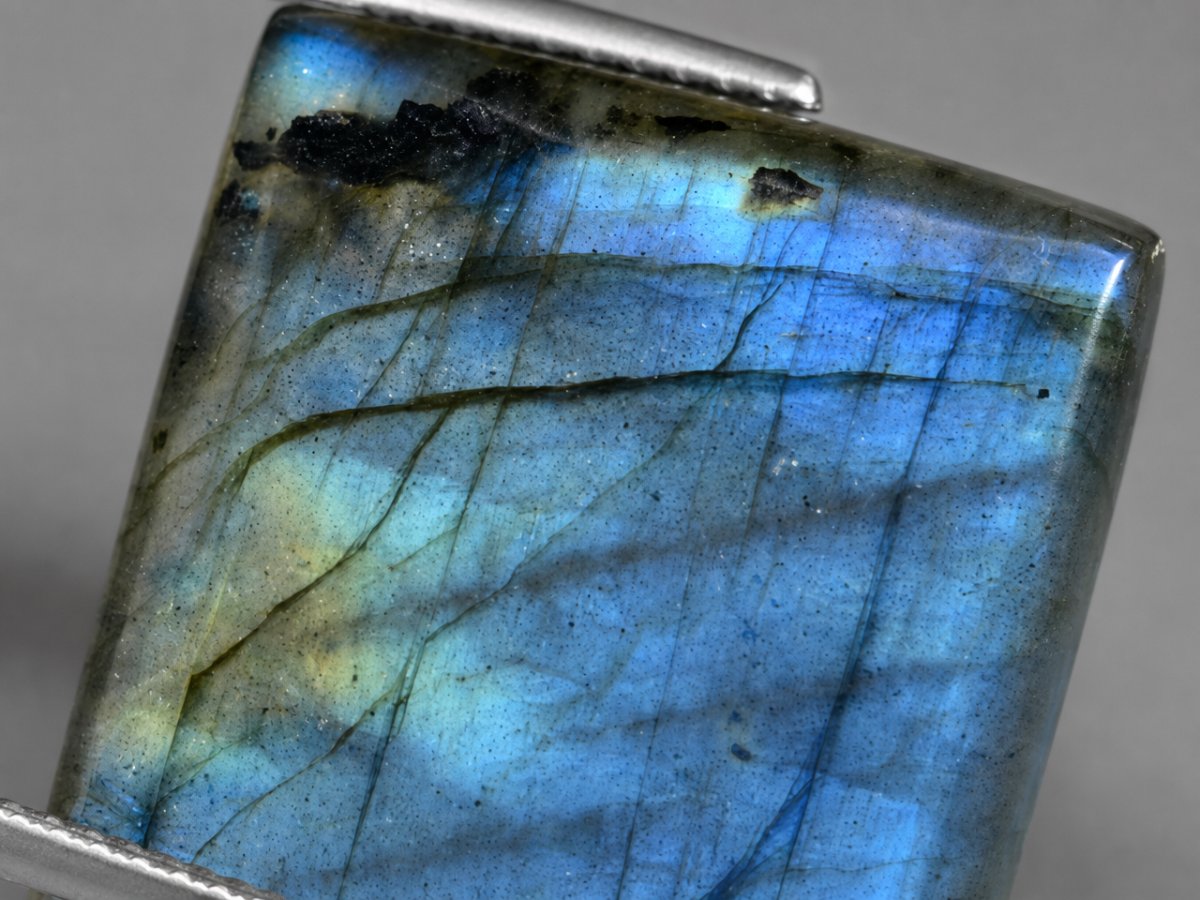
Labradorescence is a directional, colorful optical phenomenon seen in Labradorite, a feldspar mineral. The visible flash can appear as blue, green, yellow, gold, orange or multicolor areas that seem to move across the stone as it is turned.
This flash is different from the gemstone's body color. The body color is the general color you see when the stone is not flashing, often gray, dark gray, greenish gray, brownish or nearly black in many pieces. Labradorescence is the reflected color effect that appears from within the stone when light strikes the internal structure at a favorable angle.
A practical example is a Labradorite cabochon that looks muted gray on a table. When lifted and tilted toward a light source, a strong blue or green sheet of color may suddenly appear across the dome. Tilt it a little farther and the flash may fade again. That change is a key part of labradorescence.
The Internal Lamellar Structure Behind the Flash
The cause of labradorescence lies inside the gemstone. Labradorite can contain a lamellar structure: extremely thin, repeating internal layers or intergrowths within the feldspar. These layers are not painted on the stone and are not visible as separate layers to the unaided eye in most finished gems. They are microscopic features formed within the mineral.
In simplified terms, Labradorite may contain alternating layers of feldspar material with slightly different compositions and slightly different refractive properties. Because these layers interact with light differently, they can split, bend, reflect and recombine light in ways that produce visible color.
The main processes involved are interference and diffraction. Interference occurs when reflected light waves overlap and either strengthen or weaken one another. Diffraction refers to light being spread or redirected as it encounters very fine repeating structures. In Labradorite, the spacing and thickness of the internal layers can favor certain wavelengths of light, so particular colors become visible to the observer.
Why the Colors Appear, Disappear and Change
Labradorescence is highly angle-dependent. The gemstone, the observer and the light source all matter. If the angle is right, light reflects from the internal layers and reaches your eye as a bright colored flash. If the angle changes, the reflected wavelengths may no longer be directed toward you, so the flash disappears or shifts to another area.
This is why a Labradorite can look calm and dark from one direction but vivid from another. A blue flash may appear at one tilt, a green flash at another, and a gold or orange flash may show from a slightly different angle or in a different part of the stone. The effect is often strongest under a focused light source, although attractive stones can also show color in normal viewing conditions.
For jewelry, this directional behavior is important. A ring, pendant or pair of earrings should be oriented so the flash is visible from normal viewing angles. A stone with excellent color that only appears from an awkward angle may be less effective in a finished design than a stone with slightly narrower color range but better face-up visibility.
Why Blue and Green Are Common, and Why Other Colors Occur
Blue and green flashes are especially common in Labradorite because many internal layer spacings favor the reflection of shorter to middle visible wavelengths. However, Labradorite can also show yellow, gold, orange, reddish orange or multicolor labradorescence when the internal layer thicknesses, spacings and viewing geometry support those colors.
The exact color seen is not a pigment choice inside the gem. It is related to how the layered structure interacts with light. Very fine differences in spacing can change which wavelengths are reinforced. This is similar in principle to other structural color effects in nature, where color comes from physical structure rather than from coloring matter.
Multicolor Labradorite can show patches or zones of different colors because the internal structure may vary from one part of the stone to another. One area may produce a blue flash, while another may show green, gold or orange. When these colors appear together with good brightness and coverage, the stone can be especially visually dramatic.
The Flash Is Structural, Not Pigmentation
One of the most useful points for buyers is that labradorescence is an optical structural effect. The blue, green or gold flash is produced by light interacting with microscopic internal layers. It is not the same as body color, and it is not a surface color applied to the gem.
This explains why the same stone can look almost colorless, gray or dark from one direction and intensely colored from another. The color is not evenly present like paint. It appears only when the light path, layer structure and viewing angle work together.
Why Some Labradorite Flashes Strongly and Some Does Not
Not all Labradorite displays the same quality of labradorescence. Strong stones usually have well-developed internal layering, favorable layer spacing and good orientation relative to the polished surface. Weak stones may have less effective internal structure, fewer areas that reflect light strongly, or an orientation that does not reveal the best flash.
Coverage also varies. Some stones show a broad sheet of color across most of the face. Others show a small flash near one edge or only a narrow line of color. Neither type is necessarily wrong, but they suit different purposes. A broad flash is often more noticeable in jewelry, while smaller flashes may appeal to collectors who enjoy subtle optical effects.
The contrast between the flash and the body color also influences appearance. A vivid blue flash against a dark gray base can look sharper than the same flash against a lighter, lower-contrast background. However, personal preference and design style matter; softer effects can work well in understated jewelry.
Cut Orientation: Revealing the Best Labradorescence
Cut orientation is one of the most important practical factors in Labradorite. The cutter must study the rough material and position the polished face so it intersects the internal layers at an angle that reveals the strongest color. If the stone is cut in the wrong direction, the best flash may be hidden, weak or visible only from the side.
This is why two pieces from similar rough can look very different after cutting. One may show a strong face-up blue-green flash, while another may appear mostly gray because the lamellar structure is not oriented effectively to the surface. Skilled cutting cannot create labradorescence where the internal structure is absent, but it can greatly improve how much of the effect is visible.
Why Cabochons, Beads and Freeforms Are Common
Labradorite is often cut as cabochons, beads, polished slabs and freeforms because these shapes can display broad areas of directional color. A smooth cabochon dome allows the viewer to see flashes as the stone is moved, and a freeform cut can be shaped around the strongest natural color zones in the rough.
Traditional faceting can be used for some Labradorite, but faceting is not always the best way to show labradorescence. Facets are designed to reflect and refract light through geometric angles, while Labradorite's main appeal often depends on preserving and orienting the internal flash. A simple polished surface may reveal a cleaner, larger color area than a busy faceted design.
For jewelers and designers, this means Labradorite should be chosen for the way it performs in the intended setting. A pendant can allow a larger cabochon with broad color coverage. Beads can show flashes as they rotate. Rings can be beautiful, but the stone should be positioned so the main flash is visible when the hand is viewed naturally.
Labradorescence Compared with Similar Optical Effects
Labradorescence is sometimes confused with other gemstone phenomena. The differences are useful, but they do not need to be overcomplicated.
Adularescence is the soft, floating glow associated with Moonstone, another feldspar. It is usually more billowy or cloud-like, while labradorescence often appears as stronger, more directional flashes or sheets of color.
Iridescence is a broad term for rainbow-like colors caused by light interference, often at surfaces, thin films or internal structures. Labradorescence is a specific type of structural color effect associated with Labradorite's internal lamellar feldspar structure.
Play-of-color is the term most associated with precious Opal, where shifting spectral colors are produced by a different internal structure. Labradorite's flashes can be colorful and mobile, but the mineral structure and visual character are different from Opal play-of-color.
What Buyers Should Look For in Labradorescence
When judging Labradorite, focus less on a fixed grading formula and more on how the stone actually looks in hand. Important factors include:
- Brightness: Strong labradorescence should be easy to see when the stone is moved under light. Dim flashes may still be attractive, but they create a subtler effect.
- Color range: Blue and green are common and popular visual effects, while gold, orange, yellow and multicolor flashes add variety. Choose the color combination that suits the design or collection.
- Coverage: Consider how much of the stone's face shows color. Full-face flashes are bold; smaller flashes can be delicate or artistic.
- Viewing angle: Check whether the color appears from normal viewing positions. A strong flash that only appears at a steep angle may be less practical in jewelry.
- Contrast: Notice how the flash stands out against the body color. Higher contrast often makes the effect more dramatic.
- Consistency in pairs or sets: For earrings, matched beads or multi-stone designs, compare flash color, brightness and angle so the stones work together visually.
If buying online, look for images that show the stone at more than one angle. A single photograph may capture the flash at its best but not show how the stone appears when the angle changes. GemSelect listings and similar gemstone presentations are most useful when images help reveal both body color and labradorescent effect.
Helpful Visuals for Understanding Labradorescence
Diagrams and close-up images can make labradorescence much easier to understand. Useful visuals include a simplified diagram of alternating feldspar layers, an angle diagram showing light entering and reflecting toward the observer, and a photo sequence of the same Labradorite moving from neutral gray body color to strong blue or green flash.
For educational or sales pages, side-by-side images are especially helpful: one view with little flash, one at the strongest flash angle, and one showing any secondary colors. This gives buyers a more realistic impression of how Labradorite behaves in normal handling.
Conclusion
Labradorescence is the result of Labradorite's internal microscopic layering, not ordinary body color or surface pigmentation. Alternating feldspar layers with slightly different refractive properties interact with light through interference and diffraction, producing the shifting flashes that make Labradorite distinctive.
The best-looking stones combine favorable internal structure with careful cut orientation. When choosing Labradorite, look for brightness, pleasing color, good coverage, a practical viewing angle and strong contrast with the body color. A stone that comes alive as it is tilted is showing exactly what makes labradorescence so appealing.