More than 65,000 Satisfied Customers in over 120 Countries - Serving the Gemstone Business for 10 Years
available 30-Day Return Policy available Worldwide Shipping for $6.99 available Actual Product Photos
available Gem Certification available Natural Gemstones Only available First Class Customer Service
Customer Certified Reviews on Bizrate Call us
Search
Pietersite Gems

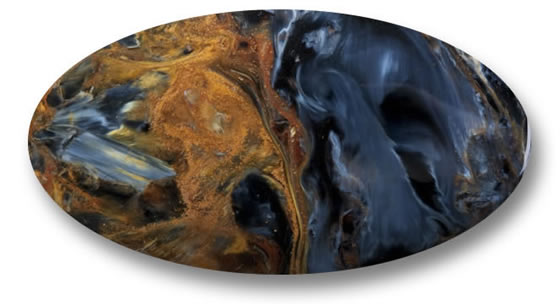
Pietersite is the trade name for a (usually) dark blue-gray breccia aggregate made up mainly of hawk's eye and tiger's eye. It was discovered by a man named Sid Pieters in 1962 in Namibia. He registered his find in Britain and the discovery was published in 1964, named Pietersite in his honor.

Pietersite from Namibia

For many years it was believed that this material was only found in Namibia. But in 1993 a similar material was discovered in Hunan province in China, though specimens did not come to market until 1997. It is now believed that the mine in China has closed, and limited production from Namibia has made Pietersite quite difficult to find.

Pietersite belongs to a branch of the tigers eye family called riebeckite. Tiger's Eye is what geologists refer to as a pseudomorph, one mineral that changes into another. Tiger's Eye began its life as the mineral crocidolite, a form of asbestos. As quartz replaced the crocidolite it took on the shape of the fibrous mineral and that is what causes the chatoyancy in gemstones of this family.

Pietersite from China

Unlike tigers eye, the surface of a Pietersite looks rather chaotic, with streaks and colors in every direction. This because during formation of the crystal, the materials that compose it were broken apart, swirled every which way, and then were reformed and cemented together by quartz. Stones and crystals that go through that process are referred to as brecciated.

Pietersite colors include blues, rusty reds, golds and browns. The blues range from a baby blue to a dark midnight hue. The Chinese pietersite often occurs in shades of gold, red and blue color segments which sometimes also include a deep golden brown.

Pietersite is most commonly and almost exclusively cut into cabochons. This is because a tall, round cut is required to maximize the chatoyancy effect. The orientation of the cut is critical with Pietersite as it must be cut exactly parallel to the length of the fibers.

First Published: January-25-2010

© 2005-2013 GemSelect.com all rights reserved.
Reproduction (text or graphics) without the express written consent of GemSelect.com (SETT Company Ltd.) is strictly prohibited.

ID: 3478491 pc
Pietersite Gemstone
11.36ct Pietersite
18.06 x 13.13 x 5.99mm
US $45.44
Click to see All Item Details
Add Item to Cart
Item is in Stock
ID: 3478552 pcs
Pietersite Gemstone
17.13ctw Pietersite
18.05 x 13.12 x 4.45mm
US $68.52
Click to see All Item Details
Add Item to Cart
Item is in Stock
ID: 3506741 pc
Pietersite Gemstone
25.1ct Pietersite
29.70 x 22.04 x 5.34mm
US $100.40
Click to see All Item Details
Add Item to Cart
Item is in Stock
ID: 3515301 pc
Pietersite Gemstone
30.21ct Pietersite
29.96 x 21.93 x 5.78mm
US $120.84
Click to see All Item Details
Add Item to Cart
Item is in Stock
ID: 3515351 pc
Pietersite Gemstone
4.92ct Pietersite
20.62 x 12.62 x 2.88mm
US $19.68
Click to see All Item Details
Add Item to Cart
Item is in Stock
Email to a Friend
Subscribe to our Newsletter