More than 65,000 Satisfied Customers in over 120 Countries - Serving the Gemstone Business for 10 Years
available 30-Day Return Policy available Worldwide Shipping for $6.99 available Actual Product Photos
available Gem Certification available Natural Gemstones Only available First Class Customer Service
Customer Certified Reviews on Bizrate Call us
Search
Hackmanite et Tenebrescence
Hackmanite Tenebrescence
Hackmanite-Afghanistan

One of the most unusual optical phenomena in the mineral world is something known as tenebrescence. It refers to the ability of a mineral to change color when exposed to sunlight, and for the process to be reversed when the light changes. Another term for this phenomenon is reversible photochromism.

The tenebrescence effect is different from the color change phenomenon, where a gemstone displays a different color when viewed under different lighting. A color-change sapphire, for example, does not undergo a persistent color change when viewed under natural light. As soon as the lighting changes to incandescent, the apparent color of the sapphire changes immediately as well. This is because color-change gems have multiple transmission windows. A gemstone that absorbs all frequencies except for blue and red light will appear blue when the light is rich in blue wavelengths (e.g., sunlight) and red when the light is rich in red wavelengths (e.g., incandescent lighting).

Reversible photochromism is the effect displayed by, for example, color-change eyeglass lenses, that will darken in sunlight, and then lighten again when the wearer goes indoors. The ultraviolet radiation in sunlight produces a photochemical reaction in the lenses such that an absorption band in the visible part of the electromagnetic spectrum changes dramatically in strength or wavelength. Thus the color change persists for a time even when the light changes.

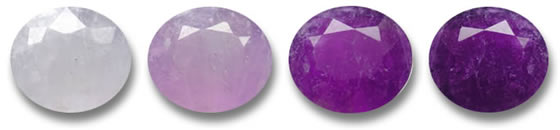
Hackmanite Color States

A similar photochromism is exhibited by a gemstone called hackmanite, a variety of sodalite. First discovered in Greenland in 1896, hackmanite is pale to deep violet when first mined. But the color fades quickly to grayish or greenish white when exposed to sunlight. It will return to its original color when placed in the dark for an extended period of time or when exposed to short wave ultraviolet light.

Hackmanite from Greenland and Quebec changes from pink or violet to white when exposed to sunlight. Hackmanite deposits from Afghanistan and Myanmar change color in the opposite direction -- they change from creamy white to pink-red or violet in sunlight. The tenebrescent effect can be repeated indefinitely. However, heating the gem apparently destroys the photochromism permanently.

Hackmanite was named in honor of the Finnish geologist, Victor Axel Hackman (1866-1941). Hackman was a professor at the University of Helsinki and a geologist with the Finnish Geological Survey.

First Published: February-01-2010

© 2005-2013 GemSelect.com all rights reserved.
Reproduction (text or graphics) without the express written consent of GemSelect.com (SETT Company Ltd.) is strictly prohibited.

ID: 3351171 pc
Sodalite Gemstone
42.99ct Sodalite
29.76 x 25.91 x 7.26mm
US $107.47
Click to see All Item Details
Add Item to Cart
Item is in Stock
ID: 3351841 pc
Sodalite Gemstone
66.87ct Sodalite
35.20 x 29.14 x 8.38mm
US $167.18
Click to see All Item Details
Add Item to Cart
Item is in Stock
ID: 3351851 pc
Sodalite Gemstone
46.25ct Sodalite
27.78 x 20.99 x 7.56mm
US $115.62
Click to see All Item Details
Add Item to Cart
Item is in Stock
ID: 3327331 pc
Sodalite Gemstone
19.69ct Sodalite
25.08 x 17.82 x 8.35mm
US $59.07
Click to see All Item Details
Add Item to Cart
Item is in Stock
Email to a Friend
Subscribe to our Newsletter