Buy Gems: Natural Loose Gemstones HomeNew ArrivalsAbout UsHelpContactSite MapBuyers GuideAccountsCart Open GemSelect Shopping Cart
Gemstone Articles :: About Coral
Back Back Forward
Loose Gemstones Direct from the Source
Items: 0 | Total: $0.00
Loose Gemstones Direct from the Source  
Click for Gem Details
2.41ct Coral
13.58 x 6.83 x 3.39mm
$45.79 
Show Gemstone Details Add Gem to Cart
Click for Gem Details
2.85ct Coral
13.01 x 7.71 x 3.73mm
$51.30 
Show Gemstone Details Add Gem to Cart
Click for Gem Details
9.84ct Coral
17.97 x 12.9 x 5.74mm
$186.96 
Show Gemstone Details Add Gem to Cart
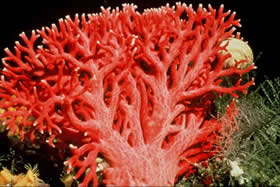
Precious Coral
Natural Red Coral
Natural Red Coral

There is a small but important class of gemstones which are not really stones at all. Rather than being minerals with a crystalline structure, their origin is organic -- they formed from biological processes, whether animal or vegetable. The class of organic gems is small but includes a number of unusual varieties which are important in the gem trade: amber, coral, jet, ivory and pearl.

Coral is a branching skeleton-like structure built by small marine animals known as coral polyps. The gem-quality coral is related to the reef-forming corals, but the most valuable coral variety is found in the Mediterranean, the Red Sea and in coastal Japan. Colors range from bright to dark red to orange-red, orange-pink, pink, white, blue and black. Unworked coral is dull, but when polished it has an attractive vitreous luster.

Precious coral is a species of coral that grows in rocky sea bottoms, typically in dark environments either in the depths or in dark caverns. The coral skeleton is composed of hard calcium carbonate, colored by carotenoid pigments. Coral typically exhibits a range of warm reddish pink colors ranging from salmon pink to deep red; the word coral is also used to name such colors. However, gem-quality coral is also found in white, black and blue.

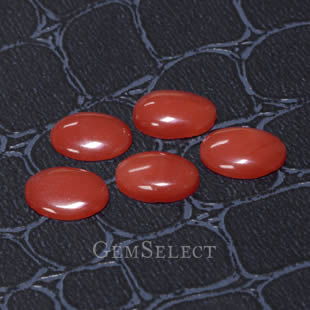
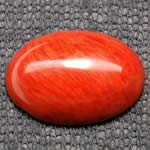
Red Coral Cabochon
Red Coral Cab

Due to its intense and permanent coloration and luster, precious coral skeletons have been harvested since antiquity for decorative use. Coral jewelry has been found in ancient Egyptian and prehistoric European burials. Most precious coral is harvested in the Mediterranean Sea, especially in Sardinia. Deposits are also found in the Pacific, in Japan, Taiwan and Australia.

Because coral is an organic material, it is not especially durable. Coral is reasonably hard, but not nearly as hard as many gemstones; it has a rating of only 3 to 4 on the Mohs scale. Corals are sensitive to heat, acids and hot solutions, and the color can fade slightly when worn. White and red coral has a specific gravity or density of 2.60-2.70 and a refractive index of 1.486-1.658. Coral is translucent to opaque.

Coral is polished with fine-grained sandstone and emery and then finely polished with felt-wheels. It is used for beads for necklaces and bracelets, for cabochons, ornamental objects and sculptures. You will sometimes see branch-like pieces drilled and strung as spiky necklaces.

Help
• Shipping
• Payment
• Return Policy
• Security and Privacy
• Guarantee
Gemstone Information
• GemSelect Newsletters
• Top Grade Gems
• Clarity and Cut
• Amethyst Cabochons
• Calibrated Gemstone Chart
• Emerald Information
• Blue Sapphire
• Andesine Labradorite
• Apatite Information
• Red Spinel
• Tsavorite Garnet
• Golden Zircon
• Rhodolite Garnet
• Round Tourmaline
• Watermelon Tourmaline
• Pink Tourmaline
• Clarity Scale
Pay Gemstones with Credit Card Pay Gems with PayPal Pay Gem Stones with Visa Delta Ship Gemstones with USPS Secure Payment Fair Gemstone Trade supported by Square Trade
Ship Gemstones securely with FedEx
GO!