
FREE SHIPPING
|
|
Reviewed By Andreas Zabczyk
Violet Charoite - Rare and Beautiful GemstonesCharoite is a rare and unusual gemstone. One of its most unusual characteristics is that it is often described as "unnaturally beautiful". It has such a unique and attractive swirling violet color that specimens of it are sometimes thought to be synthetic rather than natural.
In fact, charoite is a natural mineral - it is composed of complex silicate-containing phosphorus, calcium and sodium. It is always found in massive rather than crystal form in nature. Charoite was reportedly discovered in the 1940s, but it was not known to the mineral world until its description in 1978. Though remarkably beautiful when cut and polished, it is said to be opaque and unattractive when found in the field, a fact that may have contributed to its late recognition. The name charoite is said to be derived from the Charo River which is near Yakutia where it was first found, in Siberia, Russia. 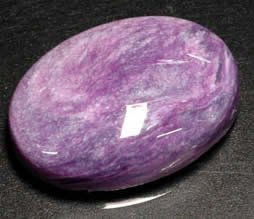
Violet Charoite Cabochon
Charoite's color ranges from lilac to violet or purple, and its unusual patterns make it a distinctive material. Charoite's patterns are variously described as streaks, swirls, feathers and mottling. In that respect it displays some similarity to granite or marble. But where granite and marble are rocks composed of multiple minerals, charoite is a discrete mineral. Sometimes charoite specimens contain streaks of orange tinaksite and green or black aegerine. Charoite has a very complex chemical composition; it is hydrated potassium, sodium, calcium, barium strontium, silicate hydroxyfluoride. It has a hardness of 5 to 6 on the Mohs scale; about the same as turquoise and lapis lazuli. Its density is 2.5 to 2.8 and its refractive index is 1.55 to 1.56; both values are roughly similar to quartz. Charoite has a vitreous to pearly or silky luster. To date, charoite has only been found in the one location in Siberia. Despite its rarity and remarkable beauty, it is still modestly priced. This Page in Other Languages
About Us
Overall Rating -> 10 Easy to use,I have spent many hours looking at the site Posted By Skip in November, 2023 Source: Bizrate Overall Rating -> 10 Extremely easy to use, and I am fully satisfied with the purchase process. Posted By Fl_Beachcomber in October, 2023 Source: Bizrate Overall Rating -> 10 Website was incredibly easy and fast to use. Navigation and product outlay was simple and enjoyable to browse. Thank you and have a blessed day! Posted By Devi in October, 2023 Source: Bizrate Overall Rating -> 10 Was easy to search for many gems and mineral stones.Authenticity of natural stones is important, and I feel this site offers some assurance on this. Posted By DanM in November, 2023 Source: Bizrate Overall Rating -> 10 first time here sooooooooooo we will seeeee!!!!! so far so good!!!!!! Posted By Seastone 56 in October, 2023 Source: Bizrate Overall Rating -> 8 Very easy to find the specific stone I was looking for. I am pleased by both the selection and the price of the stones that are available. The only "bad" thing that I have to say is that the interface of the site is outdated. Posted By Nick in March, 2024 Source: Bizrate Related Articles Charoite Info Charoite Information - Gorgeous purple gemstone from Siberia Understanding Gem Sizes Understanding Gemstone Sizes Untreated Gems for Jewelry II Untreated Gems for Jewelry - Part II |
| STAY IN TOUCH | NEWSLETTER |
| *You're signing up to receive GemSelect promotional email. |


Copyright © 2005-2024 GemSelect.com all rights reserved.
Reproduction (text or graphics) without the express written consent of GemSelect.com (SETT Company Ltd.) is strictly prohibited.
852


