
FREE SHIPPING
|
|
Reviewed By Andreas Zabczyk
Prong Vs. Bezel Settings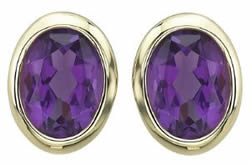
Bezel-Set Amethysts
The two most common ways of mounting a large single gemstone are the prong (also called claw) setting and the bezel setting. These two popular settings are used in earrings and pendants as well as rings. In a prong (claw) setting there are typically three or more pieces of metal raised above the base of the setting, which bend slightly over the stone to hold it in place. Usually the prongs are notched so that the girdle of the gemstone sits firmly in the prong. In a bezel setting a piece of metal partially or completely surrounds the stone to hold it in place. 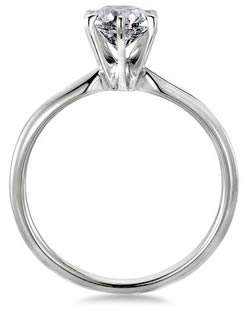
Classic Tiffany 4-Prong Setting
Both types of setting have their advantages and disadvantages. The main advantage of the bezel setting is that it is very protective of the gemstone, and this is particularly important with some stones that have become popular due to their lesser hardness. Gems such as opal, sphene, chrome diopside, turquoise, apatite and fluorite have a hardness score of less than 7 on the Mohs scale, meaning they can be scratched fairly easily. Bezel settings help to protect these softer stones, particularly if they are set in rings. Another advantage of the bezel setting is that a well-designed precious metal bezel can be extremely attractive. The main disadvantage of bezel settings is that they are typically more expensive. This type of setting requires more metal, and the setting usually has to be custom-made to properly fit the gemstone. A bezel also covers more of the gemstone. This is not so much of an issue with opaque stones like most cabochons, but it may affect the amount of light that reaches a transparent stone. Some designs address this issue with bezels that that don't completely surround the stone. The height of the bezel is also an important factor; a lower bezel will expose more of the stone. 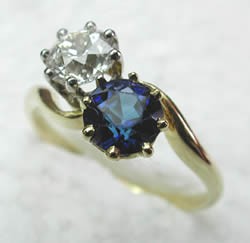
8-Prong Sapphire Diamond Setting
Prong settings provide optimal exposure for the gem. This is both an advantage and a disadvantage. It lets more light reach the stone and often makes the gemstone look larger by raising it from the band, as in the classic Tiffany setting. But it also exposes the gem to knocks and bumps. Prong settings need to be checked frequently to ensure that none of the claws are loose or broken. Losing a claw can mean losing a valuable gem. Though prongs are often unobtrusive, different designs can enhance the setting. Prongs come in many different shapes, and there are special ones to hold the sharp points of a marquise or pear-shaped gem. The most common prong settings use 4, 6 or even 8 prongs. The greater the number of prongs, the more secure the setting. The quality of the setting is also extremely important. A well-constructed prong setting will last for many years. This Page in Other Languages
About Us
Overall Rating -> 10 I was looking for a source for affordable genuine gemstones for my grandson who is currently very interested in rocks and gems. I was quite surprised and pleased to find GemSelect and finding the right stones at the right price couldn't have been simpler. Posted By Papa in December, 2023 Source: Bizrate Overall Rating -> 10 It was easy to search and find what i wanted Posted By Gunner in November, 2023 Source: Bizrate Overall Rating -> 10 I have used this site for sseveral years now. All has been great. I started collection gems from GemSelect for years and wanted to collect at least one of most stones. I loved Safers because the mols is a 9 + and they come in every color. This is the best place to buy gems for the assortment and price. Great place to learn about gems too. Sometimes the shipping is a little on the long side. But I would give them a 9.9 out of 10 !! Posted By Steve in July, 2023 Source: Bizrate Overall Rating -> 10 Todo muy bien en la compra ahora esperar recibir el pedido. Posted By MAGSMX in August, 2023 Source: Bizrate Overall Rating -> 10 Very good, very fast, everything as described. Posted By B in October, 2023 Source: Bizrate Overall Rating -> 9 My first purchase went well. I will purchase more gems in the future. Posted By NoHalalAl in March, 2024 Source: Bizrate Overall Rating -> 10 Always have good experience Posted By Ginnie in September, 2023 Source: Bizrate Related Articles Chalcedony Info Chalcedony Gemstone Information - Subtle colors with an inner glow Emerald Info Emerald Information - Vivid green gemstones of unequaled quality Tanzanite Info Tanzanite Information - Africa's wonder risen from the ashes Zircon Info Zircon Information - A gemstone as old as the earth itself Birthstones by Month Birthstones by Month, Every Birthstone, Zodiac & Anniversary Caring for Gemstones Gemstone Care - Gemstone Information - GemSelect Gemstone Hardness Explained Gemstone Hardness | Mohs Scale with Images and Charts Precious and Semi-Precious Gemstone Glossary Gemstone & Mineral Glossary - Gemstone Information - GemSelect Gem Info Gemtone Information - GemSelect Gemstones By Color Gemstones by Color: Color Guide for Gemstones, All Colors Cleavage Chart Gemstone Cleavage Chart - Gemstone Information - GemSelect Tension Settings Tension Settings Types of Gem Settings Types of Settings for Gemstones - Gem Settings Uniqueness of Gold Uniqueness of Gold Jewelry Gemstones Jewelry Gemstones - Colored Gemstone Jewelry Information |
| STAY IN TOUCH | NEWSLETTER |
| *You're signing up to receive GemSelect promotional email. |


Copyright © 2005-2024 GemSelect.com all rights reserved.
Reproduction (text or graphics) without the express written consent of GemSelect.com (SETT Company Ltd.) is strictly prohibited.
611


