
FREE SHIPPING
|
GemSelect Newsletter - May 2008In our newsletter this month:
Our Home in Chanthaburi, Thailand Back to Top
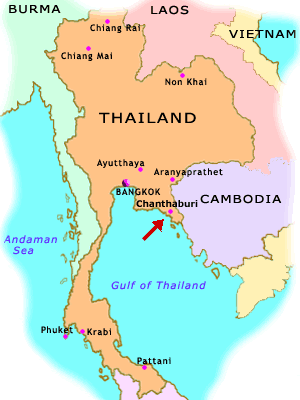 Thailand Map - Chanthaburi
GemSelect is based in Chanthaburi, Thailand, a town of about 50,000 people located 245 km southeast of Bangkok (see map). It is not a very well known tourist attraction. In fact you'll hardly find it mentioned in the average guidebook. In the gemstone world, however, it's a different story - Chanthaburi is one of the international centers for cutting and trading colored gemstones, as important as Jaipur in India or Idar-Oberstein in Germany. Chanthaburi's weekend gemstone market is a rare experience for any gemstone lover. Chanthaburi is also a wonderful place to live and work. As expatriates who've settled in Thailand for some years, we've come to love the life here. Though living and doing business in a developing country can be challenging - we've survived a major flood and a minor military coup in the last couple of years - the quality of life and the hospitable Thai people more than compensate for the occasional difficulties. 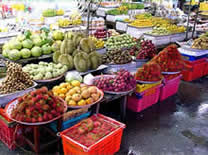 Local Fruit Market in Chanthaburi Thailand
While foreign tourists have not yet discovered us, Thai people know Chanthaburi as an area of great natural beauty and outstanding food. Located on a plain between the Gulf of Thailand and the rugged Chanthaburi Mountains, Chanthaburi is one of the few places in Thailand where you can enjoy both unspoiled beaches and mountain waterfalls. With an annual rainfall of more than 3,000 mm, Chanthaburi is famous for its tropical fruit, particularly durian, rambutan, mangosteen and longan. We also have abundant seafood, especially shrimp, much of it exported; and Chanthaburi is an important producer of high quality white and black pepper. 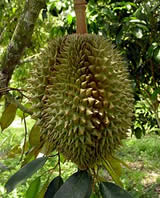 World Famous Durian Fruit from Chanthaburi
Chanthaburi also has quite a fascinating history. When Ayutthaya, the historical capital of the Kingdom of Siam, was attacked and completely destroyed by the Burmese in 1767, the country was thrown into chaos. A Thai military commander named Phraya Taksin retreated to Chanthaburi, where he built up a force to repel the Burmese. After the defeat of the Burmese, Taksin became King of Thailand in 1768 and started to rebuild the nation. 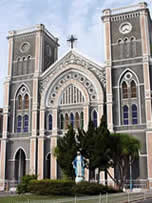 Catholic Cathedral in Chanthaburi, Thailand
Though they fought a series of wars with Burma, the Thais are proud that they have never been colonized. While all the other countries in the region - Vietnam, Cambodia, Laos, Burma, Malaysia and Indonesia - were once colonies of the French, British or Dutch, Thailand remained independent. Chanthaburi, however, was a temporary exception. When Thailand tried to exert control over Laos and Cambodia in the 19th century, it led to a conflict with France in 1893, known as the Paknam crisis. This resulted in the French occupation of Chanthaburi until a peace treaty was signed in 1905. Signs of the French occupation can still be seen in the French architecture of the old town and the largest Catholic cathedral in Thailand. With its flourishing gem trade, and fruit and seafood industries, Chanthaburi is a prosperous town; probably one of the wealthiest in Thailand. It has a small but significant foreign population, though most are African gem traders, not Westerners. English is not widely spoken, but foreign visitors are warmly welcomed.
New Content at GemSelect Back to Top
We add hundreds of new gems to our inventory every day and we upload new content to our site each week, in the form of articles and reference material. Recently we've added new articles on topics including Zultanite, synthetic corundum and the gemstone cutting process. For useful buying information, see our new articles on untreated gemstones and buying tourmaline.
Rare and Unusual Gems Back to Top
In a new feature beginning this month, we focus on a rare and unusual gem from our recent acquisitions. This month's featured gem is a huge sphene from Sri Lanka: 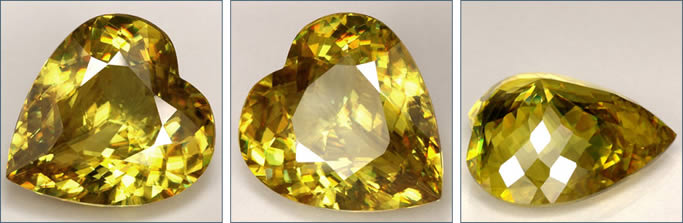 Natural Heart Shaped Sphene at GemSelect
Sphene, also known as "titanite", is a brilliant yellowish-green, green or brown gemstone of high luster, unique shades of color and an intensive fire, comparable to that of diamond. Although it is always in demand, sphene is a rare gem and very large sphene gems with excellent clarity are extremely rare. This 12.18 carat heart-shaped piece is the largest sphene we have ever been able to buy, and also one of the cleanest. Sphene tends to be included, but this piece is so clean we've graded it VVS. The brilliance and fire of this sphene is difficult to capture in a photograph; this gem glitters like very few colored gems we've seen. This large sphene is perfectly sized for a very impressive pendant.
Customer Questions Back to Top
Every month we answer questions of general interest from our customers. Please feel free to send your questions or suggestions to our support team at help@gemselect.com! Question
I was just wondering ... why do so many gemstone names end in "ite"? Thanks for your thoughts. MM, USA.
Answer
The "ite" suffix is derived from the Greek word, lithos meaning rock or stone (the adjectival form of lithos is "-ites"). It is a convention in the mineral world that new minerals are given names ending in "ite." The Commission on New Minerals, Nomenclature and Classification of the International Mineralogical Association publishes guidelines for naming new minerals (or renaming old ones).
Question
Is there a difference between brilliance and luster in gemstones? Or do they have the same meaning? FB, Australia.
Answer
Brilliance and luster have loose meanings in everyday language, but they are technical terms in gemology. Brilliance refers to the light reflected from the interior of a gem. Thus only a transparent gemstone can be said to have brilliance. Luster, on the other hand, refers to the light reflected from a gem's surface. Brilliance is graded from low to high, but luster is usually described in terms such as vitreous (glass-like), adamantine (diamond-like), silky, resinous, dull and greasy.
Keep up with our new arrivals before they hit the newsletter by joining our thousands of fans and followers on our social networking pages. We love interacting with our customers - you can visit us on Tumblr, LinkedIn, Twitter, Facebook or Pinterest! To ensure you can receive our emails, please be sure to add help@gemselect.com to your list of safe contacts, or you add us into your email address book! Please feel free to contact us with any questions, comments and queries! We respond to each and every email we receive. Happy Gem Hunting! This Page in Other Languages
About Us
Overall Rating -> 9 The selection and filtering is a little overwhelming, but that's only because there is so much to choose from. Posted By Kasper in June, 2023 Source: Bizrate Overall Rating -> 10 My overall interaction with your website was pleasant, as always. Posted By RJ in April, 2024 Source: Bizrate Overall Rating -> 9 It was simple and clear to understand. Posted By Thora007 in December, 2023 Source: Bizrate Overall Rating -> 9 So many gorgeous stones! The only "complaint" I have is it's difficult to visualize sizes in mm. Perhaps some way to compare in inches?It has been a long time since I bought stones from Gem select, but the process wasn't too difficult. Posted By Ktreva52 in February, 2024 Source: Bizrate Overall Rating -> 10 I really enjoy browsing through GemSelect. The selection is always marvelous and I love how detailed everything is described. The only thing I noticed is that when browsing through my phone, the videos of the gems do not load. If there were more videos of the gems, that would be amazing, though I understand that is a lot of work on GemSelect's part! Checking out is also very fast and easy, and I love that the return policy is very good, though I hope I don't have to use it anytime soon. Posted By ChiChi in January, 2024 Source: Bizrate Related Articles Sapphire Info Sapphire Gemstone: What is Sapphire? Sapphire Color and more Tourmaline Gem Info Tourmaline Information - The most colorful gem on Earth Aquamarine Info Aquamarine Information - Get the facts, figures and stories behind... Emerald Info Emerald Information - Vivid green gemstones of unequaled quality Fire Opal Info Fire Opal Gemstone - A Mexican sunset captured in a gem Iolite Info Iolite Gemstone Information - Facts & Benefits Jade Info Jade Gemstone Information - GemSelect Kunzite Info Kunzite Gemstones - The must-have pink gem for evenings Orthoclase Info Orthoclase Gemstone Information: Unveil Its Natural Beauty Peridot Info Peridot: Properties & Value, Peridot Meaning & Healing Rhodolite Garnet Info Rhodolite Garnet Information - An elegant rose among thorns Ruby Info Ruby Information - The gemstone of passion and seduction Ruby-Zoisite Info Ruby-Zoisite Information - A unique gemstone mixture Spessartite Garnet Info Spessartite Garnet: The Best Orange Garnet, A Detailed Guide Sphene Info Sphene Gemstone Information - GemSelect Spinel Info Spinel Gemstone Information - An often overlooked Beauty Tanzanite Info Tanzanite Information - Africa's wonder risen from the ashes Topaz Info Topaz Gemstone Information – Take a look beyond the blue Zircon Info Zircon Information - A gemstone as old as the earth itself Lapis Lazuli Info Lapis Lazuli Information - The timeless deep blue gemstone Moss Opal Info Moss Opal Gemstones - Intriguing branch-like inclusions Mystic Topaz Info Mystic Topaz Information - A kaleidoscope of colors Star Ruby Info Star Ruby Gemstone Information - GemSelect Birthstones and Anniversary Gemstones Birthstones by Month, Every Birthstone, Zodiac & Anniversary Caring for Gemstones Gemstone Care - Gemstone Information - GemSelect Color Basics Gemstone Color - A Quick Guide to Colors Diffusion Treatment Diffusion Treatment for Gemstones - GemSelect Irradiation Treatment Irradiation Treatment - Gemstone Information - GemSelect Gemstone Hardness Explained Gemstone Hardness | Mohs Scale with Images and Charts Gemstone Clarity and Cut Clarity and Cut - Gemstone Information - GemSelect Precious and Semi-Precious Gemstone Glossary Gemstone & Mineral Glossary - Gemstone Information - GemSelect Medicinal Gemstones Medicinal Gemstone Information - GemSelect Gemstone Treatments All About Gemstone Treatments - Information - GemSelect Fracture Filled Fracture Filled Treatment - Gemstone Information - GemSelect Gem Market Chanthaburi International Gemstone Market in Chanthaburi, Thailand: Shopping f... Gemstone Prices Gemstone Prices - A review of what influences the amount you pay Loose Gemstones from Mine to Market Loose Gemstones From Mine to Market - Gems and Jewelry Information... Precious Stones Precious & Semi-Precious Gemstone History, Legends & Myths Rare Tourmaline Rare Tourmaline Gemstones - Unique and distinctive varieties The Secret of Spinel The Secret of Spinel Gemstones Allure of Yellow Sapphire Yellow Sapphire: Meaning, Properties, Details and More Kunz and Tourmaline Kunz and Tourmaline - Creating the colored gemstone market Sources for Fine Ruby Gems Sources for Fine Ruby Gems Gem Mining in Madagascar Sapphire and Ruby Gemstone Mining in Madagascar Healing Gemstones Healing Gemstones: Could Gems Have Special Powers? Rare Garnets Rare Garnets: Tsavorite, Spessartite and Rhodolite Colored Gemstone Business Understanding the Colored Gemstone Business Tanzanite Prices Tanzanite Prices - Limited supplies of this stunning stone Star Gemstones Star Gemstones Gemstone Names Gemstone Names | Gem Name Origins, History, Lists and More Apatite Gemstones Apatite Gemstones - They are a lot more common than you think |
| STAY IN TOUCH | NEWSLETTER |
| *You're signing up to receive GemSelect promotional email. |


Copyright © 2005-2024 GemSelect.com all rights reserved.
Reproduction (text or graphics) without the express written consent of GemSelect.com (SETT Company Ltd.) is strictly prohibited.
492


