FREE SHIPPING
|
GemSelect Newsletter - June 2009In our newsletter this month:
Gemstone Prices during Recession Back to Top
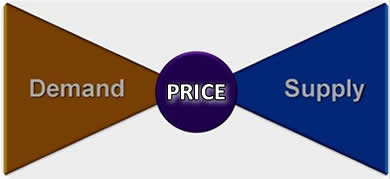
The prices of many goods fall during periods of economic recession. Various factors contribute to declining prices, including falling consumer demand, liquidation sales and attempts to stimulate business through discounting. Depending on the severity of the economic downturn, the effect may be shortlived. In a protracted recession, such as Japan experienced in the 1990s, a nasty deflationary spiral can develop, where steadily falling prices lead consumers to delay purchases in the hope that they can buy the same goods in the future at a lower price. Not all commodity prices fall during recession. While oil prices fell dramatically during the current recession, the price of gold has remained stubbornly high, even rising from the start of the global economic crisis in October 2008. This is not unusual in a recession, when speculators seek a safe haven in gold. The high price of gold has certainly cut into jewelry sales, even leading some consumers to cash in their gold jewelry. Sales of luxury items such as jewelry are always slow during economic downturns, but the high price of precious metals has made times even tougher for many jewelers and jewelry designers. Surprisingly, the gemstone trade has not suffered to the same degree. This is because the market for fine gemstones tends to be limited by supply, rather than demand. The demand for the finer stones always exceeds supply, and the better the stone, the more competition there is to buy it. Smart gem dealers put as much effort into establishing sources for good stones as they do to marketing their wares. We are fortunate to have a diversified business, with customers in more than 90 countries. That has helped cushion the impact of the recession on our business. In fact, you may have noticed that we've actually increased our buying in these tough times while many other dealers are cutting back. For us it's an opportunity to buy special stones at good prices. We've been buying more calibrated pieces and more top-grade sapphires, including many unheated stones. We've also added substantially to our stock in aquamarine, spinel, tanzanite and spessartite garnet gems. Few economists are brave enough to forecast an end to this recession. We're all hopeful that we might see some improvement by the end of the year. In the meantime we're taking advantage of the opportunity to buy some especially fine gems. Rare and Unusual Gems Back to Top
Each month we feature a rare and unusual gem from our inventory. This month we feature a rare, flawless Paraiba tourmaline from Mozambique: 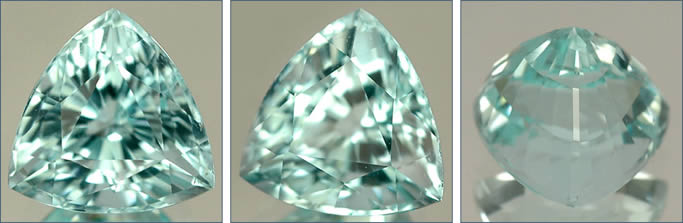
Paraiba Tourmaline from Madagascar
A rare vivid blue-green tourmaline was first discovered in the Brazililan state of Paraiba in 1989. Lab analysis showed the unusual color was due to the presence of copper and manganese. Market demand for these stones was so strong that the Brazilian mines were soon worked out. Fortunately similar material was discovered in Nigeria in 2001, and then in Mozambique in 2005. The Mozambican material is regarded by many experts as the closest in color to the original Brazilian cuprian tourmaline. But where the Brazilian stones tended be heavily included, the Mozambique mines sometimes yield very clean specimens. The 2.21 carat trillion pictured above is the first Paraiba tourmaline we've found that is graded IF. Customer Questions Back to Top
Every month we answer questions of general interest from our customers. Please feel free to send your questions or suggestions to our support team at help@gemselect.com! Question
I have heard that the sapphire from Kashmir is the best. Do you sell this sapphire? RG, Canada.
Answer
Kashmir sapphire is indeed the most famous sapphire in the world. But it is extremely rare. New sapphire is rarely found in Kashmir, and in fact most of the material that exists was discovered more than 100 years ago. You will almost never see genuine Kashmir sapphire offered for sale; indeed they rarely appear even at the high end auctions.
Apart from its extreme rarity, Kashmir sapphire is valued for its intense cornflower blue and its silky sheen (due to rutile inclusions). You will sometimes find a similar color in the best sapphires from Ceylon, Burma and Madagascar. Question
How can I find the untreated stones on your website? I want to buy a blue sapphire that has not been treated in any way. Thank you. CY, Singapore.
Answer
We have created pages where you can view just our unheated sapphires and our untreated gems in all varieties. Just click the links to visit the pages. Once you reach these pages you can use the blue pull-down menu to sort the gems by size, weight, color, shape and price.
Keep up with our new arrivals before they hit the newsletter by joining our thousands of fans and followers on our social networking pages. We love interacting with our customers - you can visit us on Tumblr, LinkedIn, Twitter, Facebook or Pinterest! To ensure you can receive our emails, please be sure to add help@gemselect.com to your list of safe contacts, or you add us into your email address book! Please feel free to contact us with any questions, comments and queries! We respond to each and every email we receive. Happy Gem Hunting! This Page in Other Languages
About Us
Overall Rating -> 9 The selection and filtering is a little overwhelming, but that's only because there is so much to choose from. Posted By Kasper in June, 2023 Source: Bizrate Overall Rating -> 10 Easy to use,I have spent many hours looking at the site Posted By Skip in November, 2023 Source: Bizrate Overall Rating -> 10 I love your selection of gems. My only complaing is I wish I could put in a page number to return to that page.When there are over 60 pages of gems it is hard to return to a page with a gem I am considering. Posted By Cahall in March, 2024 Source: Bizrate Overall Rating -> 10 The website is well organized and works fast forward and back. Plenty of filters. Each gem is described in detail and you receive the one pictured. Gem material info and sources available. I would like to see more specifics on sources besides country- at least region or state and in the US with Turquiose which mine. Thanks! Posted By Orchidisle in February, 2024 Source: Bizrate Overall Rating -> 10 Great selection, I love your site! Great product visibility, information, etc. Posted By John in February, 2024 Source: Bizrate Overall Rating -> 10 Easy to find the stones I was looking for. Always good quality stones Posted By Erin in June, 2023 Source: Bizrate Overall Rating -> 9 Everything was good but since I am still new I was surprised at how small the stones where. Posted By Js in May, 2023 Source: Bizrate Related Articles Sapphire Info Sapphire Gemstone: What is Sapphire? Sapphire Color and more Tourmaline Gem Info Tourmaline Information - The most colorful gem on Earth Aquamarine Info Aquamarine Information - Get the facts, figures and stories behind... Emerald Info Emerald Information - Vivid green gemstones of unequaled quality Fire Opal Info Fire Opal Gemstone - A Mexican sunset captured in a gem Iolite Info Iolite Gemstone Information - Facts & Benefits Jade Info Jade Gemstone Information - GemSelect Kunzite Info Kunzite Gemstones - The must-have pink gem for evenings Orthoclase Info Orthoclase Gemstone Information: Unveil Its Natural Beauty Peridot Info Peridot: Properties & Value, Peridot Meaning & Healing Rhodolite Garnet Info Rhodolite Garnet Information - An elegant rose among thorns Ruby Info Ruby Information - The gemstone of passion and seduction Ruby-Zoisite Info Ruby-Zoisite Information - A unique gemstone mixture Spessartite Garnet Info Spessartite Garnet: The Best Orange Garnet, A Detailed Guide Sphene Info Sphene Gemstone Information - GemSelect Spinel Info Spinel Gemstone Information - An often overlooked Beauty Tanzanite Info Tanzanite Information - Africa's wonder risen from the ashes Topaz Info Topaz Gemstone Information – Take a look beyond the blue Zircon Info Zircon Information - A gemstone as old as the earth itself Lapis Lazuli Info Lapis Lazuli Information - The timeless deep blue gemstone Moss Opal Info Moss Opal Gemstones - Intriguing branch-like inclusions Mystic Topaz Info Mystic Topaz Information - A kaleidoscope of colors Star Ruby Info Star Ruby Gemstone Information - GemSelect Birthstones by Month Birthstones by Month, Every Birthstone, Zodiac & Anniversary Caring for Gemstones Gemstone Care - Gemstone Information - GemSelect Color Basics Gemstone Color - A Quick Guide to Colors Diffusion Treatment Diffusion Treatment for Gemstones - GemSelect Irradiation Treatment Irradiation Treatment - Gemstone Information - GemSelect Gemstone Hardness Explained Gemstone Hardness | Mohs Scale with Images and Charts Precious and Semi-Precious Gemstone Glossary Gemstone & Mineral Glossary - Gemstone Information - GemSelect Medicinal Gemstones Medicinal Gemstone Information - GemSelect Fracture Filled Fracture Filled Treatment - Gemstone Information - GemSelect Gem Market Chanthaburi International Gemstone Market in Chanthaburi, Thailand: Shopping f... Gemstone Prices Gemstone Prices - A review of what influences the amount you pay Loose Gemstones from Mine to Market Loose Gemstones From Mine to Market - Gems and Jewelry Information... Precious Stones Precious & Semi-Precious Gemstone History, Legends & Myths Rare Tourmaline Rare Tourmaline Gemstones - Unique and distinctive varieties The Secret of Spinel The Secret of Spinel Gemstones Allure of Yellow Sapphire Yellow Sapphire: Meaning, Properties, Details and More Kunz and Tourmaline Kunz and Tourmaline - Creating the colored gemstone market Sources for Fine Ruby Gems Sources for Fine Ruby Gems Gem Mining in Madagascar Sapphire and Ruby Gemstone Mining in Madagascar Healing Gemstones Healing Gemstones: Could Gems Have Special Powers? Rare Garnets Rare Garnets: Tsavorite, Spessartite and Rhodolite Colored Gemstone Business Understanding the Colored Gemstone Business Tanzanite Prices Tanzanite Prices - Limited supplies of this stunning stone Star Gemstones Star Gemstones Labradorite Iridescence Labradorite Iridescence: Discover the Mystic Glow Prong Vs. Bezel Settings Prong Vs. Bezel Settings Discover the Beauty of Aventurine Gemstones Aventurine Gems Blue Larimar Blue Larimar Gemstones - A beauty from the Caribbean Green Seraphinite Green Seraphinite information - The heavenly gemstone of angels Native Cut Gemstones Native Cut Gemstones Gem Silica Gemstone Silica |
| STAY IN TOUCH | NEWSLETTER |
| *You're signing up to receive GemSelect promotional email. |


Copyright © 2005-2024 GemSelect.com all rights reserved.
Reproduction (text or graphics) without the express written consent of GemSelect.com (SETT Company Ltd.) is strictly prohibited.
919