
Gemstone Hardness | Mohs Scale with Images and Charts

Gemstone hardness… who cares? You should. If you are wearing gems, looking to buy them, or designing gemstone jewelry, hardness is something that should concern you. Why? The usual bottom line: money. Your gemstones add charm and allure to your person, but they're also investments that need protection from harm - scratching, in particular.
A low Mohs hardness value (lower than 7) increases the risk of damage which results in a loss of value and necessitates expensive repairs.
More than that, though, as a lover of gemstones, you want to safeguard their elegance and keep them looking brilliant. You can easily do this by becoming aware of your gemstones' place on the Mohs hardness scale (explained later) and taking the appropriate care when creating settings for your gemstones and while wearing them, whether for everyday use, or for special occasions.
Hardness is part of the holy trinity used by dealers to rate the durability of a stone; the other two qualities being toughness and stability.
Gemstone hardness, what exactly is it?
We usually think in general terms of something being hard (or the opposite - soft) as a measure of how it feels to us. And we consider whether or not we could scratch it, bend it, break it, or what would happen if we dropped it on the ground or whacked it with a hammer. All of these actions are important when dealing with gemstones, but gemstone hardness has a very specific definition:
Gemstone Hardness is a measure of how difficult (or easy) it is to scratch the surface of the gemstone.
The hardest gemstones (diamonds, rubies and sapphires) get a rating closer to 10 on the Mohs scale, while the softer gemstones (amber, chrysocolla and pearl) are placed closer to 1 (see the entire Mohs index above).
How is gemstone hardness tested?
The really interesting thing about making this distinction is that there is no one judge of hardness; determining gemstone hardness is a process that involves using materials with known Mohs hardness scale values and scratching the surface of a rough gemstone. This scratch test is referred to as destructive, for the obvious reason that it inflicts damage upon a gemstone and there are more sophisticated ways of identifying a gemstone by measuring its other qualities (refractive index, specific gravity, etc.).
Moreover, Friedrich Mohs went through this whole procedure of using different gemstones to scratch each other until he could confidently develop the index that we rely upon today. Friedrich Mohs simply gathered 10 gemstones that represent the most common gemstone families (talc, gypsum, calcite, fluorite, apatite, orthoclase, quartz, topaz, corundum, and diamond) and set about scratching them against each other, until he was able to develop a hierarchy of scratchability - the Mohs hardness scale.
10 gemstones of common gemstone families
- Talc
- Gypsum
- Calcite
- Fluorite
- Apatite
- Orthoclase
- Quartz
- Topaz
- Corundum
- Diamond
It's a sort of last-man-standing knockout scratch contest. The undisputed heavyweight champion of this game is diamond, who sits at 10; while talc sits at 1, nursing a glass jaw - actually it should be a talc jaw because glass, also known as silicon dioxide, or quartz, is considerably harder than talc and sits at number 7 on the Mohs scale. We'll come back to quartz in a minute because it is a major player in why you should be concerned with gemstone hardness and what to do about it.
How does gemstone hardness apply to everyday life?
Firstly, if you are inclined to wear gemstone jewelry every day, then you must consider the way in which your gemstones may interact with the environment, not only as you wear them, but as you store them, as well. A good example of how gemstone hardness applies to everyday life, even for those who may not often wear gemstone jewelry, is a watch crystal.
I have two watches in my collection: a Swatch that I've had for two years and 75-year-old Omega Speedmaster, given to me by my grandfather. The former has an acrylic glass crystal and the latter a sapphire crystal. Though I rarely wear the Swatch, it is covered in scratches, whereas the Omega, which went through the trenches of World War II, is as clear as…well, it's crystal clear - not a scratch on it!
This is evidence of the hardness of sapphire and a testament to its place at number 9 on the Mohs hardness scale. More germane to this discussion of gemstone hardness though, is the reason why sapphire and ruby (of the same family, Corundum) are so highly recommended for everyday wear jewelry, such as rings and bracelets - they are tough as nails! In fact, much harder than nails, which typically have a Mohs hardness of about 6.5 (see our cross-referenced hardness charts for gemstones and other common materials above).
What is wearability and how does it relate to durability?
These terms are essentially synonyms; they both refer to how well gemstones can stand up to everyday use - and possible abuse - taking into account the qualities of hardness, toughness (a gemstone's tendency to fracture or cleave) and stability (resistance to disruption from chemicals or environmental hazards). Wearability is graded as excellent, very good, poor, and display only;
Gemstone hardness is one of the primary factors when making this comprehensive determination of wearability.
For example, gemstones such as opal (Mohs 5.5 - 6.5), moonstone (Mohs 6 - 6.5) and pearl (2.5 - 4.5), are considered to have poor wearbility and should, therefore, be worn in earrings and pendants. If you have your heart set on wearing a soft gemstone in a ring, make sure to set it in a low, protective setting with a lot of metal, such as gold, which is easy to polish and replace. This type of ring should only be worn occasionally to minimize the risk of scratching.
Rubies and sapphires (Mohs 9) and diamonds (Mohs 10) are considered to have excellent wearability and it is, therefore, recommended that they can be used for any setting and worn for any occasion, especially for everyday use.
How does gemstone hardness affect a gemstone's appearance and value?
Beauty may be in the eye of the beholder, but science provides an objective explanation for how you are able to appreciate that beauty - mainly reflection and refraction of light. All gemstones have a unique way that they bend light (refraction) and bounce it to your eye (reflection). Lapidaries (people who cut and polish gems) work meticulously to create facets and surfaces that optimize the quality of light that passes through each gemstone on its journey to your eyes, the beholders of the beauty.
Any damage to those surfaces in the form of scratches will diminish the quality of the light and, therefore, affect the perception of beauty, ultimately devaluing the gem.
As a result, you will have to spend money to recondition or repair your gemstone which can make it vulnerable to other problems; so, it is best to avoid this sort of damage by having an awareness of gemstone hardness and keeping good practices when wearing and caring for your gemstone jewelry.
Are harder gemstones more expensive?
Generally speaking, we could answer ‘yes' to this question, although the appraisal of gemstones is not only a comprehensive process that considers many factors, it is also a subjective evaluation based on the preferences of the individual at that moment. When one considers the value of a gemstone, durability (enduring beauty and radiance) is a primary consideration, yet the rarity and acceptability (how the stone relates to fashion trends) are also important factors of determination.
Take diamond, for example, it is the hardest gemstone and one of the most expensive, yet it has toughness properties (it has easy and perfect cleavage, making it brittle under the right circumstances) that compromise its durability. Moreover, diamond engagement rings with medium to lower grade diamonds have suffered a slight drop in popularity among millennials, enough to cause DeBeers to decrease their prices by 9%.
While diamond is the hardest gemstone, its all-round durability is considered less than that of relatively softer gemstones, such as sapphires and rubies, which can garner higher prices due to their toughness.
So, hardness alone, cannot be used as a price guide.
Let's take, for example, tanzanite (Mohs 6.5 - 7) and topaz (Mohs 8). While topaz is considerably harder than tanzanite, it is often much cheaper, with the exception of imperial topaz, and this highlights the futility of using only gemstone hardness as a price guide. After all, the La Peregrina Pearl (Mohs 2.5 - 4.5) is worth $11.8 million!
How can I avoid scratching my gemstone jewelry?
You love gemstones and love wearing them, but you should know that when you put on your gems, you put wear on your gems. As we have seen, harder gemstones, worn in concert with softer ones, can cause scratches and other damage. Rings worn together are notorious for causing scratches, (especially that bully diamond), but non-mineral substances can and will cause scratches, too. Gold, silver, zinc and platinum are around 3 and above on the Mohs scale, while different types of steel can range from 4 to 8.
All of these substances are commonly used in making rings and bracelets (the type of jewelry that is likely to clash with others) and care should be taken when wearing them. Consider how many times you put your hands in your pockets, or reach into your bag; your gemstone jewelry is likely to encounter all sorts of relatively hard objects: coins, keys, nail files, glass perfume bottles, etc.
It is also important to take note of how and where you store your gemstones; for example, gems stored together in a box or bag may get tussled around and end up scratching each other. Whether you are using a dedicated gemstone storage case or a simple plastic organizer box.
it is recommended that you use individual jewelry bags or jars with foam inserts to stabilize the stone and protect it from clashing with others.
Another common method is to use a parcel paper organizer that can store gemstones enclosed in special acid-free paper envelopes (a.k.a. diamond papers).
What does quartz (Mohs 7) have to do with it?
Though quartz (Mohs 7) is used in jewelry - most commonly as amethyst - and other products you may find around your home (e.g. kitchen worktops), it's what makes up quartz that is what we have to worry about when avoiding scratches - silica. Quartz, glass and sand are all composed of silicon dioxide (SiO2), also known as silica, one of the most common compounds of Earth.
Don't worry, this isn't a chemistry lesson (Friedrich Mohs did all that so you don't have to), but you must be aware that this substance is everywhere - it's even airborne! So this stuff is in the dust that may settle on your gemstones. Therefore, if you have jewelry that features any gemstones lower than 7 on the Mohs scale (moonstone, opal, turquoise), you must take special care to rinse them in warm water with a mild detergent before using any other cleaning method.
How can I repair my scratched gemstones?
The answer to this question depends on the type of gemstone, the way it's cut and the extent of the damage; it is best assessed and answered by a qualified jeweler or lapidary. If the scratches are superficial and you are feeling bold, there are abrasive compounds (aluminum, tin and chromium oxides) and diamond pastes available, but do you really want to experiment with your precious gemstones? You have made a financial investment and perhaps even gotten your heart involved, why take a risk with something you cherish? There are people with years of experience caring for gemstones in cities all over the world.
The Bottom Line
You love gemstones - it's not all about the money, it's the beauty they add to your environment; so, care for your gemstones while you wear them by staying aware of gemstone hardness. You don't have to memorize the entire scale - it's right here for you to reference whenever you have a query. You may also be interested in the gemstone cleavage since this is closely related to durability of gemstones, use this link to read about it; Understanding Gemstone Cleavage.

Overall Rating -> 10 
Gem Select has a user friendly website and the product is very good as is the price. The gems are described accurately and I always get what I think I'm getting.
Posted By Happy Customer in June, 2025
Source: Bizrate
Overall Rating -> 10
Would have bought an indigo and selenite, but neither listed. But, you do offer quite a large assortment otherwise.
Posted By JD in July, 2025
Source: Bizrate
Overall Rating -> 10
I was looking for high-quality amethyst on this site, and I was able to compare size, color, and weight in detail before making a purchase.
Posted By Atsuhisa in January, 2026
Source: Bizrate
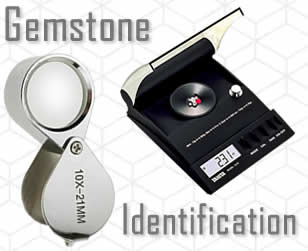
Tools and methods to identify gems

Overall Rating -> 10
GemSelect is always my first choice for purchasing gemstones. The fact that the gems are always exactly as described and pictured on the website has earned my trust many times over. Even when I don't buy, I still love browsing all the beautiful stones. My new favorites are the bright green Tsavorites!
Posted By Lkcisneros in March, 2026
Source: Bizrate
Related Articles
Caring for Gemstones
Gemstone Care - Gemstone Information - GemSelect
Gemstone Hardness Explained
Gemstone Hardness | Mohs Scale with Images and Charts
The World's Rarest Gemstone
The World's Rarest Gemstone - Say hello to the Red Diamond
History of Birthstones
The History of Birthstones
The Future of Gemstones
The Future of Gemstones - Resources and Sustainability
Refractive Index Chart
Refractive Index Chart of Gemstones - What does it mean?
Gem Hardness and Durability
Gemstone Hardness and Durability
Mexican Fire Opal
Mexican Fire Opal: Properties, History, and Care Guide
Tourmaline Buying Guide
Tourmaline Buying Guide - What to look for in tourmaline?
Fine Green Sapphire
Fine Green Sapphire: Properties, Origins, and Appeal
Friedrich Mohs
Friedrich Mohs
Raman Spectroscopy
Raman Spectroscopy
Life and Death Gemstones
Life and Death Gemstones
Maw-Sit-Sit from Burma
Maw-Sit-Sit from Burma
Gemstone Jewelry
Colored Gemstone Jewelry Information from GemSelect
Idocrase Vesuvianite
Idocrase Vesuvianite Gemstones
Gem Treatment Disclosure
Gemstone Treatment Disclosure
Moldavite and Tektite
Moldavite and Tektite
Druzy Gemstones
Druzy Gemstone Info
Hackmanite Tenebrescence
Hackmanite Tenebrescence
Singly Refractive Gems
Singly Refractive Gems
Gem Size to Weight Ratio
Gemstone Size to Weight Ratio
Sacred Emerald Buddha
The Story of the Sacred Emerald Buddha: History and Creation
King Tut's Tomb of Treasures
King Tutankhamun's Tomb of Treasures
White Gems for Jewelry
White Colorless Gems for Jewelry
Famous Fine Rubies
A Few Famous Fine Rubies - Rosser Reeves, Sunrise & DeLong
Jaipur, Jewel in the Desert
Jaipur, Jewel in the Desert
